Introduction to the Printing for Interference Archives ( September 11, 2024)
Cop City, or the “Atlanta Public Safety Training Center,” was proposed by liberal politicians in Atlanta, Georgia as a response to the 2020 nationwide uprising against the police. The proposal to bulldoze 300 acres of wetlands and forest and build a $90 million militarized police training facility was quickly discovered and scandalized by local militants dedicated to carrying forward the combative spirit of the George Floyd Uprising. Opponents launched a multifaceted campaign against the project, welding together the two most conflictual forms of struggle that have manifested in the so-called United States in the past decade — struggles against the police, and struggles in defense of the land.
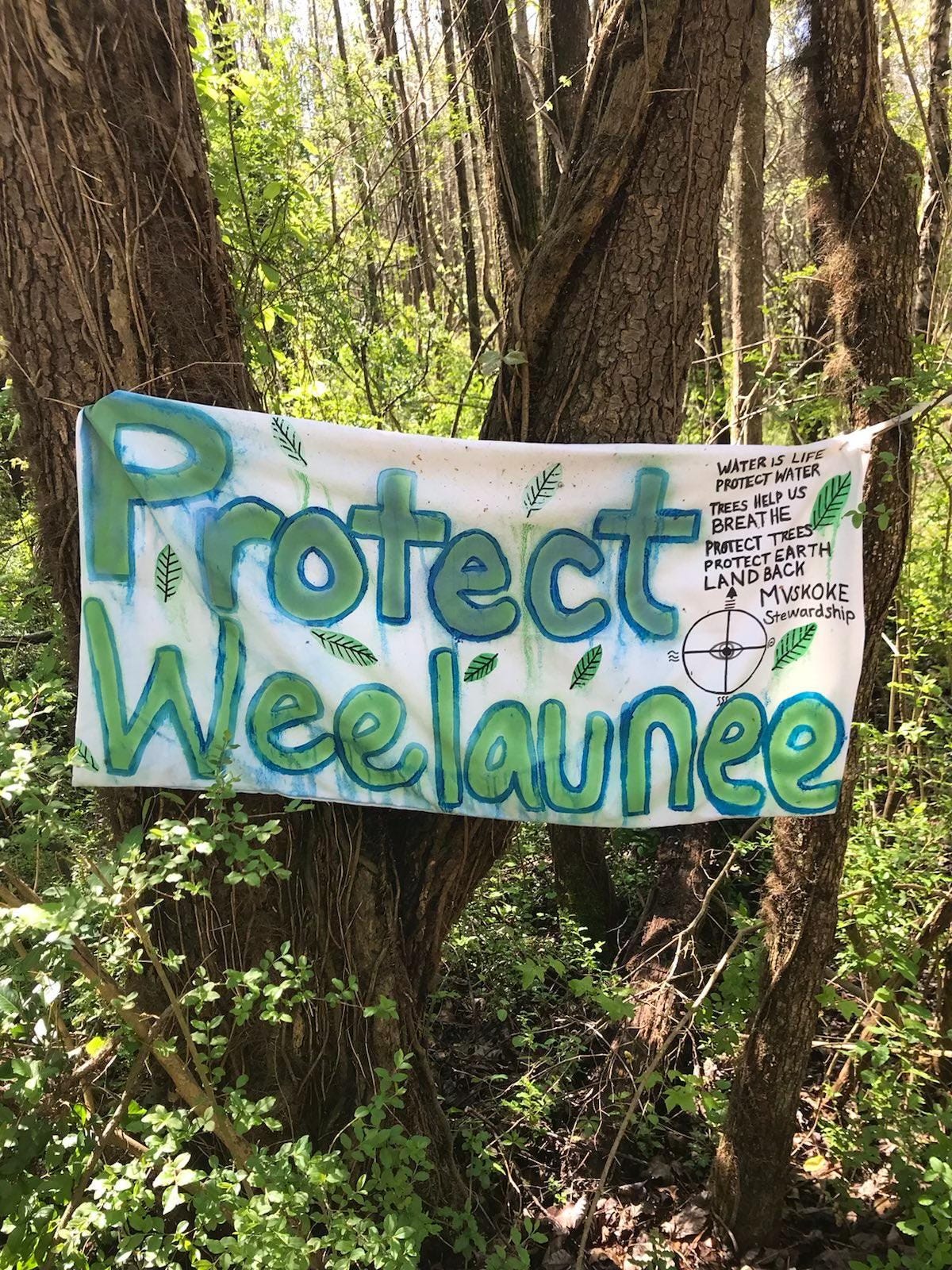
The forests and wetlands to be destroyed are some of the only access to green space in an otherwise impoverished majority-Black neighborhood. Deforestation will worsen urban flooding and destroy a large carbon sink and forest that helps to cool urban space during heatwaves. The land itself carries the memory of multiple waves of racialized violence and dispossession. Called Weelaunee by the Mvskoke (Muscogee) people, the original inhabitants of the land who were forcibly evicted in the 1830s, it later became a slave plantation, and then a prison farm. Local police use an abandoned school bus for target practice, spreading the sound of gunfire throughout the neighborhood.
At the same time, the forest has been reclaiming this history of violence. The trees and plants help to heal and restore the soil, and provide solace and refuge for local residents to connect with nature, forage wild foods, exercise and play. As one slogan of the movement goes, trees give life; police take life.
The struggle against Cop City has included fierce resistance in Atlanta and around North America, and has inspired solidarity actions around the globe. The logic is clear: Cop City is an attempt by the ruling class to slam shut the revolutionary door opened by the 2020 Uprising, while preparing the country for a new regime of militarized policing in anticipation of the mass unrest sure to accompany a 21st century characterized by climate disaster, war and austerity. The protagonists of the struggle understand this, and have brought appropriate dedication to confront the situation. From tree-sits and petition drives to midnight sabotage and mass arson in broad daylight, the movement has raised the bar for resistance across the country. Repression has been predictably harsh: despite mass public opposition to the project, Atlanta politicians and capitalists are dedicated to forcing it through, with assassinations, smear campaigns, terrorism charges, doxxing and every other tool in the repressive handbook.
These interviews were conducted in March 2023, less than two months after the police assassination of Tortuguita, and just weeks after 300 people dressed in camouflage marched through the forest to the construction site, drove away the police with fireworks and Molotovs, and destroyed construction equipment and silt-fencing. At this time, most of the twenty-three people arrested at an adjacent music festival were still incarcerated in Dekalb County Jail in abysmal conditions, and much of the local movement was focused on anti-repression and regrouping. Our conversations, taking place on three different occasions with different participants, comprise a nuanced mosaic of the struggle at a certain point in time — a compound vision that illustrates the different stakes, everyday lives and political acuity of some of the protagonists. We are grateful for the depth of thought, the clarity of perception, and the dedication that clearly shines through in the texts, as well as the generosity of our comrades who took time out of a particularly busy and stressful week to reflect and think together.
The larger project that these interviews take place under, 1000 Voices, aims to help struggles reverberate across the planet by conducting conversations with people engaged in local struggles and then translating and sharing them with comrades elsewhere. We are aspirational technicians of what George Katsiaficas calls the eros effect, the tendency for struggles to mutate and spread across the planet, erupting and finding new resonance in unanticipated ways. We were fortunate to bring our experiences and the wisdom captured in these conversations to partisans in Korea and Japan in the winter of 2023, where we shared information about the George Floyd Uprising and the struggle against Cop City with Korean labor militants and disability rights activists, Japanese farmers, fishers, carpenters, collectors of folk tales and activists still struggling against the radioactive fallout from the Fukushima nuclear disaster and the disaster-capitalist reconstruction schemes that continue displacement and separation of people from the land and their livelihood. The conversations included in this publication provided a bridge to help connect the context of struggles across the planet, and inspired assemblies and collaborations that continue today.
As this edition goes to print for a new exhibit at Interference Archives in September 2024, sixty-one people are still facing RICO charges for their participation in the struggle against Cop City, the genocide in Palestine continues unabated, extraction continues on Indigenous land and the current election cycle seeks to starve the oxygen from revolutionaries and militants across the US. But the fault lines and tensions brought to the surface by Standing Rock, the George Floyd Uprising, the struggle against Cop City and the student struggle for Palestine still remain. With each phase of struggle we continue to sharpen our tools, and to retain the wisdom and intellect developed in the past. We hope that these conversations will help to preserve memory and deepen a revolutionary perspective within the American Empire and outside it.
PART ONE
Setting: The living room of a collective house in Atlanta, Georgia. People are arrayed on couches, chairs, standing nearby and listening in. Snacks and sparkling water cover the table.
Q: Before we dive specifically into the current struggle around the Weelaunee Forest and Cop City, can you talk about the past struggles, cultural or historical reference points that helped form your foundational politics, and how that has led to this moment?
RAPHAEL: I guess I’ll say what’s not a reference point for me, which is most North American land defense struggles. I think most people from here who have participated in this struggle have no direct participation in those. Not that we’re against them, just that that’s not the valve towards participation. It is for a lot of participants in the movement, but not many from Atlanta. For me, the closest thing to that is the anti-roads struggle in the UK in the ’90s. I think in everyone’s mind, part of what you want in the struggle is Standing Rock-level participation, but obviously we’re in a completely different context. We can’t just do what they did. We can’t have a prayer camp that eventually leads to 12,000 people.
SCHEHERAZADE: I’ve been a participant in many movements since about 2010. Occupy Wall Street was the first big movement that I was a part of. And then the waves of anti-police protests locally around the country that preceded what later became codified as Black Lives Matter. Those were all the most formative for me. And, because of my age, this strongly impacted my sense of what the role of individuals and small groups are in struggles, which is probably different from people who were radicalized after the events in Ferguson in 2014. They probably have a different idea about what politics is. I feel like I was radicalized in a period of extreme social peace, and so that affects my ideas. Also, I developed my sense of self and politics within a framework of hardcore punk music, and not through participation in civic, student, or political organizations, or through participation in the university system or any kind of institutional thing like that.
When I think about the current movement, a lot of people I’m close to think about the ZAD in France. There’s the Stop Huntingdon Animal Cruelty (SHAC) movement which was a reference point for a few people, for certain things. When I was first getting into radical politics, that movement was being crushed. But then, also actually the Narita Airport struggle was huge. I know a couple people who went through phases of watching all the crazy videos on YouTube of Japanese anti-airport riots.
Q: It seems like Atlanta has a big hardcore/punk scene?
RAPHAEL: We have a hardcore scene the exact size of the scenes in most college towns, and Atlanta is the eighth largest metropolitan area in the country. It’s vibrant, but it’s not to-scale, not in the way we might think it would be. Not as good as Hammond, Indiana or Hattiesburg, Mississippi. But it is totally true, that all the music aspects of the movement are not done cynically at all. It’s not like activists being poseurs. It’s just actually that most of us come from participation in some sort of DIY music culture, probably a majority being hardcore, but others as well. I don’t believe in mass society as a reachable thing; you can reach different algorithm segments, and one that we’re tuned into that we can consistently reach is people who participate in DIY or music subcultures.
Q: That’s something that has been very obvious from a distance about Atlanta. Any time, anywhere, that I’ve been around people talking about what’s going on here, people are always referencing that what sets the Atlanta movement apart is the centrality of joy. And it seems like the access point to joy is mainly through music. It’s the palpable reputation of the movement.
This critique of mass society reminds me, our friend from Japan studies what they call inhabitants’ struggles, locally-specific, molecular struggles, in opposition to vast social movements. At the end of the Japanese ’60s there was a disintegration of these mass social movements, particularly due to political in-fighting and the Left completely devouring itself through violence, like assassinations and tortures of various opposing sects. At the same time, there was this proliferation of extremely site-based, localized struggles. Struggles over the construction of the Narita Airport, or development in villages, or mercury poisoning in Minamata, that were more tied to people’s subsistence and experience of needing to live, versus a political ideology. So it’s interesting that you mention the Narita Airport struggle, which is also a reference point for me.
From a distance, we’ve been continually amazed at how you have managed to dodge the pitfalls of the Left and “woke” culture that continue to devour so many movements everywhere else. We’re curious what that experience has been like, and how you’ve done it? Or, is it even intentional? This is an interesting tension that we’re trying to unpack. Our friend who studies these inhabitants’ struggles is interested precisely because the participants are not necessarily “political,” but develop militancy tied to their own direct experience of immiseration or attacks on their subsistence. I think he might say that that’s what allows these struggles to avoid being devoured by the Left. But it seems like you all have been able to engage in a fairly voluntaristic struggle. You’ve decided what the struggle is and built around it — and yet you haven’t been taken over by the Left.
MYRA: When I hear that question, my first thought is that for many years, my first introduction into anything political was being extremely hated and ostracized by the Left. From there, it was not possible to work with the Left in a bigger sense, and necessitated doing things anyway. At some point, I think particularly with this movement, it’s not organized from a place of trying to appease the Left, but it’s something that other people can join and are encouraged to join.
BUD: I think one aspect of it is that people who are really active participants in the movement, including some of the organizations that are participating, are very aware of how this movement began. And they saw the ways that that allowed for the movement to progress and to grow. And that helped to keep things contained. If there’s a moment that the Left tries to recreate the narrative about how the movement began, that is where it could become problematic. But they haven’t done that. And I think that this is because all of us actually really feel like we’re winning. Creating external divides versus internal communication just hasn’t happened because people understand that that would destroy the movement.
SCHEHERAZADE: To add to what you’re saying, at one point, pretty early on, that did happen. In the late summer/fall of 2021, before the encampments began. There had been some acts of sabotage and no participatory action, and the Leftists did construct a coalition and an organizing initiative that excluded all of us for the most part. And that incentivized a certain kind of coalitional politics that mobilized people according to their “respective positions,” which is the watch-word of identity politics. So there were different groups, and they were all supposed to combine their respective experiences to contain a universal experience. So there were some students, Black women, LGBTQ groups, there’s all of this, and they’re all pseudo-hierarchically organized around who’s the most oppressed. And they destroyed one another in three months. There’s all kinds of ways that they narrate this that tends to blame the Democratic Socialists of America (DSA). They were the most powerful group within that coalition, and they simply refused to lose. And that was because of the way that the coalition was organized, that meant that they had to fuck over people who were also trying to fuck them over. And all of those groups, I believe, quit. After the vote [by City Council to build Cop City] passed, they quit. They were like, well, we’re going to vote these people out in two years.
And so, within six months it went from people at farmer’s markets and anarchists and people in the DIY subcultures to a Leftist coalition, and then back to square one. And I think that since that moment, the idea of creating a lot of internal conversation in the movement has been suppressed. The idea of linking up with everyone, like “we’re stronger when we all get into the same room together,” “let’s not recreate the wheel” — these are things that people don’t say, because they’re not true. People do a lot of redundant tasks, people are doing all the same kinds of things but slightly differently, people don’t know what other groups are doing: it allows them to ignore people that they strongly dislike. And it allows them to not know about people that they don’t trust. It means that a lot of forms of action are not possible. But, in my opinion, it’s contributed to the longevity of the movement. People who have real or completely petty grievances with one another can just stay away from one another. And I’m sure that there’s hundreds of people who believe that the movement is being mismanaged because of “internal dynamics,” and maybe they’re right? I don’t know. I don’t have to hear from them, and they don’t have to hear from me. So, I like that.
RAPHAEL: To add some larger context for the Left in Atlanta: for one, Georgia has not historically had high union density. Currently it’s less than five percent of the entire workforce, including public sector workers, it’s less than five percent unionized. And it’s never been particularly high. There’s no subset of the population that can look back on being a formerly politicized proletariat. That does not exist here. And the NGO-backed institutional Left is also incredibly weak here. After 2016, the Black Lives Matter money ran out. The ones that were able to get jobs in Oakland, New York and Chicago left here. The rest got spat back out into the hood, and some have died since then by police violence.
And since then, in my opinion, the Left effectively does not exist here. There’s the DSA, which is a voluntarist organization made up of downwardly-mobile white kids with bad affects. And then there’s small amounts of paid Black staffers that are part of a clientelist structure with the local Black bourgeoisie that works in tandem with corporate white elites. And they have no base of support. In my city council district, the city council person who introduced the Cop City bill, Joyce Sheperd, lost her electoral seat. Some people in the movement say it’s because of her position on Cop City, but it’s actually just because the guy who ran against her is from here and has good relationships with local wealthy people.
That’s just to show how weak the Left is. But, the people I organize with, we’ve had some level of consistency together for over a decade. And also, the autonomous organizational Left that aren’t getting any NGO money, but are in formal organizations, some of these groups have been in the movement for a while and have been able to stand the test of time, and have lasted through multiple cycles of struggle and downtime. It’s us and them that have been able to stand the test of time, whereas the institutional Left is nothing, and can’t do that. So it’s obvious that, once struggle gets going, our respective forces are the most relevant.
SCHEHERAZADE: There are probably thousands of people who think this movement is too toxic. Or that it’s racist. Someone went on a podcast and said, “The struggle against Cop City is more upsetting than Cop City itself because of the internalized racism.” I’m sure it’s just music to the ears of the police foundation. You know, there’s people who think all kinds of dumb things, there’s plenty of anarchists all over the country who have conspiracy theories about vague things. People find excuses not to participate in the struggle. This one, though, might be too easy to participate in for many of those types of narratives to take hold. It’s irresistible to a lot of people, I think. There’s not a lot of gatekeeping going on. The bad part is that it doesn’t necessarily challenge people to change what they believe. But it allows you to just think whatever you believe, and fight for whatever it is you think you’re fighting for.
MYRA: I think that in a lot of cities there’s this feeling that people aren’t powerful to do anything without the left. But because of the histories that have been described, being a group of people who have worked together for a long time through struggle and lulls, it gives a sense of confidence to do it without needing to call on the Left. Critiques do come up, and a lot of it we just don’t have to talk about, but there are also critiques that are taken to heart. It’s not from a Leftist moralist perspective, but more of like, well these people have been there over and over, and they’re upset for these reasons. And so people have conversations and try to work things out that really matter, but not from a moralist position. It’s more like, that person is upset, and so I’m upset that they’re upset and would like to help fix it.
Q: That’s really interesting. What you’re saying is that it’s on a more personal, real level. People actually talking to each other, less factions warring on the internet.
SCHEHERAZADE: Or ignoring each other.
Q: And it’s big enough that you actually can just ignore people.
SCHEHERAZADE: I also want to say that people in the movement have worked hard to uplift the participation of a very strong, independent Black politics that actually has an advantage over the ability of anti-oppression activists to over-determine a certain range of discourses. That can’t be underestimated. In my view, the participation of groups that I would call post-Black nationalist — all of the exclusively Black groups that are in the movement — they don’t use the word “micro-aggression,” that’s not part of their understanding of what racism is. Their idea of power is not based on individual attitudes and actions, it’s based on structural factors and histories. And I think people have worked hard to uplift those perspectives, to the detriment of the “woke,” university-funded, post-Judith Butler identity politics Left stuff. Without the all-Black groups doing their thing, pushing hard, I think that would all be way worse than it is. And this stuff would have already cannibalized things. The fact that there’s groups that are like, yeah of course white people are kind of weird to us. Well, they start with the assumption that it’s not going to get any better until there’s Black self-determination and so, they’re not as concerned.
RAPHAEL: It’s true. Since the Week of Action I’ve tried to tell people from around the country who are visiting that people from the Black nationalist current are much better to work with than abolitionists. This has just been proven true. I think it has to do with everything that you just said, but also that while there’s currently no insurrectionary position within Black nationalism, that milieu is still actively supporting people in prison who are part of an insurrectionary trajectory within Black nationalism, and I think that that definitely helps them feel better. Like, yeah, ok, the mostly white kids are doing that thing, that’s fine — we’re supporting people who did CRAZIER SHIT than that! Whereas, abolitionist politics completely divorces itself from that, it has no insurrectionary trajectory when it comes from the academy and NGOs.
Q: Would you say that that is the main distinction between those two currents, Black nationalism and abolition?
B: Didn’t abolitionism get revived as a term in the first Black Lives Matter sequence?
RAPHAEL: No it was the ’90s, from Critical Resistance.
SCHEHERAZADE: In my opinion, the thing that is meant by abolitionism in the world today is essentially an institutional way to substitute the self-activity of poor people with policy reform. So it’s the idea that you can defund the police, you can abolish mandatory minimums, you can do these policy reforms. In the absence of upheaval, you can fine-tune elements of the carceral state such that they make racialized existence — and thus, so the mythos goes, insurrectional activity — more likely to take hold, more likely to work, more likely to succeed, or something like that. This is the most radical version of that actually, this is maybe what people like Joy James would say, to take the most charitable reading. I think it’s disconnected from any historical lineage. I don’t think it’s connected in its self-understanding to abolitionism as it existed leading up to the US Civil War.
RAPHAEL: Whereas Black nationalism, at its core, understands that the United States is a country that fundamentally is not for them. And they need something else. This is not a reformist position, It is, even if it’s one that I don’t completely agree with, a revolutionary position.
Q: Let’s bring it back to the day-to-day. Y’all have been engaged in this struggle really intensely. What kind of everyday life are you having? And what does that look like with regard to subsistence, accommodation, safety, confrontation — what’s it like to actually live in this struggle?
RAPHAEL: All of us presently here are in the very low income bracket in the United States. I am part of the downwardly-mobile white millennials. I try to work as little as possible for as much as possible, so that I can have a good life, and a lot of that involves political struggle and participation in DIY culture. And just hanging out with people.
Q: Hanging out is part of what makes it what it is. Encounter and conversation beget friendship and trust.
RAPHAEL: Yes.
MYRA: I know very few people who have a full-time job. I do have some friends that do that, but most of the people I associate with don’t have that type of structure. I did for four months, and it was really brutal.
RAPHAEL: It’s inhuman.
Q: What kind of work were you doing?
MYRA: I was building treehouses. It was really awkward, because it was when the first treehouses were being built in the forest. I was in the backyard of a mansion in north Atlanta, building a treehouse for $18 an hour. It was for a 3-year-old — a $30,000 treehouse. I’ve never had a car that was worth an eighth of that. Not even a tenth of that.
S: Living in Atlanta has been the longest period of my adult life that I’ve been able to work as little as I have. I think that’s in part because comrades have houses and have been generous with letting me stay in them. I lived in the forest for some time while that was possible. And I bought a bus from a friend, had it parked outside a friend’s house. So, a combination of being able to move between the forest and the city where people have crafted a life in common, has allowed me to work like three hours a week basically, and dedicate most of my time to the movement and music.
Q: What’s the experience of rising costs of living here in Atlanta?
RAPHAEL: Atlanta inflated eighteen percent in costs last year, which is more than any other metropolis in the country. That’s not just rent, that’s inflation in general.
SCHEHERAZADE: Currently Atlanta is undergoing a rapid increase in the cost of living. Gentrification is the word that people use, which I feel describes a different period of urban renewal, in which every piece of dense dwelling on earth, even in the Global South, is becoming more expensive. I think something else is happening, which is not gentrification, it’s actually capitalization, where the big industrial actors are afraid of market volatility and are moving from exploiting labor as a way to make money, to simply just trying to extract more rent as a more stable investment of their money. This is a huge aside, but it feels strongly relevant, and does explain why the ecological concerns become extremely acute and will increasingly take on a social character. Where things that maybe affected some farmers before affect entire housing blocks now. Or parts of towns or cities or metropolises — megalopolises, you know. I think that’s a new paradigm, where more struggles will have to deal with things that have to do with what markets see as real estate. Like land, or rivers, or watersheds.
RAPHAEL: We’re not a city like some coastal cities, some of which have largely emptied out the population of people who are in or near poverty, into the suburbs. Over twenty percent of Atlanta is below the poverty line, and I don’t know the statistic but I would assume another twenty percent also earn less than $30,000 a year but more than $12,500. At the same time, though, we are not like certain other coastal cities that still have a high poor population, but still have some semblance of social democracy, or a welfare state. People here are extremely desperate in a lot of ways. There’s probably tens of thousands of young to middle-aged Black and white men who just put up drywall sometimes, and then also have to sell drugs sometimes, or do other things.
SCHEHERAZADE: I think it’s important to say — probably some people had a deeper inoculation into organizing through the grassroots Left, also through Left-wing organizing structures or movements, and I can’t speak for them — but I’ll say that we’ve worked really hard to avoid the kind of compulsory urgency that attaches itself to activist campaigns. We talked a lot in the beginning about how this is probably going to take a long time, and I don’t think that many people I’m close to spend all day every day doing hard or rote tasks. Although, it’s not just all fun, we do make sacrifices. I work on tasks that aren’t always fun, or that are labor-intensive, fairly often, several days a week or even a few hours every day sometimes. So, it’s not just a constant grind, and it’s not highly unenjoyable either. Or, maybe I’m an asshole, and for some people, so that hundreds of us can deal with it like how I do, there’s a handful of people who are just constantly grinding. I think that’s probably true actually. Like the jail support people especially.
MYRA: But there’s also a lot of room to come in and out of organizing structures, or whatever it is that’s happening. You can be there, or not be there. People go on a vacation, and take breaks, and then come back and know their role and do the things that they enjoy doing.
S: Yeah. I kind of had that inoculation through the activist Left, pre-2020. I became very disillusioned with that, realized that was bullshit, and then came here and was inspired by the informality of things. Sometimes it does get exhausting, because it’s like, are we hanging out, or is this a meeting? But it also just allows for more creativity. You can figure out what you want to plug into, when you want to plug into that, and follow your own rhythm. Maybe sometimes I do really want to grind on this thing, but next month I’m going to go out of town and not do anything.
B: I had connections with people in Atlanta before this struggle, but I’ve mostly moved here as a result of it. I feel like I have a little bit of a different work/life balance than maybe people who are here who have other things going on. I go through phases of each day just starting the day with no idea what I’m going to do aside from maybe some accumulated obligations. But throughout the day there’s so many different people who ask me to do things, and I just kind of take a little bit of each thing that I want to do. I have this sense that I’m just voluntarily ceding some of my autonomy or free choice in what I’m gonna do, go with the flow. A lot of it has to do with certain resources that I have. I’m borrowing a truck, so a lot of the things that I do are just determined by what the truck needs to do. But also it does really feel like there’s enough flexibility because there’s enough different people willing to do all the different things that I can go from that mode of being into another one, where I very specifically know what I want to work on and I just flat out refuse almost all requests for assistance on other people’s projects. I’ll be like, nah, I’m on strike from driving for the next week. I’m gonna do something else. Pass the keys off.
Q: Can you talk some about the jail support infrastructure?
RAPHAEL: The movement would have fallen apart without a very robust anti-repression infrastructure. We have very high bail here. Bail is ransom by the state to get out of jail. Unless it’s a federal crime, you generally don’t have high-quality public defenders, so you have to get a lawyer. If you’re stuck in jail for a little bit, you need money to spend at the commissary, to buy nicer things in jail.
MYRA: Like a long-sleeved shirt.
RAPHAEL: Yes. And there’s a 24/7 jail support hotline that a team of thankless people rotate with the phone. And this infrastructure informally existed for a while, and formalized in 2016 in the lead-up to an antiracist mobilization. And, the infrastructure itself had like $20,000 in assets until 2020, where in the first two weeks of the Uprising it went viral along with many other jail support funds around the country, and amassed enough money. It’s actually public now, I’m allowed to say now, finally: less than $3.5 million.
Q: What?!
RAPHAEL: This is low. The Minnesota Freedom Fund — which only bails people out, doesn’t help with lawyers or anything else — got $40 million. But anyway, because of that, and because 900 people were arrested in Atlanta in 2020, the infrastructure had to scale massively. And I actually find it hard to work with it because it’s too bureaucratic for me, and for many people. But it gets the job done, and is a thankless thing that a lot of us participate in when we can, and that some thankless people do all the time.
MYRA: For some people, it’s their way to engage in this struggle. For a lot of jail support people, that is just what they do. It is extremely thankless in many ways, but, for some people it’s just how they engage in what they love to do for the struggle. Which is awesome.
Q: Would anyone be able to talk more about the repression? And give context for the domestic terrorism charges, and the ramp up in December, and the murder of Tortuguita?
SCHEHERAZADE: I want to let someone else talk about the repression, but I do want to say that part of what movements need to succeed — and this is something that historically lots of anti-authoritarian politics forget — is an understanding that repression is a part of struggles. It’s not outside of it, it’s not something that’s occurring that’s avoidable, like if you’re really clever you can avoid repression. I think that people think that if you’re really careful, or if you’re really smart, you can avoid it. This kind of dynamic has been very divisive within movements in the last century, maybe longer. But in fact, the form of the repression models itself on the form of resistance, and they’re both immutable and in fact are the motors of history. All of the good and bad things that have happened have been the struggle between colliding ideas of happiness, and they structure one another. If you don’t have an idea that there will be repression, you don’t actually fully understand the movement you’re in. And if you can’t model what that repression will be, you are playing with one eye closed. I feel that that’s really important to understand, because a lot of people in movements imagine that every time there’s repression, there’s been a kind of failure, or they imagine that they could be so clever that there’s never a reaction. But I think that’s naive and it means you don’t actually yet have a political idea about how the world can change, you only have an idea based on the hope that there’s no one fighting against you.
MYRA: I’m curious, were you surprised the first time you heard the “domestic terrorism” charges? Like how it hit you?
SCHEHERAZADE: I was very surprised that it took so long. I thought there would be domestic terrorism charges way before.
S: They started calling us domestic terrorists in the spring of 2022.
SCHEHERAZADE: On May 21st, 2022. Generally.
RAPHAEL: For context, there’s been a little over ninety arrests over the course of the Stop Cop City movement. Eighteen of them have had their charges dropped. There are forty-one domestic terrorism charges (one person facing two separate ones from different alleged incidents). But, for example, someone who’s alleged to have just flyered a church of a business executive: they were not charged with domestic terrorism — and this was before those charges started — but, at the initial hearing, the prosecutor referred to that person to their lawyer as a member of a terrorist organization. Which is an absurd thing.
S: And this is around the time that they started trying to set up the justification for their disproportionate use of force and violence, by creating this highly dubious story that someone throwing a rock at a work truck actually fired a gun at the work truck. Using random bullet casings in the area as evidence, and publishing this story all over the news.
RAPHAEL: The president of the Boulder Walk Homeowners’ Association is on the new task force that’s supposed to consult the mayor on how to build Cop City, and he’s the one who went and gave that press conference, he’s the one who made up this story.
Q: And this all led to forty-one domestic terrorism charges…
MYRA: It started with six. It was a raid. There had been roughly forty arrests before that point, at various demos and in the woods. But the repression really escalated with the raid in December 2022. On December 13th, there was a raid, and they destroyed a bunch of things and arrested six people. Five people on one day, and then one on the next. It was a two-day raid. And they were all charged with between seven and nine charges each, including domestic terrorism. They were released on bond, which was not that high, from $12,000 to $40,000.
S: This was also after an appeal. They were denied bond, which I feel like was really shocking. It was the first time in the movement that anyone had been denied bond.
MYRA: That’s right. And then, there was another raid in January. In between that time, people had gone back to the forest. There was bigger infrastructure built, and a really big rave on New Year’s Eve, a big celebration. And, what day was it in January?
SCHEHERAZADE: January 18th.
MYRA: January 18th — oh wait was it earlier?
SCHEHERAZADE: The day that Tort was killed.
B: The 18th.
MYRA: Right ok. So then they made a raid in the woods. And then they murdered our friend. And they continued to raid, and arrested six people, and in the morning they arrested the seventh person who had been in a tree all night. So there had been raids before December, but they hadn’t… and with the raid in January they continued the domestic terrorism charges. And then, at the protest on January 21st, six more people were arrested. And they were also charged a bunch of charges, and that was when we saw the highest bail. Two people were granted bond, and the other four were not. But, the two granted bond were granted $355,000 bond each. Which, with fees and everything, is almost $400,000.
RAPHAEL: Which if you do pay it in full, you can theoretically get that money back at the end of the trial, at the end of everything which would be several years. Or, you can go through a bondsman, where you will pay them a percentage up front — usually like ten percent — and you will never get that money back.
MYRA: But you also have to sign off your house! The bondsman will pay the $400,000 and take your house as collateral. And then if you don’t pay it they’ll come get you with a bounty hunter.
RAPHAEL: We live in dystopia.
SCHEHERAZADE: It’s the Wild West.
MYRA: But anyway, that was pretty much it. And then there was the Week of Action in March, in the forest. Between the time of the murder and the Week of Action, it didn’t feel great to go in the woods. The police had began to occupy it. There were like thirty police present on the other side of the forest, every day, costing them $42,000 a day to secure the area to begin construction. People really weren’t there in any kind of numbers. There were events happening, but it felt pretty tense. You felt watched. I felt violated to be in the woods, where I once felt like it was a place away from cameras and the world. So you just felt watched. I felt watched. And then, during the music festival in the first days of the Week of Action, twenty-three people were arrested and charged with domestic terrorism.
RAPHAEL: Another twenty or so were detained, but ultimately released. And all the twenty people who were ultimately released had Atlanta or area addresses listed on their drivers licenses. Everyone who was arrested did not. They had drivers licenses and addresses elsewhere.
Q: The state has been relying heavily on this “outside agitator” narrative, and it’s interesting to see how people have responded to that by repeating that it’s not a local struggle.
BUD: All throughout this movement, there’s been a lot of action around protecting different public land, whether that be parks or homeless encampments. And there are proposals like Cop City in other places. You can’t think of it just as a local struggle. Also in the movement there have been shifts in the way that some of the people giving speeches at protests talk about outside agitators, they’re like, yeah, there are definitely people from outside of Atlanta coming here, and we invite everyone. There’s just so much obvious hypocrisy in the way that the GBI (Georgia Bureau of Investigation), APF (Atlanta Police Foundation), etc., try to spin a public narrative about outside agitators. It allows people to see that hypocrisy and then to double down on it more. Which I think could have really positive effects for the future of movements in general in this country.
SCHEHERAZADE: In addition, there have been other forms of repression. There’s been a number of door knocks around the country, and locally there’s been feds calling people. There’s been drones flying over people’s houses or over fundraiser events for the movement, or helicopters, things that are typical of repression in general. Contact from authorities. Things that are not quite an arrest or an indictment, but are still repression.
MYRA: Also, at public locales that were hosting safe, informational spaces for people who didn’t want to go into the woods or risk any type of charges, people have been harassed, with raids and fines.
SCHEHERAZADE: One of them is a church. They had a bunch of stuff destroyed, and then the church was inundated with an abnormal amount of code violations.
RAPHAEL: There were threats to shut down a queer youth homeless shelter that operates out of the church…
SCHEHERAZADE: …As a byproduct of their support for the movement. Also a part of the repression that is of a higher level is that the mayor’s office has been mobilizing their clientele activists to attend meetings and to go visit nonprofit organizations and labor unions and other groups and politicians that have mobilized support for the movement, to visit them and try to convince them to boycott the movement and to not go to rallies, to withdraw their support, things like this. This is a kind of preemptive control that is only possible within the kind of clientele structure of a place like Atlanta or other places. Throughout Latin America of course clientelism is the governing logic, or like in Lebanon, the sectarianism is a kind of clientele politics.
Q: I know or have heard most of this stuff, but being in this room hearing you all talk about it so matter-of-fact — how does it feel to be talking about it? It’s so fucking heavy. Like, are you ok?
B: My threshold has changed dramatically since the murder. Things that would normally be really terrible are just the most minor inconvenience, I’m not even concerned about it. Somebody accidentally drove a car into the house I’m living in and kind of broke it. And literally when I was told about it, I was just like, I’m not even concerned about that. I’ll think about it tomorrow, there’s too much going on.
RAPHAEL: A good anecdote is that, one time a friend who doesn’t live in Georgia called me, livid, because some anarchists were spreading conspiracy theories on the internet about spaces in Atlanta and alleged cults and stuff. And I’m like, hey, I can’t be mad with you right now, I’m outside of the jail waiting for my roommate to get out. I’m really sorry this happened, probably tomorrow I’ll be a bit more angry about it, and we’ll talk then.
SCHEHERAZADE: Many times, in the past three or six months especially, when police are chasing people in the forest, they have pivoted from yelling simply, “Get on the ground,” which is their favorite refrain across the US, to “Stop or I’ll shoot.”
MYRA: “I’ve got real bullets.”
SCHEHERAZADE: Yeah, “I’ve got real bullets.” “I’m gonna put a bullet in you.” Things like this. But especially “Stop or I’ll shoot.” Probably many people, including myself, have had a cop yell “Stop or I’ll shoot.” That’s also a form of advanced repression that probably people in some other parts of the world would think is very alarming, or people in other parts of the country. Maybe people who aren’t in the movement as well, would think that’s alarming. I think it’s alarming. Not actually, I’m not alarmed by it because I’m used to it. But people get used to lots of repression, and it’s a form of internalized repression, that we’re not outraged every time they do this. Repression affects us. The fact that we become more cynical about our own rights is actually how we facilitate the escalating repression against us, in this way where we expect only brutality and carnage from the state, in a way that also allows them to do that. And I think the lack of proportionate response to the murder of an anarchist in the forest by the police is part of that. There were definitely some actions and social or political consequence for that, but not properly proportional. And I think it’s because a lot of people in our society believe, yeah, ok, the police kill people who are fighting for justice, therefore they will kill you. This becomes more true the more we believe it. This is a form of de-radicalization, that people in the far-left participate in by spreading resignation around things like this. It seems more radical to believe that of course the state are thugs and they’re gonna kill you. But I think there’s something deeply wise about the hysterical, shocked reaction of people who just cannot accept that the police killed someone, like, let’s do something now, they violated my rights. These people often do the most radical actions. This is why I think that radicals and anarchists often contribute at the rear of movements. It’s because they don’t even believe that they have rights. They don’t even expect to not be killed.
MYRA: That makes me think of the recent court hearings, where the prosecutor said, “We arrested this person because they have the jail support number written on their arm, and therefore that presumes guilt.” And I think that’s another form of repression, these narratives that they say in the court, which is the logical framework by which they do everything.
BUD: And specifically a bond hearing, where there isn’t time to argue the facts on whether that’s true, they just get to say it. And it sticks in people’s heads, and that’s all it’s meant for.
RAPHAEL: It’s probably relevant to explain the conditions that the eleven people inside are currently dealing with. Eight of them are at Dekalb County Jail, which houses people in Atlanta and in a nearby majority-Black suburb. In 2019 there was a small but fierce struggle against the conditions at this jail. What they’re dealing with is mold in the walls, in the food, wastewater routinely coming out of the ceiling, depending on where you are in the facility — always out of the toilets, but also, depending on where you are, from the ceiling or from the ground. There’s no social programs, there’s no outside time. It’s a very bleak, bad place.
The others are at Fulton County Jail, which houses for Atlanta and some other suburbs. It’s called Rice Street commonly. And that’s worse. It’s a worse facility, it’s also incredibly dangerous there. At both facilities, a large segment of the populace are there for years, pre-trial, which is quasi-illegal. Certain segments of those facilities are controlled by criminal organizations that are very anti-social. Not a great place to be. So one person is there, and the others are at a different facility via Rice Street, called Atlanta City Detention Center (ACDC). Most people at ACDC are not there very long. It was built in the lead-up to the 1996 Atlanta Summer Olympics. The City of Atlanta gave homeless people bus tickets wherever they wanted to go, one-way. And then the rest who didn’t take that, they swept them up, literally, and put them in ACDC during the summer Olympics. And it stayed as kind of a place you go to for very low-level misdemeanors and zoning laws. And there was a small struggle against it in 2018, when around the country there was an activist movement against ICE, that had encampments because some ICE prisoners were there. And that was successful at getting ICE detainees out of that jail. That facility is objectively better than the other two, but it’s also absurd, because their food — because they’re technically Rice Street prisoners, food has to be driven there three times a day to them, and it often comes completely wrecked.
MYRA: They’re obligated to have warm meals, for two meals a day I think, but because the meals are driven there they just come cold. They’re cold and fused together by steam under plastic wrap, and it’s just one big congealed blob.
RAPHAEL: You’re entitled to two meals per day, but they could be at any time. Sometimes you receive two meals at 3am. And then it’s your job to ration that. But at Dekalb County Jail, where eight of them are, even after the cycles of struggle that happened there in 2019, there’s still definitely pockets within the jail that are seriously combative. When there’s outside support, like noise demos or sometimes even if there’s large vigils — at a recent jail vigil/noise demo for the people who were locked up, there were cops on a roof, and two prisoners smashed out jail windows by punching them, and threw blankets that were on fire at the police officers. Unfortunately they did not connect, they missed.
MYRA: But a bush caught on fire.
RAPHAEL: But when I saw this, I was only shocked about the fire, as a new innovation.
MYRA: The fire going out the window.
RAPHAEL: Yeah, that’s a new innovation. Again, it’s been a protracted struggle at the Dekalb County Jail. When I heard there were windows smashed I was like, yeah that’s normal. One time there were like 120 people outside the jail, and twelve windows got smashed in a coordinated fashion. So when I heard there were two windows broken I was like, ah, no big deal.
SCHEHERAZADE: The logical next step would be to throw guards out the window.
RAPHAEL: The windows are not big enough to fit humans.
Q: Not in one piece.
Q: To circle back to the domestic terrorism charges, do any of you feel equipped to give a larger political context for rhetoric on domestic terrorism in the US? And also, the end of liberal democracy in Atlanta?
SCHEHERAZADE: Terrorism has a specific place symbolically in US politics because of 9/11, but also legally it covers a larger range of things compared to many other countries. After 9/11, there was the Patriot Act, and a law called the NDAA (National Defense Authorization Act). Basically both of these laws strongly reduced the amount of freedom and privacy of people within the legal territory of the United States. It sharply reduced those rights, and sharply expanded the budget for “counter-terrorism,” which is a dystopian phrase that the State Department developed. They use anti-terrorism in other countries, but in the US they say counter-terrorism. Which means, they’re doing terrorism, according to their framework.
Terrorism, politically and legally in the US, is the destruction of vital infrastructure of the country, which normally referred to things like hydroelectric dams, water treatment facilities, power grids — things that possibly millions or tens or hundreds of millions of people rely on for their biological existence, or for social reproduction in general. It would not refer to things such as government buildings, corporate property, things like that. That is, in the past. But over the years, the interpretation of terrorism has continued to broaden more and more and more.
Essentially, the framework for terrorism politically is no longer strictly attached to Wahhabism/al-Qaeda-inspired jihadis, and is increasingly targeted against the extreme Right. Actually, the majority of people who are targeted for domestic terrorism in the United States are people in the extreme Right: neo-Nazis, anti-abortion fanatics, etc. And that’s for doing things like shooting electrical substations, attempting to poison people with ricin, or these kinds of deranged things. And to tie this back to the 1996 Olympics: the 1996 Olympic games in Atlanta were actually bombed by Eric Robert Rudolph, who was an anti-abortion extremist. Just as an aside.
But after the Charleston massacre — the shooting at the Black church by Dylann Roof, who was directly inspired by many white supremacist shootings around the world — Georgia passed a law called HB452, which is the Georgia domestic terrorism law. The Dylann Roof shooting was in 2015. And the Pulse nightclub shooting in Orlando, Florida was in 2016. House Bill 452 is the Georgia domestic terrorism law which was adopted partially because the old Georgia domestic terrorism law had a quota for deaths. And so, if ten people had not died, it would not be terrorism. The new law was kind of embraced by the institutional Left and the Right as well, but especially the institutional Left, as a way to say, wow that’s crazy, we shouldn’t have this quota. That it should simply be a certain kind of action — to actually remove consequences from the consideration, and recenter motivation and tactics. So it makes a highly technical definition, which really hones in on this vital infrastructure component, and government facilities. So it broadens it a little bit. But no one had been charged under HB452 until now.
Which is why I think Sherry Boston, the district attorney for Dekalb County, is actually just a social climber who is making career moves, and does not intend to convict a single person on this, but intends to overturn HB452 in the Supreme Court of the United States. The Supreme Court could be interested in that because it’s currently controlled by the Right, and the Right is interested in overturning domestic terrorism laws because of January 6th, when there was the kind-of riot at the US capital, resulting in the death of Ashli Babbitt and four others as Q-Anon protestors attempted a kind of fake, symbolic coup d’etat in order to defend the presidency of former US President Donald Trump.
The FBI is not overseeing this, because they’re currently targeting the far-right as their bogeyman for who does terrorism. But the Georgia Bureau of Investigation, which is controlled by Republicans, are trying to target “antifa” — or however it is they conceive of the movement. It feels partially like there’s an interdepartmental feud about the definition of domestic terrorism. All of this is designed to go up to the Supreme Court. That’s conjecture, though, that last part.
Q: We’re short on time, but I have a last question. Can y’all talk about the role of music and raves in the forest and in this movement? Both politically and also experientially?
MYRA: Was the first rave in the woods on the creek?
RAPHAEL: Yes.
SCHEHERAZADE: Wow. What an incredible experience. 500 people.
MYRA: Yeah. It was amazing. We had a rave on the creek. There’s this one part where the embankment is kind of big, and it’s sandy, and when the water level is down there’s this smaller crossing — the shoreline is always changing — there was a little bridge across, so there was a fire on one side, and then the dance party was just in the creek, on this sandy bank. It felt like we were at a beach.
RAPHAEL: If it rains, there’s water there. We were in the creek bed.
MYRA: Yeah, it’s a shallow part that becomes a beach, when it’s not raining. It was the first Week of Action, I think fifty people were camping in the woods. And there was a forty-five minute hike through the woods from the encampment, a really nice hike, to get to the rave.
RAPHAEL: There were lights to guide you, and you could hear the
MYRA: Yeah. And this was a time when there was no repression.
SCHEHERAZADE: There was no repression.
MYRA: Nothing had happened yet.
SCHEHERAZADE: This is before the Left had joined the movement.
MYRA: And so the idea at that point was: people need to come to the woods.
SCHEHERAZADE: No one had even been here.
MYRA: No one had been here. If anyone’s going to care, people need to have a stake in the woods, they need to come here and they need to experience it, to feel and hear it. And camping was part of that. And obviously a lot more people came to the rave. And one of the things that I noticed from the second Week of Action, and the second rave, was that there were ravers who brought tents. Some people were camped intentionally, but the ravers who came just set up their tents off-trail. People wanted to camp.
RAPHAEL: Also, the first Week of Action was during the roaring June days, the lowest COVID has ever been.
MYRA: Oh right, yeah! People were so excited.
RAPHAEL: A month prior, there was a one-band show indoors at a venue that was about to be demolished. It was one band, and less than a hundred people went. Then we had the first proper show in Atlanta in a long time, there were four bands. There were 300 people in a space that could could comfortably fit eighty. And eventually the police came, not because of the movement, probably because of a noise complaint.
MYRA: And why don’t we know? Why don’t we know why the cops came? Because they left!
RAPHAEL: Oh right! Half of the crowd stayed inside and moshed, and the other half ran outside and just gave pure grief. Not just like “fuck twelve” but also targeted, mean things to say, about their lack of hair, etc. And also just throwing rocks and bottles at them. And they quickly left.
MYRA: I think it was the rocks.
S: And hundreds of punks.
MYRA: And they only had one or two cop cars.
RAPHAEL: Since then, music has continued to be a vital part of it. As I said, the base of support for the movement is DIY music subculture. And for context, that’s not just punk and hardcore, that’s also hip-hop, it’s also various genres of electronic music, house, indie rock, jungle, noise… And there’s shows all over the country that are fundraiser shows for the movement. And there are shows here all the time, of all these genres, some taking place in the woods, some taking place elsewhere. There were two big apexes. During the fourth Week of Action, there was a three-day music festival in the forest, probably 1,000 people attended over the three days. During the most recent Week of Action, there was a two-day music festival that the cops ultimately interrupted with their raid, but probably 1,200 to 1,500 people attended. It was in the far west corner of the RC field, which is an open area with not a lot of trees, but it was nestled into a little peninsula of the treeline. That’s where the South River Music Festival was. The most popular artists, by Spotify metrics, had a little over 2 million monthly listeners. And others had dozens. It was great.
MYRA: I can’t remember if it was the second or third Week of Action, but the music was really great, there was a multi-genre show. And afterwards people just starting setting up and doing shows. I heard it referred to multiple times as the last remaining DIY venue. It was in the forest. This patch of woods became known as the Living Room.
BUD: I think for a lot of anarchists, they consciously or maybe subconsciously separate their political and social lives. We have made an extensive effort to not do that. There was a really intentional effort to go outside of thinking about just purely identity politics, but also all of the different subcultures that we want to be a part of this movement, that we want to encourage people to be a part of it. It even goes beyond different music subcultures, it goes to different factions of people. There was a big intention toward that, but also people are genuinely part of these subcultures to begin with. So it wasn’t forced. And it never felt forced, it felt really natural and beautiful because of that.
SCHEHERAZADE: We also need new ideas, and we get them from music. I think a lot of the struggles of the past ten years have expressed a shared intelligence globally: that large sections of unorganized humanity can spontaneously flood city centers, plazas, shopping districts, over a single grievance, and that a single thrust of mobilization, a mass encampment, could topple a regime or a political order, and create new social forms capable of contesting other indignities. That’s basically the idea that humanity has cycled through, a lot of times in lots of countries, beginning with Tunisia and Egypt and then going to a lot of other places too. There’s other ideas that reacted to that idea, including smaller, less ambitious territorial ideas, or site-based initiatives, that give up the idea of regime change and replace it with these other segmentary ideas that make a lot of other things possible. All these ideas have expressed themselves in a lot of different ways. And I really believe that we need new ideas. Because those ideas didn’t work. Or, they worked, but then they produced civil wars that people couldn’t end, or new forms of dictatorship, or they didn’t even lead to substantial reforms — let alone the transformation of daily lived experiences.
People need to find new ideas. You can’t find new ideas just in the realm of thinking based on reflection and idea-making. Politics can’t help you produce new political ideas. So, music, we’re really connected to musical things. And people need to be able to come up with ideas, and they’re going to have to reach outside of politics for that, somehow, in earnest. Not as a cynical appropriation, of medieval theater or whatever. And so I think the movement is really offering a lot to us, because of the experiences we’re having with each other and because people are giving us these musical experiences as well.
PART TWO
Setting: a dinner table after eating together, in a shared house dedicated to the struggle. Many people from out of town stay for days or weeks at a time on the floors and couches. Candles and flowers and bottles of wine create a small oasis of calm amidst the ups and downs of the movement. We had all just received the news that the forest had been raided, and barriers erected around Weelaunee People’s Park.
Q: This is your conversation; we can talk about whatever you want. But we’re hoping to hear about life in the forest, and about what brought you here to Atlanta and to participation in this struggle. To start with, can you each talk about the political or cultural reference points that led you to end up here? From your own life experience, historical context, subcultures…
BUSHEL: My first personal reference point was Occupy. But I actually largely missed that and was out of the country during that time. Afterwards, over the next several years I was involved in probably five different pipeline struggles, as well as protests around Ferguson. And then Standing Rock was a very important reference point for me, and definitely informed how I think about land defense and things in the forest here. In terms of reference points outside my own experience, I’ve also been really influenced by land-based peasant and Indigenous-led struggles in Central and South America. Like the uprisings in Bolivia over the last couple decades, and MST (Movimento dos Trabalhadores Rurais Sem Terra, Landless Workers’ Movement) in Brazil, and things like that. I have balanced the oppositional stuff that I do with working on farming and land-based stuff, so those things are intertwined for me. And that plays out in my analysis of the forest. The last thing I’ll say that’s been a big part of my development has been migrant solidarity struggles on both sides of the border — solidarity work with the migrant caravans showing up in Tijuana and other places.
I guess I’ll also say that the most important reference point feels like the [George Floyd] Uprising, obviously. Very much what’s happening in Atlanta feels like a continuation of the Uprising. Atlanta, in addition to Minneapolis and a couple other places, are the places where the Uprising has really stayed alive and the torches remain lit.
שְׁכִינָה: There are these reference points like Standing Rock, or like the ZAD. It’s really dangerous to make those reference points, because they’re just different enough that you can’t necessarily understand this struggle based on that. And people import these ideological conflicts that really don’t fly here because they’re from a different situation. But it feels like there are a lot of examples, observations you could make about how things went down in 2020 and how things played out, that are directly applicable here, like social dynamics and strategy. You know what I mean?
612: I guess I’ll say something about my trajectory and how I got here. I wasn’t always interested in politics growing up, I was pretty apolitical. It just wasn’t on my radar. When Occupy happened, I went to some protests in Baltimore. Those were some of the first protests I ever went to. Then I started getting more interested in politics and the world around me, and started reading anarchist theory at some point, and started to really identify with what I was reading in that literature. It was putting words and terms to feelings and ways that I’ve always been. And then at the time of Occupy ICE, in the city that I was living in, there was a two-month protest camp. That was the first time I had ever seen a protest camp. I think that was 2018? I spent a little bit of time there — I didn’t camp, but I did visit there often. And then the Uprising happened, and during that time I had met someone that I started dating for a while, and they were an old-school Northwest tree sitter and lifelong activist. They were at Ferguson, Standing Rock and all these places. And I heard their stories, they told me everything they did with their life, and it just sounded so interesting. I had never done any forest defense before I came out here, but I have spent a lot of time in forests and in nature. And this struggle here in Atlanta seemed really interesting because it’s the intersection between anti-police struggle and forest defense. This intersection between the two is kind of unique, I feel. I don’t know if we’ve really seen anything like this before. So I came out here when I could, which was the end of last year. I spent three weeks here and fell in love with the people I met here, and the forest.
Part of my background is also in antifascist organizing and counter-protesting in the Northwest. Soon after Trump took office, these groups started popping up, like Proud Boys and Patriot Prayer, and the white supremacists started feeling more emboldened to come out. And so that was kind of my start to on-the-ground activist stuff.
Q: As people from the Northwest, I’ll just say that it’s really nice to be here and to feel like no one is concerned about fascists. I mean there’s police fascists. But there’s a baseline level of paranoia around armed militias in the Northwest, that has been so heightened. It’s funny to see that — because there’s so much state repression here — but people are so chill and less paranoid than most people most of the time in the Northwest, where there’s much less active repression, but there’s these extra-state actors.
612: Totally. Yeah I feel like if the same struggle was happening somewhere in the Northwest, it would be much more at risk of a three-way fight, where we’d be seeing IEDs in the forest placed by militia-types and chuds, and drive-by paint balling or whatever, maybe worse.
BUSHEL: My understanding just from Atlanta is that the white supremacist right wing is pretty scared to come here, because of how powerful Black power is in Atlanta. There are a few exceptions to that. Like in 2020, white supremacists attacked the Wendy’s, which was a center during the Uprising. But, that seemed to be at a dramatically lower scale than in other places. I would want to hear more from people who were actually around, but I think it might also have to do with the last time the right wing tried to have a big mobilization at Stone Mountain, which was very successfully shut down.
שְׁכִינָה: It’s so nice hearing these stories about where everyone is coming from.
🐞: I found out about Stop Cop City through my radical reading group. We had just read The Dawn of Everything by David Graeber, and we were pretty stoked about alternative ways of living described in it and some of the ideas of what’s possible that came out from reading that as a group. Then a friend of mine asked if I wanted to go to a rave in Atlanta, and I was like, cool that sounds sick. I had never done any forest defense before that. Just some Black Lives Matter protests. And then we went to the festival really not having very much context, and it was so crazy! A friend of mine who came with me, we both shared the experience of not really knowing why we needed to go. We had read about Cop City, we knew about the festival, and somehow our bodies were just telling us that we needed to be here, it felt extremely important for us to be here. There was intense anticipation and excitement over something that we just really didn’t know anything about. And then when we got into the forest, we were walking there together, we both had the experience of being like, fuck yeah! Yes! Yes! We’re here! And then meeting people, and seeing how things were going down, and looking at the way people were living, gave us the analytical reasons why. The intellectual explanation of what we somehow knew ahead of time. Very strange.
Q: I had a very similar experience in my body.
🐞: Really?! We have to be here!
BUSHEL: Yeah, I had that same exact experience. I remember having a conversation with Tortuguita within a week of them arriving, and they described the same thing. They knew that this was where they needed to be.
שְׁכִינָה: A couple starting points for me, I was first getting more activated around radical politics during the 2014 Ferguson riots. And also learning about the history of environmental sabotage, shit like the Monkey Wrench Gang and the deep history of that — that it had been going on for a long time, and not just by a tiny militant subculture, but by a decent number of people. That was really eye-opening to me at the time, because it introduced a more direct line of engagement with the world. Obviously, people putting their life on the line in Ferguson raised the stakes of what I felt was possible, like the degree of engagement that I felt responsible for. I was like, if they’re doing this, then it’s important that they’re not the only ones. Also the prison strikes by the Free Alabama Movement, I think it was in 2016 and 2018. I knew how fucked up prisons were for a long time, but it was different having that sort of antagonism present, that drew such a direct line to the brutality of slavery. Not just the brutality of slavery but also the ways at hand to defeat slavery at the time, and are still relevant now. It’s really inspiring to see people taking such clear action with such a clear intervention point. And then Standing Rock was very beautiful. I think I’m a little too attached to Standing Rock. I spent a long time trying to kind of salvage the potential that Standing Rock promised and then didn’t fully deliver.
B: I’ll briefly say, I’ve had a much shorter path, I’m much younger and newer to things. But I got involved doing things in the Mountain Valley Pipeline struggle. The culture around that very much formed how I approach things, and was my direct line to here.
MOTE: I also vibe with that. I feel like my path was mostly through anti-pipeline campaigns, especially one in particular. The people that mentored me were old Earth First! types, and so I understand my place in the movement as being the latest person that’s part of this whole Earth First! thing that goes back several decades, and now sort of questionably even exists at all. That’s how I got into things all the way, and that’s definitely how I ended up here.
Q: This is a good segue into talking about land defense, and specifically the land defense in the forest. I live in the woods, though in a really different way, and I also come from a context that is extremely inspired by land defense. So I have a lot of questions about how Atlanta is doing this, because it’s so different than any of my own reference points. I’ve never seen this before, this urban eco-defense. And for some people in this struggle, it seems like the eco-defense part is a way to talk about police, which of course is really important. We can talk about intersections, but the more I see it the more I can’t even see a crossroads, they just can’t actually be separated. It’s totally enmeshed and the same thing. Which is so beautiful.
From afar, I heard that there was old growth in the Weelaunee Forest. And then I heard that the state narrative is, “No, it’s only invasive species.” And then I heard people here say, “I love our trash forest!” So I just want to ask, on your own terms, about your relationship to the forest, or how your relationship to the forest started and changed over time throughout the movement and through being here.
BUSHEL: I really love our trash forest. I am personally very inspired by understandings of ecology and the anthropocene, and contamination, the word Ana Tsing uses in The Mushroom at the End of the World. The ecosystem of the Weelaunee Forest includes the people who can’t afford the dump fees and the hour-long wait at the dump, and so they come and they dump their trash in the forest. They are part of the forest ecosystem. The forest is full of trash. People have dumped trash there for so long. Intrenchment Creek is full of trash and full of all these contaminants, and it’s full of sewage because the overflow system in Atlanta, whenever more than one-tenth of an inch of rain occurs they just put all the shit into the overflow drains and it goes into places like Intrenchment Creek.
Obviously, we see a vision for the forest in the future when all of those things can hopefully be healed and remediated and addressed. But we want to defend the trash forest. We want to defend the invasive species. I understand that there’s this idea that we only want to protect the old growth, this bureaucratizing of conservation. For the Bayou Bridge Pipeline in Louisiana, when they clearcut everything in a 165-mile line to make this pipeline, some of the environmental liberal NGOs made a deal to save the old growth, and it saved one tree. It saved one cypress tree that was technically decided to be old enough. And the pipeline company wrapped all this colored tape around it to make sure it didn’t get cut down, and they made this big thing about how they were saving the old growth. And it’s entirely possible that that tree is going to be shocked by the total deforestation that occurred to all the other trees around it. And because of all the soil that’s going to get washed away through that process, trees are not going to get newly established there anymore. And so yeah, there’s a few old growth trees in the Weelaunee Forest, but if those are the only ones we’re trying to save…
We actually need every little bit of tree cover and photosynthetic living material — including the kudzu — that we can get, in the city, to sequester carbon and prevent erosion and prevent flooding. And also we need it just to be alive, and to feed us in those other ways. They provide us with the feeling of being able to be part of an ecosystem.
J: I really agree with a lot of that. I had never been to Atlanta before hearing about this movement, and I really vibe with what you were saying earlier about the way that this defense is different, because it’s a scrawny, baby forest. But after living there for a period of time, and seeing that this land has been disturbed really recently, it’s obvious, it shows — there’s the pine stands, everything is young — but it’s so alive. It’s so very alive there, and there’s so much there. There’s salamanders and newts and owls, and opossums, raccoons — and these are just the animals I’ve personally seen and experienced community with. There was a turtle that must have lived nearby because it crossed my tent path every morning, we knew each other. So, young forests are just as important as old forests. We need to let the earth be, it is healing itself. All of these things are working together to heal it. Maybe it’s full of privet and wisteria, but those things are holding the forest down. And if that forest didn’t exist, shit would be so much more flooded. Did you see how flooded the roads are today after three days of rain? It’s already so bad.
Living there and being with all of these creatures in community — during the Week of Action we were there in defense and in celebration of the land. At one point, we were partying, because there was this crazy chaos wedding where people decided they were going to marry the people to the forest. And someone said to me, “This is the first time in hundreds of years that this land has not been a site of pure suffering.” From colonization to slavery to the prison farm. The forest has rested, and has the potential to be a place where people join to celebrate and build community.
Y: Can I jump off of that? Not to get too mushy, but when people are like, oh this is new growth, this is a trash forest, and make the whole argument about old growth, it reminds me a lot of when people say, “Well, anarchism is never going to work because people are so screwed up.” And it’s like, well yeah the forest has been really, really damaged by its history, and people have been really, really damaged by their histories. But anarchism, or belief in this struggle, is not a belief that it’s going to be this utopia or that things are going to be perfect. It’s a belief in orienting ourselves better towards a world where we can heal ourselves. And where the forest can heal itself. We are able to heal ourselves, and it happens a lot faster than you’d think. And I think that we got to see that here. I think that’s so much what you’re talking about, like how quickly it comes back and how there’s an ecology there. And also how much, when people get these tiny little spaces that are, in certain ways, outside of their relationship with capitalism, how much that changes them, and how much they’re willing to fight for that.
Q: Hell yeah. You all are totally making me cry.
J: I spent some time in the woods, sitting and reflecting about the history of domination in this country, and it’s extremely significant that killing the forest is like killing the people. The whole master-slave relationship of man over nature — it’s power incarnate, the way they’re trying to build a police militarization center, here where organically things are growing and healing. So, I feel like it’s so enmeshed for me, that abolition means freeing, rewilding, decolonizing, letting go of the structures of power that have played out here in history.
BUSHEL: That reminds me, another big influence on me in this struggle is lessons of the Black vitalist current, represented by the MOVE family. They weren’t even talking about capitalism and anti-capitalism, but really framing things as a life and anti-life struggle. They were doing that a long time ago, really ahead of the curve on a lot of that stuff. I think that’s been very animating of the struggle here, because it speaks to the truth that it’s not even an intersection of different struggles. It is just true that everywhere that we are trying to stop the destruction of the Earth, it is the police who are there, stopping us from stopping it. And if we are going to succeed and survive, the first thing we have to do is destroy the police.
שְׁכִינָה: At the end of the day that’s my reason for being here. If the police were gone tomorrow, people would just go and stop the machines that are destroying the Earth. In a matter of weeks.
MOTE: We would simply win.
Y: They have so much on their side, but they’re still not that good at stopping us, you know?
שְׁכִינָה: Yeah, if anything, they’ve come across as incompetent throughout the course of this.
BUSHEL: One hundred percent. One of the biggest things I’ve learned in other struggles that I’ve really tried to share with newer folks here, is that ninety-nine percent of the time, our tendency is to overestimate the intelligence of the police and the state. And sure, the one percent of the time that we underestimate them, they fuck us up really bad. But it’s definitely not the norm. And it certainly hasn’t been in this struggle. Their learning curve has been shockingly, stupidly slow. They’re just really reliant on certain types of brute force that they have access to. But a lot of times when they are bringing those things to bear, it is ultimately just strengthening the movement.
שְׁכִינָה: Yeah they’re extremely complacent as an institution. This thing caught them extremely by surprise, in terms of how potent it’s been.
Q: You say they have all the money and technology, and yet we also have all these things they can’t imagine, making meaning and connection together and sharing daily life. They also seem completely captured by their own sense of time. I heard that the forest was declared closed when I arrived here at the end of last week, but they waited to officially close it until the beginning of the work week on the next Monday. The movement is on a different rhythm, there aren’t work weeks and weekends, which I think speaks to these totally incompatible visions of the world.
One of the lovely things being here is witnessing the baseline level of sharing, which makes being able to exist with a certain distance from the economy possible, so you can do other things with your time. Can you talk about the practices, habits and relations that allow you to be here doing this and going so hard?
J: One thing is that in pretty much every communal space, there’s free food, which is really incredible and important. Atlanta is the most food-generous, mutual aid kind of space. People are sharing food everywhere constantly. It’s wonderful.
Bushel: For me, existing in Atlanta is definitely made possible by this sense of a communal way of life, or a commune, that people here have been investing time in prior to this struggle. And so many more people have come into connection with that through this struggle. There’s really good free grocery infrastructure, and that’s complimented by this general sense that any house I go to, I can expect that all the food is open to be shared with anybody who’s there. People who have food stamps or assistance to get food are freely sharing that with everybody. When we had a camp in the forest, a lot of people put in effort to get not just the essentials, but also nice things like chocolate, coffee and candy, by any means necessary, and bring them to share in the camp kitchen for everybody.
שְׁכִינָה: People in the woods have eaten pretty well through the course of this. A lot of people have come to the woods because people just bring them infinite free food, every day. Sometimes it’s even prepared. There’s a huge machine feeding this, and that’s been really essential. To expand on food too, all kinds of domesticity have been vital to me feeling ok when I’ve been in Atlanta, and something I’ve really focused on even when I’ve been living in the woods. I try to make it feel nourishing. Whether that’s keeping everything organized and clean, or making sure people have what they need to take care of their health. It’s the sort of work that can go unnoticed, except when it’s not there and you’re miserable.
J: People who have been raised in a capitalist system have all kinds of baggage around labor, so I wouldn’t say all the labor gets done in a super egalitarian way all the time. But I think that it is usually done in a pretty honest way, which is cool, and a step in the direction of how to be fair. In the woods, there is space to rest. I don’t think it would be possible for people to exist in a communal way without having tension about how work is getting done, especially the domestic work. Everyone here is queer and has different gender baggage going on too, so I think that the way that things go is not always perfect, but I do feel like there has been a decent culture of not forcing labor onto people who don’t want to be doing it, or making people take on amounts of work that are too much, but that they choose to do.
MOTE: For me, part of the answer is disappointingly that it’s kind of difficult to be here. The food situation is extremely figured out thanks to long-term organizing that’s been happening here, and also food stamps. So that solves a problem for me. But otherwise I often find that I spend resources to be here to a certain extent, and it’s kind of difficult. It just is what it is. I think there’s some things that we could do better, and I think there’s some things we do really well. Government benefits in Georgia are garbage. My benefits are better, though out-of-state, so if I want to go to the doctor, I have to drive a thousand miles. That’s the only option, because other places want cash up front. This makes being here difficult. And also, just not having income. Everything just fucking costs money.
BUSHEL: That brings me to something I was thinking earlier. It’s true that me being here is really facilitated by the good food infrastructure, and the level of communal housing. Another thing that allows me to be here is that, during the Uprising, I was physically and financially in a position where it was very difficult to participate. I was living like a thousand miles away from anywhere where anything interesting was happening, and I didn’t have a working vehicle, and I had all these other financial limitations.
So I really oriented myself over the following two years towards trying to be more prepared the next time I wanted to be someplace. I feel lucky that I’ve been able to lay some of that groundwork, and I can be here, and I have the support to do that. One thing that I’ve also noticed is that there’s a certain element of the communal life here that involves not just people sharing food or housing, but also actually collaborating on earning money in different ways. People get in on different hustles together. Selling blood plasma, exploiting weird loopholes in online sports betting to make a thousand dollars, or other things that I don’t need to mention.
One thing that’s really exciting to me, and something that I’ve tried to cultivate, fully apart from the struggle, in my life elsewhere, is this sense of teaming up. Not just for the reproductive labor side of things, but for our interactions with the market — where we’re actually going to get our fucking money, and the ways we can be smarter and more effective by doing that together. That has been cool to see.
Q: Last week, Dekalb County declared the park closed. And today there was a big raid on the forest, and they put up a bunch of barriers to block Weelaunee People’s Park, and they installed flood lights and are presumably preparing a way to start clearing and other operations. There’s been a really interesting rhythm in this movement. It’s been an interesting exchange of blows and counter-blows, that have developed their own rhythm and logic. It feels like an ongoing war, in which both sides have their own pace. Could you talk about the current moment? What’s happening now, what do you think is coming? How do you feel?
BUSHEL: The rhythm really speaks to how I think about this. There are times when they act, and we react. And there’s times when we act, and they react. This moment of closing the park, to me, still feels like them being in reaction from the effectiveness and strength of the Week of Action and the action that happened there, during which their entire construction site was destroyed. Their immediate reaction to that was to arrest twenty-three concert-goers and charge them with domestic terrorism. Looking back on that, and seeing the media response, their additional reaction has been to say, oh, it kind of looks bad when we keep charging people in a public park with domestic terrorism — let’s make it not a park anymore. So it’ll be better next time. And that’s kind of where I see this as coming from.
I also just see it in the broader pattern of the movement. Potentially, this is another misstep or overreach on their part. Every single time that one of the movement adversaries has attempted to take away the public park, it’s been an opportunity for us to actually maintain and increase our control over those spaces. The Weelaunee People’s Park was declared and created after the first attempt by Ryan Millsap and Blackhall Studios to shut down that portion of the park. And then later attempts to shut down the park also led to lots of new support and energy coming into the movement, people from Atlanta coming in to defend their park. And I don’t think that now will be any different. I think that people will rise to the occasion and once again take back the People’s Park, and even more so assert that Intrenchment Creek Park is dead, long live Weelaunee People’s Park.
שְׁכִינָה: It feels like we’re winning right now, to me. And I think it feels that way to a lot of people who I respect. I agree that the police are trying to catch up with what the movement has been doing, and are reacting. I think they’ve overextended themselves by arresting random concert-goers and charging them with domestic terrorism, and like you said earlier they’re complacent, and used to being in a position of absolute power. I don’t think they’ve fully adjusted to their actual position of weakness right now, and they are overextending. It’s just not going to go well for them. They’re just looking worse and worse.
In France, 30,000 people just stormed one of the megabasin sites where industrial forces were privatizing water and redirecting it into some private reservoir. It was stormed and sabotaged, people fought the police. And we’re moving in that direction right now. I think America is becoming more like France specifically, in how unpopular the police are becoming. Not just by militants or people of color, but by everyone. And that’s very beautiful, and gives me hope that the world won’t burn quite as badly as it might otherwise.
MOTE: Two weeks ago, when it was the Week of Action and hundreds and hundreds of people came here, there was a day where a group of people stormed the Cop City construction site and thoroughly destroyed it, and torched the machines, torched the building, all of their shit was just completely fucked. And then afterwards they arrested people at a concert. But it feels to me like the movement is going toe-to-toe with the state, and no punches are being pulled on either side. This is reflected in how the state is charging people with domestic terrorism, and in one case, murdered someone in the forest. I don’t think they can try any harder to repress the movement, besides rounding people up and just killing them. Which seems, for the current moment, implausible. Thankfully. Hopefully. But the fact that they’re charging people with domestic terrorism, for nonsense, like anyone they grabbed it’s just domestic terrorism — to me this means that they’re extremely concerned about the direction things are heading, and have pulled out all the stops in terms of police repression. Whether or not I think they will ultimately succeed in their efforts remains to be seen. I don’t know if we’re going to win, but if we were to win, this is what it would look like beforehand.
Q: One of the constant watch phrases of this struggle is this is not a local struggle, which is really true and really resonates within the US, and people have started to understand that more and more. There’s comrades all around the world who are living out their own specific struggles, but all of us and all these struggles are linked existentially by the existence of the police and the destruction of the Earth. I’m curious what y’all would want people elsewhere in the world to know about here? And also, how you could imagine this struggle being in relation with struggles around the world, and on a longer trajectory?
BUSHEL: I was really inspired at the Weelaunee Food Autonomy Festival that just took place in the forest near the end of the Week of Action. There were a bunch of seeds that were brought from so-called Brazil, from a collective called Teia dos Povos, which is a radical Indigenous struggle to defend their territory. Folks who came to the food autonomy festival had recently traveled there and talked about the movement to defend the forest here in Atlanta. And those folks specifically sent seeds with the understanding that they would be shared with people from all over who had come to the forest at that moment. There were also seeds that were brought from Rojava, and that felt really meaningful. Both of those struggles have been incredibly inspiring for a lot of people here and in the forest. Things like this give people here the courage to do what is necessary, looking to those other struggles that are in even far more intense situations of repression and violence.
MOTE: There’s two things that I want people throughout the world to understand. One, you’re more likely to win if you have more people on your team, in the literal sense, not metaphorical sense. You want to come to the forest and have a music festival? That’s great, because it’s your forest too. You want to canvas the neighborhood? That’s awesome and really important. Whatever your role in the movement is, if you’re against the thing we’re against, go do it. And at the very least, I’m not going to criticize you, at least not publicly. I’ll just let you exist in the same movement ecology.
And two, which I think is at least as important, people don’t want to join something if it looks like it’s losing and they don’t understand it. So I think you should be able to explain your tactics to a regular person on the street. Really early on in this movement, some of the first stuff that happened was that construction machinery was sabotaged and the Atlanta Police Foundation building was smashed up. I think for lots of people, it was possible to understand that as a tactic, like, here are your enemies, and you’re going to where they are and destroying the shit that they need to do the thing that you don’t want them to do. And that makes sense to people. It’s legible, as we like to say. Historically there’s been a lot of other tactics that certainly had their uses, but I think increasingly, stuff like intentional arrests, lockdowns, tree sits, etc. are understandable to some people, but regular folks don’t get that shit. But they do understand like, oh, you’re setting fire to the construction equipment? That makes sense to me, I know how fire operates. You want their machines to be on fire. It seems like you’re doing the thing, it seems like you’re winning. I wanna be a part of it. Throughout the movement, there’s been a very strong chorus saying that we are not defeatists, we are playing to win, and we are going to win. There’s no compromise on that front. And I think people find that inspiring.
שְׁכִינָה: Which takes courage in the context we’re in, with the way that property damage is treated by the courts in America. I’m always really shocked to hear about how it’s different in some places in Europe, where you can burn a bulldozer and get convicted of burning a bulldozer, and be out of prison in a couple of years. It seems kind of ridiculous, but, actually what’s ridiculous is the American context. So that’s just to say, reading between the lines, a lot of people are animated by the specter of the trans-Atlantic slave trade, and the great violence that was done to the Indigenous societies of Africa at that time. The American empire has it coming to them.
BUSHEL: To speak more to the line this is not a local struggle, I think about it on a couple different planes. In one sense, just the phrase Stop Cop City evokes so much more than this particular project of Cop City in Atlanta. Cop City evokes the feeling of living in a police state. And so in that sense, there’s this easy universality that you spoke to earlier, the way the police operate so similarly all over the world.
But Atlanta, in particular, is really historically situated, going all the way back to slavery and the Civil War. More recently, the role that Atlanta played in the 2020 George Floyd Uprising is really important. After the Uprising, they had a shortfall of police. They couldn’t hire enough police because so many people don’t want to be cops anymore after 2020, and everybody hates the police. And rebellion and hatred of the police is so normalized and still fervent in Atlanta following the Uprising, that the balaclava is regular street fashion, in a way that I don’t see in other places in the United States
So this entire project is specifically the response of the elites in one of the most economically important cities in the South — kind of the capital of the South, that is also the capital of the Black bourgeois — and their reaction to the Uprising was to try to have this glamorous police training facility. It just shows their moment of weakness now, that they’re so out of touch that they thought they could put this thing on this site of their old prison farm, over the bodies of the escaped prisoners who were murdered when they were caught at the prison farm, and buried on the land and have never been recovered. And they think they can build over that and bulldoze all of it, and that people will actually thank them for training the police to be more whatever-the-fuck, you know, tactful, when they’re kicking down people’s doors with automatic weapons.
It doesn’t even need to be explained why the George Floyd Uprising was not just a local occurrence to the United States — and for that reason I say it should also be apparent that what’s going on in Atlanta is at a critical point of weakness for all these systems. We know that the US method of policing is very specifically being exported all over the world, through specific contractors and corporations that bring these trainings and expos and technologies from the laboratories in the US and Israel/Palestine, and export them to Brazil and all these other places, where this new form of policing is taking hold.
S: Something that I see spreading and being refined here is a move away from the logic of complaint and demand to the people in power, trying to pull on their hearts and appeal to their good conscience to make the right decision, and actually looking at, ok what is propping up this project, what are the critical nodes that make it possible? How do we economically and logistically isolate them? So that, if anyone is stupid enough to work on this project, all of their other operations become impossible. There have been moves to replicate that in struggles in Philadelphia, in Nevada, and probably elsewhere. It feels important.
שְׁכִינָה: There’s a lot of specifics about tactics that are relevant. Not just why this is important, because the police. America is tied into the police state elsewhere for all these specific reasons. But also there’s lessons learned through trial and error here that are applicable elsewhere. One thing that feels really present is that people involved with this are interested in escaping some of the traps of leftist or right-wing politics, and are really cognizant of that. And that’s been part of it — talk about having a lot of people on our team, and that being a main thing, rather than being leftist. It’s important to not be too trapped in all that.
Q: That’s very interesting. We talked with other comrades last night about escaping the trappings of the Left in this movement. From a distance, it seems like this movement is doing that so well. That must be a conscious effort, though I imagine it’s also specifically cultural.
BUSHEL: It’s also the space created by the 2020 Uprising and realigning anti-police sentiment beyond Right and Left. I hear stories from local friends in Atlanta who are part of the movement who work in construction or things like that, and all their coworkers are kinda-right-wing-leaning white guys, and they all are like, Cop City is fucked up and shouldn’t be built. They think it will be built and they think it’s probably pointless to oppose it, but they don’t support it.
Q: From a distance, this is one of the many things that has been inspiring about watching this struggle over the last couple of years. It’s just so evident that the movement here is operating from the realm of power, focused on what is possible and on winning and generating strength, rather than operating from the realm of having the right ideas and opinions and demonstrating them to the world. That’s actually very rare. That is getting outside of leftism in a way that is very hard to do — or just outside of American politics. Obviously it’s successful because people are attracted to something that is strong and winning, as you’re saying. People are attracted to things that work, more than they’re attracted to ideas. It’s beautiful to see.
שְׁכִינָה: To be appropriately humble, I think shedding the unproductive parts of leftism is an ongoing project.
MOTE: This is something that really drew me here, initially, when I first visited Atlanta quite a while ago, that it seems like the movement here has a vitality that is lacking in other parts of the Left, including the anarchist Left. People are very clearly experimenting and playing with new forms of opposition and struggle, as opposed to merely repeating the past ways of doing things. And naturally, we’re learning that some of the things we’ve done didn’t work out so well. And other things are working out really well. What gets me is the fact that it doesn’t feel dead. It’s not mere rote repetition. It’s active experimentation. And that to me is the essence of vitality and liveliness, when things are constantly changing. And when movements reach a point where they’re not changing, and are just kind of stable, or whatever, they’re actually dead or declining. For better or for worse, things are alive here in Atlanta. We’re still trying.
PART THREE
Setting: On the bed in a shared office room, at the end of a long day after finding out that clear cutting had begun in the Weelaunee Forest.
Q: You were just saying that you’re feeling sleepy, and how maybe that has to do with your role in this movement and your energy for the forest. Maybe your low energy has to do with how the police declared the park closed this week, so you can’t get into the forest safely right now, in the way that you’re used to being able to. Can you tell me more about your relationship with the forest and the movement?
R: I moved to the city right before the Defend the Forest/Stop Cop City movement popped off. I don’t have that much experience in this kind of movement. I’ve gone to protests, but haven’t really organized anything before this. I got way more radicalized in the Uprising of 2020, which compelled me to move back to Atlanta, where I’m from. I wanted to be doing more of this kind of stuff in my life. I didn’t know what I was doing with my life, nothing seemed fulfilling at all. I was aimlessly traveling for many years, living a very anti-capitalist life without much of the theory or understanding to back it up. I just knew that shit was whack.
I wanted to go back to where I was raised to see how I can revisit being who I am, now. So I moved to Atlanta, and didn’t know very many people here anymore. But I did have a few friends, and we were getting really into mushroom foraging at the time. We looked on a map of Atlanta and saw this big green spot, so we went there. We parked at Intrenchment Creek Park and went into the forest looking for mushrooms. We went all through the forest, through the pine patch, got down to the river on the floodplain, where all the box elders are growing. We found black walnuts, and a mulberry tree. This was sometime in the summer, so there were still black walnuts on the ground and there were mulberries fruiting, and there were mushrooms fruiting, chanterelles, mostly, and some oysters. Over the years, I’ve found chanterelles, oysters, lion’s mane, shrimp of the woods, and ovoids [Psilocybe ovoideocystidiata] all near the creek there.
We crossed the creek, and we were walking deeper and deeper into the forest, and actually getting really lost. We had no idea where we were, which was kind of scary, because it was getting dark. We went through swampy areas, it felt like we were going in circles. We found the Bradford pear orchard in there. And then finally we made our way back to the parking lot. I thought it was amazing to find a forest I could actually get lost in, in the city.
I think it was the next week that I went on an app for neighborhood communication, which I joined because I thought I would get to know my neighbors that way. And then I saw that Clarence Blalock, who was running for city council at that time, posted the ad that the Atlanta Police Foundation had put out about Cop City. Blalock had posted some message to the effect of, look what they’re trying to do, they’re trying to destroy the South River Forest, and they’re trying to do this behind our backs, there’s been no input, no one was asked, and part of my platform that I’m running on is to get transparency on this issue. He didn’t end up winning, but he was involved in the movement for a little while. He dropped off at some point.
But anyway, I took a screenshot and sent it to my friend, who sent it to some other friend, who sent it to some other friends, and suddenly there was a new Signal thread organizing around this issue. There was a meeting, and then there was an info night, and everyone had done research. People gave some talks, gave some background info, some history, some ecological details. And then there was the first Week of Action! It just amazed me how things got organized super fast. You know, this was not long after the Uprising. The energy was still there. It felt so disgraceful that so soon after Rayshard Brooks was killed and the Wendy’s was burned down, that they were proposing such a thing.
I didn’t really know how to organize at that point. I was watching people come up with these ideas and organizing things like info nights and the Week of Action and I was like, woah, I’d never think to do that. That’s so cool, what a great idea! And I’d try to plug in, but also, not knowing many people, there wasn’t a lot of trust yet, or relationships and connection. To this day, I feel like I’ve found that my position in the past two years is to be a friendly face to people who are new to being part of a movement, like I was. Part of my role is helping make connections between people who might have similar ideas, and having lots of conversations.
This all started out with foraging for me, so I’ve done a lot of foraging tours in the forest because that’s what connected me to the land. And so I thought, ok, this is a way to connect more people to the land, to help them realize there’s nourishment here. There’s names for all the plants that make the green wall that you see if you’re not really looking at each plant individually. We can learn to see each plant as its own being that’s alive and deserves to live. We can have reciprocal relationships with the plants, and actually receive a lot from getting to know them. The foraging walks have been really popular! The food autonomy aspect of the movement is really big for me, like hosting breakfasts in the forest that are made from foraged things from that land. That was really touching for a lot of people. What I was observing while people were eating that food, was that you don’t need property to have food autonomy. But you do need to defend the commons that exist.
Q: How long passed between you getting lost in the forest on that first mushroom foraging walk, and there being a solidified Defend the Forest/Stop Cop City movement?
R: Maybe like two weeks? And I was only in Atlanta for a month or two at that point.
Q: That’s amazing.
R: Yeah. And then it kind of became my whole life, essentially. Me coming to Atlanta was an experiment, because I’m not usually a sedentary person. I told myself, alright, I’m gonna stay here for one year. No matter what calls me, I’m gonna try to stay here and see if I can do it, see who I can be if I don’t just keep following the wind all the time. And after a year, I couldn’t imagine leaving. It’s been two and a half years now.
I don’t know if I would’ve stayed if it wasn’t for the movement. I don’t know what else I would be doing here. The people are great, but Atlanta’s going to shit. Right when I moved here, I heard about how this or that community space had just closed down, DIY spaces, cool music venues, the cool coop workshop space — all these cool spots had gone out of business or gotten evicted. I was like, damn I missed all the cool shit! I got here and there was almost nothing going on, and I didn’t know how to meet people if there weren’t places to meet.
And now I’m constantly meeting new people because of the movement. It’s awesome meeting people like you who come from other places, that’s so great. I feel lucky, like I’m traveling through other people. I’d never had any elders in my life until this movement started. Now I have some older women who I go foraging with sometimes, and I’m learning a lot of skills from them, and I go to them for advice. I also otherwise never get to be around kids. Through being involved in this movement, I’ve been the closest that I could’ve ever imagined myself being part of a utopic community — or, not utopic, but this more ideal community that is intergenerational and diverse. People coming together from lots of different backgrounds. I’d never experienced that. During the Uprising, it was mostly young folks out in the streets. This is next level for me. It’s always felt so wrong to me: why do I not have any elders? And now, in the context of this movement, I feel like a lot of young people who became experienced in the Uprising are mentors for the older people who have never experienced a real way to exert agency over the state. This is my favorite part.
Q: Your entry point to this movement was foraging and relationships with plants and the forest. And one of the things that’s been so clear here, talking to you and others, is that the anti-police social movement part of the struggle does not just intersect with the forest movement, they’re inextricably enmeshed. Do you feel like the relations you’ve built with the human community here through this movement have been facilitated by your relations with the nonhuman, with the forest?
R: The forest is where I feel safe. I feel socially anxious, especially when it comes to trying to organize with other people. I feel so inexperienced, I don’t know what to do. That’s my own imposter syndrome. But when I’m doing things in nature with plants, I feel at ease. In Stone Butch Blues, Leslie Feinberg writes something along the lines of, “Nature held me and found no fault with me.” The forest accepts me. I can feel safe there. And when I’m talking about plants, this can carve a path for political discussions. It’s always a good starting point for me. I wouldn’t have the community that I do now if it wasn’t for the plants finding me first, or me finding them first. That’s definitely true.
When I’m walking with a new comrade in the forest, and we’re getting to know each other and maybe feeling shy, I’ll say, “Hey do you know what this plant is?” It’s one of the most satisfying things, to show a new plant to someone who wouldn’t have otherwise looked at it or thought about it. Not all of us are going to be plant people, but to see people being like, “Woah, you can eat that?” Or, “Damn, that does smell good! I wouldn’t have known!”
Q: Yeah and of course many people come into the forest initially to stop Cop City, or for the music festival aspect, but have inadvertently spent so much time in the movement actually learning a lot about relating with the planet through being present in the forest.
R: I think a lot about how the forest is our commons. We don’t have commons anymore! There are less and less commons where we can just be. Learning a little bit about food sovereignty, and the history of the enclosure of the commons in the 1800s, and how that kicked off our whole dependence on these manufactured food systems… You can farm, which is intensive and kind of rough on the Earth. If you’re trying to feed so many people, it’s never going to be very holistic, not on such a large scale. I find it more fulfilling, attainable, and acceptable to get just at least a degree more autonomous in my access to food through foraging.
Seeing everything that’s happened through the course of the whole movement, all the workshops, all the meetings and camping and shows, everyone agrees: we need the commons. I don’t know what we would do without it.
Q: Did you ever live in the forest?
R: Not really, because I’ve always rented housing in Atlanta, But I definitely stayed overnight in the forest. In the beginning, multiple times a week I was there and really connecting with a lot of folks that way. When the first eviction/raid happened a lot of the forest defenders came to my house. After that I realized that this is a role I can play. I know how to connect people with resources. I have a really easy time navigating the material world and meeting my own needs. That’s where I feel I can really help.
This movement is possible, obviously, through a lot of local effort. It’s also been made possible through a lot of effort from people who’ve come here from far away because they’re so moved by the struggle, and we need to support them. Sometimes paranoia prevents people from providing that support to others. Also, it takes a lot of capacity to support the movement in this way. Recently my housemates have become burnt out from providing the house as a resource for people, coming to do laundry and shower all the time, so they said we need to not do this anymore. And I just don’t like hanging out at home anymore! That’s what made my house such a magical place for me. I was always so grateful for having that home because I could share it with other people.
Q: And right now the movement is in this critical moment, where people have been through a lot of shit at this point and are burnt out and need space, but also, people have been evicted from the forest and need extra resources and space to sleep and be. It seems like a high-intensity time.
R: Definitely. It’s hard because we’re in a city. If people want to be involved in the campaign, they need somewhere to be. We need to find more places for people to be. At least now, when the forest is not accessible as a home.
The other day, when they closed the park and put signs and barricades up, and installed cameras and surrounded the park, I woke up in a fright. I woke up with a gasp of breath, what’s going on, what’s happening?! That morning, I just felt like something was happening. Today I felt similarly anxious, before I knew they were cutting down the trees. I could sense that something was happening there. It’s like how sometimes you can feel a person, you just have a feeling about them and so you call them and it turns out something’s going wrong. I feel like I have that kind of certain relationship with the forest. Probably a lot of us do. It’s so hard. They’re tearing down trees. Those are my friends.
Q: Of course, and especially after you’ve been working so hard for so long trying to protect your friends from getting cut down. That’s been your life for over two years. I’m sorry.
R: Yeah. I mean, I’ve gained some new friends from it too. Ryan Millsap just needs to touch some grass! If he went on a foraging tour, I wonder what he would think. The last house I lived in was this very old house that was falling apart. It was really affordable rent, in east Atlanta. It was a dingy old house, the windows couldn’t even open, but I chose to live there because the back yard had this giant fig tree. All summer I was eating figs. It was an amazing blessing. And a mulberry tree too, and honeysuckle. I would forage from my yard all the time.
I drove by there the other day, just to see it again. They had remodeled the whole house, it was totally flipped. New windows, new paint, new porch. And then I drove around the back, and my heart fell when I realized they tore down the fig tree. They razed the yard completely. All the edible things I used to pick and love, they completely scraped it down to the clay. That’s what they do when they renovate a place, “clean slate.” I feel like they must not have known that it was a fig tree, because they planted little saplings of new fruit trees. It’s like, oh look, we planted new fruit trees just for you and your new home! If they knew it was a fig tree — they must not have known, because that’s gotta be good for your property value right? They’re just so disconnected from who this plant is, who this tree is, and what the tree has to offer.
Q: There’s not any room in the timeframe of the market for plants to get to live on their own terms, to be alive for the sake of living. They need to make the house look like it’s been newly made in order to keep up with the pace of the market.
R: Right, to disguise its history. But it’s actually a historic Atlanta home, and the tree had been growing there for a long, long time. It reminds me of when the police terrorize people. They have to block out any thoughts about how those are people with lives, with kids and parents. Whatever helps them execute their job better. And I think it’s the same with people who operate the machinery to tear down the trees. They don’t realize that the trees are beings with history, who have been there and seen so many things. The trees have seen so much history, and have seen so many different people walk this land, and serve a role in the ecosystem and in the world. These people are disconnected to that, or they suppress any thoughts about it that come up, because it would interfere with their work or morality. Capitalism relies on people being disconnected from each other and from nature. It all started when the land was stolen.
Q: That reminds me, have you been around for any of the activities with the Mvskoke (Muscogee) delegation here?
R: Yeah. I helped to plan the Stomp Dance with the Mvskoke people who came from Oklahoma. The Stomp Dance was really beautiful. It was the first time I saw so many people in the forest. It brought like 500 people, with lots of kids, lots of parents, and older people too. I think it caused a lot of organizers to create more family-friendly events in the forest, because it was just so beautiful to see so many families there.
Q: Yeah, and thinking about the time cycles, generations, the idea of returning to land — it seems like that necessitates intergenerational witnessing.
R: That reminds me of something that Mekko Chebon said when he was talking around the fire after the Stomp Dance, that some of the Mvskoke people there that day spoke in their native language. He talked about how long it’s been since the trees heard that original language. They came here so the trees could hear them talk in their mother tongue again. He said that their ancestors are among these trees, especially some of these trees that are really old. Did you see the Mother Tree? That’s like 300 years old. That tree must’ve had relationships with them.
Q: It was just a little acorn.
R: When I was in Palestine this summer, I went to a site the day after settlers in the West Bank came and cut down some really ancient olive trees. It happens all the time. But the trunks were like this big, I’d never actually ever seen such big olive trees. This is because I was born in Jerusalem, and I would go back to visit Israel every summer as a kid. And I sense that the olive tree has something to do with my background, the part of me that’s not American that’s always kind of calling to me, especially when I was growing up and taught to see Israel as my home. Then, I went to Palestine, and saw those ancient trees! And they don’t have trees that old in Israel because it’s a western country. Probably there had been lots of ancient olive trees, but to make space for all the settlers, they razed so many ancient trees, and planted new ones strategically and culturally. So all the olive trees I’d seen were smaller. I thought that’s what olive trees lived to be — a shrubby, small, slender tree.
And then I saw the olive trees in the West Bank where there’s an Indigenous culture living there, living more traditionally and in connection with the land. And to see the settlers, that they had just cut those ancient olive trees! They claim to love this land, and they destroyed it. And it’s very strategic for them. This is very pointed and very clever. It’s a good try, to sever people’s connection with the Earth as a tactic to try to break their will. In order to break their relationship with the land, so that they have less will to defend it, and to try to cause people to give up.
Q: Which is probably not dissimilar to them cutting trees in Weelaunee Forest today?
R: Yeah. And the same thing when Ryan Millsap had a tantrum and came into the park and tore down random patches of trees. It makes no sense at all, for him to be like, I can do whatever I want! Fuck you protestors! Just to try to break our will. There’s no other reason to do that. I don’t think he even has any actual site plans that correlate with this deforestation. It’s insane tactics. It’s using the Earth to hurt one another. To instill politics on one another and dominate one another. The trees didn’t do anything. But they get used as a tool.
Q: I’ve heard inklings about the connections between this struggle and the Palestinian struggle. Like the IDF training the Atlanta police.
R: Yeah. Another grotesque similarity is the mock city thing. You know that Riotsville, U.S.A. movie that’s been watched everywhere? A lot of people say they wouldn’t have seen that movie if it weren’t for this movement. It’s really interesting, it tells the story of a kind of precedent to Cop City, because it’s a mock city and they’re trying to hire Black actors to pretend that they’re protesting, and they have the cops trained there. But also, the IDF has mock-Arab villages that they build in their army bases, so that soldiers can run around in a setting that will be similar to where they’re going to be, because the Palestinian architecture is different, the ways they plan their cities are different. And so the IDF built one in their bases. And that’s the thought I had when I heard about Cop City, I was like damn, I see that rhythm.
During the early police raids on the forest, they weren’t really going for arrests back then. They were going for infrastructure. And that meant obviously slashing tents and tarps, but also flipping over and destroying the water containers. Attacking the things that people need in order to live out there, infrastructure for people’s basic needs. That is something I saw a lot this summer when I was in Palestine, too. An invading force comes in, and the first thing they do is destroy water containers. Then you’ll need a whole new container that will need to get filled somehow. People don’t have connections to potable water out there in Palestine, the same way the people in the forest don’t. There’s no plumbing or anything, so it’s a lot of work to get water.
There’s also the huge Jewish aspect of this movement. That’s been awesome. All of the Jewish forest defenders, we’re exiled from our Jewish community because they’re all liberal Zionists at best. The synagogues all around Atlanta that we grew up in, we don’t find ourselves belonging to them. And so to find each other belonging in the forest, we’re making the forest our place of worship. What brought us together as a radical Jewish community in the first place is anti-Zionism. And the forest gives an outlet to practice Judaism that’s not related to Zionist institutions.
I tried to find the radical Left in Israel. I wanted to know, where is the radical Left with Jewish Israelis? If I had grown up there, what would I end up doing? What are people like me doing there? From afar, it’s hard to imagine that there’s any sort of Left there. I knew it existed, but the Left that I found was really small, and really burnt out. And, I just thought a lot about the strategy they had, compared with the strategy that this movement has. It was really interesting to those activists in Israel to hear about Atlanta’s pressure campaigns and direct actions.
There are radical Jews living in villages in the West Bank, and have a level of trust with local people who otherwise don’t have any trust for any Jewish person out there. They’ve managed to create these networks of mutual aid and solidarity across the region. They are an emergency response team. If soldiers or settlers are harassing Palestinian people, or if villages are getting breached by settlers, or whatever’s happening, it’s multiple events per day. So people in this mutual aid/solidarity network can hop in the car and go there. This confuses the soldiers and settlers, because they’re like, wait, you’re one of us, but you’re on their side, and I don’t know what to do! You’re in our way but I can’t hurt you because you’re a Jewish person! It diffuses the situation, which I think is cool. But, they’re very much in a cycle of reaction. And so I was comparing that with my experience here, and how I feel like this movement has always been on the offense, and that has felt so powerful. We always feel like we’re winning, because our enemies are always responding to us, instead of the other way around. House demolition in the West Bank happens every day, and it’s not soldiers who come on the bulldozers and demolish the houses, it’s workers — people and companies who have names, with CEOs and addresses. And so I’m saying this to people there, and just, I don’t know…
The Left in Israel is really disconnected from global anarchist dialogue, theory or writings. And so they might not have access to some strategy and analysis of what happened in different radical movements throughout history in different parts of the world. It felt meaningful to come from Atlanta into their world, and to have conversations about what I see here. One of the things that is definitely lacking over there is that they weren’t really writing or printing things, there were no printed materials or zines. That’s been a huge part of this movement here in Atlanta. Coming from here, I saw a lot of lack, and lots of ways to improve what people are doing over there. It would be cool if we were more in dialogue, especially because we reference Palestine a lot in this movement. Maybe that’s something to do: create networks, channels of communication between people doing work over there and people doing work over here. It’s complex.
Q: I wish I had the background to ask more pointed questions about the Palestine connection. It’s very potent. And definitely part of the ideas that formed this interview project — we want to help create more dialogue and share more ideas. We’re hoping to share the feelings that help us to understand what is at stake in each others’ struggles. And at the end of the day, we’re all on the same planet, and the stakes are getting higher every day. Every day there’s olive trees cut down in Palestine, and the world is burning, and there’s less and less water.
I’d like to circle back to the forest. Plants have informed my politics a lot as well, and foraging has been a big part of that. Working toward food autonomy, and trying to stay tethered to cultural memory about food systems and how to subsist. But also, a lot of my history with foraging has been about medicine. I’ve noticed there’s a lot of herbalism practiced in this movement, which is beautiful. But the other thing that is striking to me about this movement is the entanglement of direct action militancy and psychedelic realism. Psychedelic plant medicine deeply informed my own politics, and came before theory for me. I had some political understandings as a young person, but it wasn’t until I was introduced to a certain way of relating, a certain way of getting right with myself through the medicine that I was able to understand what to do with my life in this world.
The rave culture that has persisted in the forest movement has been interesting to me for this very reason, but now I’m especially interested to know that Psilocybe ovoideocystidiata grows in the forest. The medicine existing there feels like some sort of sign that the forest and the forest protectors are in communication. As a movement that has welcomed this way of being and relating in the forest, I can imagine that there has been a dynamic — maybe a friction, or no? — between different forms of activity and activism. Is that a dynamic you noticed? Has it been easy to navigate, how do you perceive this dynamic informing the movement?
R: It’s definitely informed the movement! The rave culture has created containers that are safe to trip in, and to be drunk in. It’s an actively militarized zone! And yet, when there are parties, people feel safe enough to do drugs because we’re around each other. At the same time, there are times when I’m like, uhhh, I’m at this party and if anything bad happens we’re gonna be on drugs. Probably people were on drugs at the March 5th music festival when it got raided. That is a scary thought, if I was on drugs — I just don’t know how I would end up after that. I’m not really the one to theorize about this, but there’s a little half-sheet that someone wrote about this is not a music festival. We’re defending our ability to be joyful together in nature. It’s not just a music festival. We need to experience all the potentials of sharing responsibility for this space, and what it can bring to us if we defend it. That’s been really important.
When there’s music, that’s when the people in the forest are the most in numbers and the most diverse. In a moment like an action camp, if there’s music, people from the city come, teenagers, kids and college students all come. Music is what brings people. Music is an entry point to radical politics, and so it’s needed. It had to be this way. I don’t know what this movement would look like without that.
At the same time, I’ve heard of several instances when friends got really paranoid because they decided to take drugs in the forest. And I’m at the point where I can’t be under the influence of anything there. Last time I was high there I was really paranoid, hearing voices and cops. So maybe we’re past that point where it’s safe to be high in the forest, for now.
Q: Yeah because they closed the park, and it’s not inhabited by human friends. If I was high, I would be so turned around right now without the camps as landmarks and without friends around. That has its own eerie presence. And also, high people in the forest probably are hearing cops, just considering the proximity to their shooting range. And the helicopters alone!
R: Yeah, that’s eerie even when you’re not on drugs. I don’t know what it is, but walking alone in the forest at night, feeling a presence — not the cops, but the forest. There’s been so much dark history there. Sometimes I’ve felt something in there, like, it’s time to turn around and walk the other way! I did trip on mushrooms once by the creek, and it was glorious. But that was back in the day. It was pretty calm then.
Q: Were they mushrooms you foraged in the forest?
R: No. I’ve only figured out that those grow there in the last few weeks. I collected a bunch in a little cup, carried them around the music festival and was like, look, I found magic mushrooms! And then all of a sudden, we were getting raided by cops. And I was running, looking for my friends, and I was like, ahhh! I don’t know what to do, I need to get out of here! And I had this cup of mushrooms in my hands, and I’m seeing cops tasing someone and tackling someone, and I’m looking at my cup of mushrooms and was like, oh no I can’t get caught with these. So I dumped them.
It was a funny story to tell people after. I did go back and find them. I haven’t tripped on them yet. I kind of wanted to trip at the music festival. I’m really glad I didn’t. I’m excited to, though. I feel like I’m gonna be high on Weelaunee! I’ve never taken magic mushrooms that I foraged myself. I have friends who went to places in Mexico or Colombia to eat the mushrooms there, but to find them in the place that you’ve had such a connection to for two years, and have seen throughout the seasons for two full years, and watched it…
Q: I believe that when you found those mushrooms, that is the forest presenting itself to you. Being like, we’re together. We’re in this. Like a pact. And offering you medicine for everything that has happened and has yet to come. That’s really beautiful to me. I’m really glad you found them.
R: I’ll let you know how it goes.
Q: Oh hell yeah. That’s a really special thing.
R: Right before this, we were just talking about how we all haven’t done psychedelics in a long time, because you need to feel calm and in a safe place to do that. And it’s just crazy here every day.