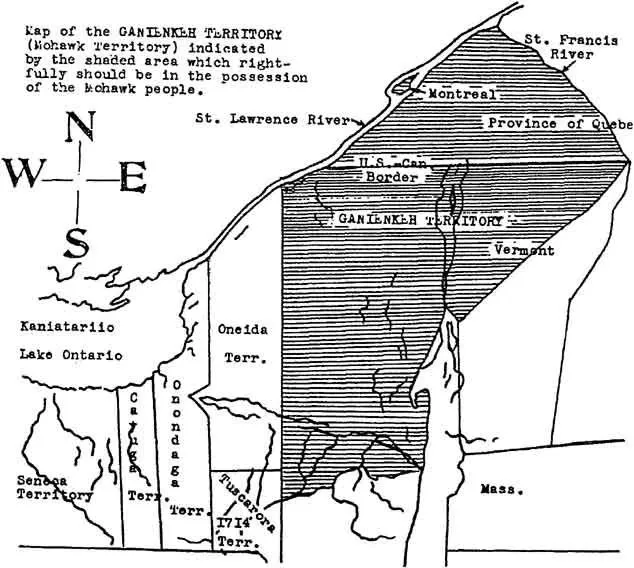
Over 500 years after the first colonists arrived to Turtle Island, after 500 years of genocide waged against the original peoples of this land, and amidst the apocalyptic culmination of an even longer war against the natural world itself, we ask: how have some traditional Kanien’kehá:ka (Mohawk) people survived to this day, and what gives them the power to keep fighting? What are the roles of culture and language in their struggle to survive as a people? For those born into settler colonial societies, inheriting their relations based on greed and destruction and the culture and language which realize those relations: could it be possible to orient towards another way, to reestablish connection with the Earth and to uphold their role as part of creation?
In the summer of 2022, we had the honor of meeting with a group of Kanien’kehá:ka elders, life-givers and warriors, including four members of the Ka’nisténhsera (Mohawk Mothers) and an original surviving member of the Rotisken’rakéhte (Mohawk Warrior Society). Thanks to our introduction through a mutual friend who collaborates in struggles with them, they welcomed us at their headquarters in Kahnawà:ke, land recognized by Canada as Kanien’kehá:ka territory, on the south shore of present-day Montreal. We went with the intention to record and translate our conversation into Japanese and Korean. As Japanese people living in Japan, Korea and the US, we were eager to introduce the long history of Kanien’kehá:ka struggle into our own political contexts.
In anticipation of this great opportunity, we attempted to prepare by reading The Mohawk Warrior Society: A Handbook on Sovereignty and Survival. This indispensable work of auto-history tells the story of the Rotisken’rakéte in their own words, not only from their formation as a group in the late ’60s, but stretching back to the establishment of the Kaianere’kó:wa, the tradition passed on by their ancestors since precolonial times. As we learned during our conversation, this inheritance is also what grounds the struggles of the Ka’nisténhsera, as they fight to uphold their responsibilities as life-givers and caretakers of the land.
At the time of our meeting, and continuing to this day, the Ka’nisténhsera have been waging a legal battle with the SQI and McGill University to halt construction at the site of the former Royal Victoria Hospital in Montreal. In addition to being unceded traditional Kanien’kehá:ka territory including ancient burial grounds, this is also the site where, during the 1950s and ’60s, medical experimentation for the CIA’s Project MKULTRA was conducted on Indigenous children, and where the Ka’nisténhsera have discovered there to be a high probability that some of these children were killed and buried in unmarked graves. They seek to uncover what happened to their kin and to honor and properly grieve for their loved ones. More information about this urgent struggle can be found in the conversation which follows.
The powerful words of the Ka’nisténhsera and Rotisken’rakéhte speak for themselves. We present them here in the hope that they can give you something in this dire moment — for traditional Indigenous peoples everywhere fighting to survive, and for all people struggling to fight for life on Earth, against the world-destroying forces of colonialist capitalist civilization.
Part One
the continuation of genocide and the responsibility of the Church; we did not lose our culture; our culture is our relationship to this land, Earth, winds, moon, sun, plants and animals, the water; everything is alive — that’s our culture; our language goes with this culture; Sha’oié:ra, the direction creation continues to travel; creation vs the creator; Kanien’kehá:ka, the people of the land of flint; the clans and their roles; consensus in the longhouse model; the three principles, Skén:nen, Ka’shatstenhsera, Karihwí:io; not law, but real freedom; Tewatatewenní:io, we are free in our ways; Onkwehón:we, the people of the ways of forever; on raising children; on picking medicine; on ceremonies; the oppressive influence of the Church brought through the Code of Handsome Lake; the beginning of the Mohawk Warrior Society, from cultural revival through song to becoming physically militant
Part Two
the Mohawk Mothers on following the Kaianere’kó:wa; buffalo speech vs taking action; the history of the band council as a mechanism of colonial control; the time of so-called treaties; we never relinquished our land or our birthright; the Circle Wampum; the Dish with One Spoon; the Earth is our mother and you cannot own your mother; the colonizers as squatters; the Mohawk language and its history; intergenerational trauma from the residential schools and the problem of reparation; the land claims process and how it ends up returning land to the Crown; reflection on the long history of Mohawk struggle and its future; the necessity to reacquire lands; the role of language in the struggle; there’s two ways to speak our language — the Christian way, and the natural way
Part Three
decision making in the Kaianere’kó:wa tradition; the Mohawk Mothers on the source of their strength and direction; intergenerational transmission and the struggle to survive; reflections from the militant struggle — the fighters had to learn to be builders; experimentation on Indigenous children as part of the CIA’s MKULTRA project at McGill University; the influence of the Rotinonhsión:ni Confederacy on the American Revolution and the European Enlightenment; the empiricism of Indigenous understandings of the natural world and living in harmony with creation; what it means to be able to survive off the land and the loss of that connection; on the possibility for collaborative relationships between the original peoples of Turtle Island and those born into settler societies; settler descendants’ relation to the land and the problem of reestablishing relationship with the Earth
Appendix A: on the Two Row Wampum
Appendix B: on the difference between English and the Mohawk language
Part One
Kwetiio: We were just talking about how the world is discovering the residential schools.
Kahentinetha: It was not known in the world? It was never known before now?
Sabu: Especially this story of how McGill University was involved, this is a new addition to the story of the residential schools’ abuse of children. As far as I know, nobody had known about McGill’s involvement before.
Kwetiio: Yeah, nobody had known it.
Kahentinetha: We knew it though. We all knew about it. But nobody believed us.
Karakwiné: No one believed us. They shut us down, whenever we talked.
Kahentinetha: We didn’t have a voice at all. So now, with the help of people like you, we’re getting a voice and people are starting to hear about it. And they’re learning. And now we’re finding the bodies, the unmarked graves. We’re finding a lot of evidence. And I wonder about how far this is gonna go, because I think they’re gonna try to stop it.[1]
Tekarontakeh: We’ve always known that this has been going on. We knew children were being abused. We knew children were being killed. Since I was little, I heard people talking about when they were in residential school and what they went through, and all the death and suffering. Many of them, we were told they were going to school, but they never learned to read and write. All they were was slave labor for the churches and so on.
It amazes me that even my own people don’t see this. We’ve known this has always been going on. We know how we’ve been dispossessed of our land. We’ve been dispossessed of our language. Everything was taken from us. Our children. And what they put those children through, it was just a continuation of genocide.
And now, all of a sudden, Canada is coming forward with new programs for Native people. This is gonna be the final nail in the coffin of Native people as a people. Now they’re just going to totally assimilate us without any question. It’s finality they’re saying they’re looking for. Canada is out there in the world saying how they care about human rights and how humanitarian they are, which is nothing but a lie. How are they going to trick us into accepting this lie? They talk about “Indian control of Indian education”. They talk about “Indian self-government”. They talk about all these things. And to the world, it looks nice. They think that the Native people finally got control of their own education. Our people don’t control any education. It’s still the same bullshit that always existed.
And then all of a sudden, they express a concern about missing and murdered Indigenous women. Because that became a big issue around the world, they attack Muslims and everybody else about the mistreatment of women. The women here in North America still are being mistreated! We all know that most of the women who are missing, are missing because of police. We have thirty-one women who were raped and so on in Val-d’Or, Quebec, and not a single policeman was charged.
This is happening all over the country. It’s happening down south in the United States, it’s happening in Mexico. Women are being mistreated all over the place. But the government said “Missing and Murdered Indigenous Women” — so that becomes a distraction. We know they are missing, and we know nothing’s being done about it. And then they’ll finance little groups in cities, Indian centers, and say, “Oh look, we gotta do something for the women” and this and that. It’s a Band-Aid to cancer! A Band-Aid to cancer. And then they come out with, “Native people need to heal.” Well we’re not sick — we’re oppressed! We’re an oppressed people. And the thing is that, we need to be able to have the freedom to exercise our human rights.
Then all of a sudden they come out with, “Oh, we’ve discovered 215 children in BC. Oh, what the residential schools did.”[2] And all they wanna do is tell us they’re sorry. But they don’t wanna do nothing about it. In our culture, there’s no such thing as apologizing. When you do something wrong, or you make a mistake, you fix it. That’s our way.
The Vatican owns 75 million acres of land around the world. The largest single landholder in the world is the Vatican. And all this wealth, all this gold they took from our people, all the silver, everything — they took it to the Vatican. And the Pope is wondering if he should apologize. He’s wondering if he should make a trip here. Now, he’s supposed to go to Africa, but he’s gonna postpone that trip so he can come over here. But if he comes here, it’s already determined who he’s going to see: people who don’t know any better. That’s the people he’s gonna go talk to. The Vatican would never come talk to a guy like me, no goddamn way! They want to talk to people that they can apologize to.
There’s never gonna be respect for our people. Never. They don’t know what respect is. It’s an ugly word for them. Because it’s something they could never live by. In our way, when there is death, we pay our respect to the people who lost someone. But when we put the body in the ground, we say to the people, [“]{dir=“rtl”}We have now returned the body back to where it belongs, our mother.” Our mother takes that body. So when we’re done here, and we go forward, no one leaves their mind at the grave. Because you cannot do anything for the people that passed. You can’t live for them. You have to live for the children that are here now and the ones that are coming. After ten days from the time the person passed, we say, “Now, you have a responsibility to move forward.” You’ll never get over your grief. You’ll never forget the people that you lost. But, they have to stay in the past. And you must go into the future, for the children.
Now, today, where did all these orange t-shirts come from? Where did all these orange flags come from? Where did all this come from? Who paid for all of that? The Canadian government. All this propaganda, who pays for it? All these groups supposed to be helping our people, who’s paying for it? All these band councils? The Assembly of First Nations, the Congress of American Indians in the United States — who pays for that? Whoever pays you, that’s who you work for. You’re not working for your people. That’s all window dressing, making our people believe that all this bullshit is for us. It’s not! It’s not for us.
They took that frog, they put him in the cold water. They put the heat on low, and slowly that frog cooks. Then he doesn’t realize after, because he died. That’s what’s happening to our people.
Sabu: Over many, many years…
Tekarontakeh: Yes. So me, I’m not going to make excuses for anybody. I’m gonna tell it the way I know it. The way I see it. I’ve lived through all these different things, I’ve seen it. You know, in our people’s ways, they say there’s three strings. The first string represents the cleansing of your eyes, so you could see the truth. The second string is to clean the ears, so you could hear the truth. But sometimes, you’ll hear something, but you didn’t see it. So you don’t know if it’s true. You don’t know if it’s a rumor. It’s only when your eyes and your ears work together, your eyes and your ears confirm, they reaffirm the truth. So when that truth you take, it goes in your mind. Then when you speak, that’s the third string. Because what went in, is what’s gonna come out.
But these people, they’re so busy crying, they got tears in their eyes. They can’t see the truth. They were told so many lies throughout the generations, they don’t know what the truth is anymore. And so now, they’re told all these things, and that’s what they want to believe. And now their minds are all at the grave. They’re concerned about the dead women, the dead children. What about the ones that are here? We can’t change the past. We don’t forget it, but we can’t change it. We move forward. That’s what we have to. And not just us, this has happened all over the world! The church is responsible for this all over the world.
Sabu: I was very impressed by your part in the book The Mohawk Warrior Society.[3]
Tekarontakeh: Because I’m the best liar.
<laughter>
Sabu: We all read parts of the advance copy. I was impressed by what you said about the struggle to recover your tradition. Your tradition was not just given to you — you worked so hard to recapture it, together with your comrades. This is so encouraging for Indigenous people across the world. Especially I thought about Ainu people, in Hokkaido, Japan. People usually say that the Ainu lost their language, they lost their culture. But this is a really great example, that people can recapture this.
Tekarontakeh: You know, when people say we lost our culture: I say, no, we did not lose nothing. I say, every morning the sun comes up in the east, and he sets in the west. Every day, the wind is blowing. Every day the Earth is pushing, and food is coming, medicine is coming. She continues to give life. How can you say it’s lost? No! It’s still here! It’s we, the people, who are lost. We need to get back to these things, to recognize these things.
Our culture is not making necklaces, or moccasins, or canoes. That’s not our culture. That’s things we make. Our culture is our relationship to this land. Our relationship, and how we respect the sky, and everything that’s in the sky. And when we say, “We are the people who make the house” it means, this Earth is our floor. And our feet touch this floor. Our head touches this floor. And so we make this house by becoming the walls that connect the sky and the Earth. We look to the east, and we have eastern door keepers. We look to the west, and we have western door keepers. And anyone who wishes to follow our ways can connect to creation. Not to an imaginary being someplace in the sky that nobody ever sees. Everybody says, “He controls all.” Well, he’s not a very good person, because all the suffering, everything that he causes. In this house that creation gave us the ability to build — that’s what we have to follow.
And when we say “all of our relations”, we don’t just talk about our human relations. We talk about our mother, the Earth. We talk about our grandfathers, the winds. We talk about our grandmother, the moon. We talk about our eldest brother, the sun. We talk about these plants and animals, which are our brothers and sisters. That’s our relation. That water that continues to keep the world alive, that rain that falls from the sky, that helps to show us. They’re showing how precious it is, that life is going to go on. This is our culture.
And our language goes with this culture. Because our language is alive. It’s not a noun. Like this, it’s not “table”. We describe what the table does. It’s what we put our food upon. Or else, like we use it as a desk, so then it’s where we do our writing and our work. So our language describes what it does. Because it’s got life. Everything’s alive.
Everything’s alive: that’s our culture. Not material things. It’s what’s real. And our eyes tell us it’s real, our ears tell us it’s real, and so we can talk about it in reality. Instead of religion, which is all make-believe. It only exists in the mind. There’s nothing to prove that these things exist, except faith. Faith — I mean, something that’s such nonsense! And the whole world wants to follow this, by faith. They want to believe that there’s a being up in the sky. They want to believe there’s the evil one below. No. You wanna know the evil one? He’s in the Vatican. That’s where he is. And every one of these countries has to kiss his butt. When you become president of the United States, where do you go? To the Vatican. You become prime minister of Canada, where do you go? Queen of England, prime minister of England — everybody gotta go to the Vatican and kiss his ring. That’s where this “sovereignty” comes from. Everybody says, “We have to be sovereign.” No, we don’t. We have to be free. Sovereignty comes from the church. It does not come from creation. And our people need to start to understand these things.
You know, I sound angry, because I am. I am angry. I’m angry at what’s happening, what’s going on. I’m not angry at the people who don’t know. I’m angry at those ones who are doing this continuously, generation after generation, to everybody. And the thing is that, they get their way. They do what they do. And who do they get to enforce their will upon the people? Your children. They put a uniform on your child. They put a gun in your child’s hand. They put a club in your child’s hand. And your children beat you down and will kill you because they willed it. It is a very sad world.
Kwetiio: When my kids come home from school and they say, “This is what I learned today.” And I’m like, “What did you just say?!” I have to deprogram my children from what they learned at school. At that young age. And where does that come from?
Kahentinetha: It’s all programming, that conditioning of our minds. The conditioning is right in there. And even when we’re grown up, and this happened sixty, seventy years ago, you still have to fight it. Because they put it in you when you were just little.
Tekarontakeh: You know, we were in Ganienkeh, my father and another man from Akwesasne. They were sitting outside my father’s house, they’re just talking, telling stories. So I stop, because I know all I’ll hear is the language, so I always sit there and we would talk in the language. And the idea of death came up. And they talked about how afraid they were to die. I said, “Why are you afraid? We’re all going to die someday.” We don’t rush it, but when it comes, it’s our time. Even in our ceremonies, we say that we never know how many days we will have on this Earth. We can have one hour, or we can have a hundred years. None of us controls that. I said, “So why are you afraid of dying?” And they looked at me and said, “You’re not afraid of dying? You’re not afraid of death?” I said, “And neither should you.” They said, “But you didn’t grow up like us.”
When my father and this other man were young, they went to those schools. They even went to church. As little children, that idea about hell was put in their mind. But me, I was raised by my grandmother. My grandmother, she didn’t go for none of that. She was strong about these things. When she taught us about death, she told us, she said, “When you die, you will feel no pain.” This white man’s belief that when you die, if you did something wrong, you’re gonna burn and all that, she said that that’s impossible. Because it’s only the body that feels pain. And when the body goes back to the grave, those nerves are no longer living. So you can’t feel pain. She said, “If it’s your spirit or whatever: it’s got no feelings. It doesn’t even have a form. So how is it gonna feel pain?” She was very logical and scientific about everything. And she told it in her own way.
So when I was growing up, I was not afraid to die. I was not afraid to get involved in the struggle and risk my life. I wasn’t afraid. And so my father and his friend says, “Well, you grew up differently.” I says, “Well, you’ve also heard all the things that I’ve heard. You’ve been a part of all the things I’ve been a part of. But yet, you still have that fear.” I says, “I know why you guys have that fear: because everything that the church said was wrong, you two guys did it. And now you’re wondering if you’re gonna pay for it!”
<laughter>
You know, the church made the statement: “Give us your child for five years, and we will have them for life.”
Kwetiio: So as they grow, even if they don’t go to church no more, all of their core values that they hold are all influenced by that. So how they perceive things, it’s all coming from the church first. So it’s harder, you have to go deep, strip it away. And how long does that take?
Karennatha: You know how they get rich, too? What they do is, you’re in the church, they scare you: “You’re gonna go to hell. You’re only gonna go to heaven if you do what I say.” So you’re always afraid, so you’re constantly giving them money. Go to the church, put money in there, put money in there, put money in there. So you’ll forget about everything that was natural. You’ll know only what they tell you.
Tekarontakeh: You know, a child is not foolish. A child is not stupid. Children can think. But we need to encourage them to think. See in our language, they always tell you, tetsa’tó:re. No matter what it is, take the body of whatever it is, split it open, look at the inside. Understand the inside. Then you know why the outside is what it is.
We say, ensa’nikonhraién:ta’ne. Your mind will never be firm on the ground, until you know and understand the truth. When you’re confused, and you can’t understand what’s going on, we say tesanon’warawénrie. Some people today think that means you’re crazy. But it means that your mind has not settled, and so your mind is like a snowstorm. When the snow is a blizzard, it’s hard to see anything clearly. But when the snow all lands, everything is clear. That’s why — our word for white, karà:ken — akwé:kon í:kare means you can see everything clearly, because of that white background. You see? That’s what your mind is.
This is why I say our language describes things. But today, we have two ways of speaking the language: we have the Christian influence on our language, but we also have the natural form of our language.
Sabu: In the book The Mohawk Warrior Society, you used the word poem. You said that language is a poem that connects us and Mother Earth. To synchronize with the Earth through the poetry of your ancestors’ language — that’s a very beautiful expression.
Kahentinetha: My Aunt Francis explained it, she said she didn’t like the way they’re teaching our language, because it’s based on just a translation of English. Whereas, she says, it’s karén:na, meaning it’s a song. She says it comes from the Earth. And it makes pictures, and then you start to see these pictures, and then you communicate with each other through these pictures. That’s what a language is, and that’s how it should be taught. And I never forgot that, when she told me that.
Karennatha: But now, everything is just… what do you call…
Karakwiné: Sterile.
Karennatha: Yeah. It’s memorization work. When I started school, the first thing they made me do, they made the whole class stand around and look at the wall with the queen’s picture and sing “God Save the Queen”. I never heard my mother tell me to save the queen.
<laughter>
She hated the queen! And here’s me, singing to the queen. They don’t explain anything, but they make you sing it.
Kahentinetha: And they punish you if you don’t. You were punished.
Tekarontakeh: When I was growing up, we always had people at our house. And it was nicer at the beginning, there was no television. And everybody used to come and people would visit, and all the old people would talk and tell stories. My grandmother would make tea, and she’d make cake or pie, and they’d sit there and they’d talk. And when I was young, I had this passion to listen to these people. Always I was around the table. And then they said, “Time to go to bed!” So I’d go to bed, but I’d lay at the top of the stairs, just to keep listening. They knew I was there, but they had to tell me to go to bed like the other kids. So I’d stay at the top of the stairs, and later my grandpa would pick me up and put me in bed, cause I’d fall asleep.
But I used to like to listen to these old people. And listening to all these things that they talked about made my mind different. And so when I went to school and they told me I had to tell God to save this queen — no, no, no. I didn’t sing “O Canada”. I didn’t do the Lord’s Prayer. I did not do any of those things. I stood out in the hall. When it was over, I’d come in to do my schoolwork. That was how I was, because there was something that those old people started inside me.
And that’s why I did all the things I did. That’s why I was ready to take the risks. Because those people who raised me were the ones who showed me the way. They showed me the way. I was four or five years old when they went and took land back in the Mohawk Valley.[4] And after that I always asked my grandmother, “How come we left?” To me that was heaven. I said, “Why did we leave?” She said, “Listen, and learn. And someday we’ll go back.” I was five years old. By the time I was twenty, we went back in and we took the land again.[5] You see? Because that was in me from childhood, to go back and take that land.
Kwetiio: You figure it out. Your mind has to stay open to keep figuring things out. You gotta use it. You can’t just take what you’ve heard for the fact. You have to take it in. You have to take what everybody says, and you figure what’s the right thing.
Tekarontakeh: That’s why in our ways, the old people used to say, “Let me tell you how it was told to me. Let me tell you how I heard it. Let me tell you my understanding.” They will not say to you, “Look, I’m gonna tell you, this is the way it is.” My grandmother said, “When somebody talks to you like that, don’t listen to him.” I says, “If he’s so smart and everything, how come I shouldn’t listen to him?” She says, “Because he thinks he knows it all now. He no longer has the ability to learn.” Because your mind is always growing. And when your mind stops growing, you stop growing.
So that’s why the old people always said, “Let me tell you how I heard it. Let me tell you how it was told to me. And let me tell you my understanding.” Because in our way, you respect the fact that everybody has a brain. And you respect that they have the ability to dissect things, that they can think things over. And the more important part is that, even though you and I might have a difference of opinion, it is not a reason for me to hate you. I need to listen to you. I need to hear what you have to say. Because maybe what you have to say might change my way.
Kahentinetha: That’s what my father told me. I didn’t want to go to school. I couldn’t speak English, I didn’t understand it. I couldn’t read or write. But he said, “You have to go.” And I said, “Why?” He said, “Because if you don’t, they’re gonna put me in jail.” You know, they were not treating me well at school. They were hitting us at that time, if we spoke any of our language. And I said, “That’s why I don’t wanna go. Because I’m so badly treated there.” And he said, “Well, you have to go.” But he told me, “There’s only two questions you have to ask all your life. The first is, ’Why?’ And the second is, ’Prove it.’ Whatever they say, you ask for proof.” And he told us, “You’ll get a good education.” And I did! But I didn’t get any friends.
<laughter>
Philippe: It’s really a method for thinking — that’s the culture.
Kwetiio: Yeah. Because we’re born with instincts, right? And that’s nature. That’s how every cell continues. It’s by an instinct.
Tekarontakeh: Even that word nature: in our language, we say sha’oié:ra. Oié:ra is a direction. And sha’oié:ra is the direction creation continues to travel. That’s the direction we must follow. We don’t go against creation. We go with creation.
Everything that’s man-made has a time limit on it. Man is constantly trying to change the Earth. To change creation. And he fails. And every time he fails, he tries to create something else, which brings on five more problems. But if he just went with creation, which has continued to go on for millions and millions of years — life as we know it may change, but creation will always be. It will always be. It was here way before human beings were here. And it’ll be here long after the human being is gone. We must stop thinking that we are the center of creation, when we’re the thing that’s the most unnecessary.
Sabu: One thing I noticed, in some part of the book you said that in your language, there’s no “Creator”. Creation exists, but there is no “Creator”. I love that! Because I hate “Creator”, like the Christian image of some old man with a beard.
Tekarontakeh: See in our language, when we first gather, someone is asked to say words, to help to prepare everybody’s mind to focus on our purpose for being here. If it’s for council, or for thanksgiving ceremony, or if it’s for a marriage, or for somebody who passed, we have a special way for each occasion. So at these times, when the old people would talk, they would address all the things. And they always started with the people who are gathered. These words are for you, to put your mind in the right frame of mind for what we’re here for.
Then now we start with our mother, the Earth. The one who gave us life. Like our own mothers, they gave us life, they continue to take care of us, to feed us and give us medicine. And then we address the water, because the water is our closest cousin, we say. Then we talk about our brothers and sisters, all the animals here, from the ones that crawl beneath the Earth, to the ones that crawl on the Earth, to the ones who fly. We address all of them. All the way to everything that’s in the sky. And we say that every one of these is a relative. Even the stars, our distant cousins. They’re always there to show us the way. To remind us. Just because they’re not as close to us as the water, doesn’t mean they’re not as important. Everything is important. Everything is necessary. Otherwise it would not be in creation.
Then in the end, they say, “Now let’s turn our direction to that which made all things possible.” It was told to us by the ones before, that we shall never know the face of this power. Nor shall we know where this power dwells. The only thing we will know is what we can see in the creation. And so, they said, we don’t know if it’s one, or if it’s more. We don’t know. But we have an obligation to say thank you. That’s all. You just say thank you, nià:wen. But nià:wen doesn’t really mean thank you. It means tsi naiá:wen, it has happened. You see? When someone gives you something, then you say, “Nià:wen.” Which is, “It has happened.”
Sabu: Acknowledging, with respect. That’s beautiful.
Kwetiio: When I try and explain to my daughters, when they come home and they tell me that at school they spoke of something, and the teacher said, “That’s the Creator.” And I said, “No, that’s not the way it is.” Then they told me that the kids in class asked each other, “Do you believe in God?” And one kid said, “No, I don’t believe in God.” Then the others said, “Well, what do you believe in?” And the kid said, “Shonkwaia’tíson, the Creator*.*” It means He who created. It’s turning the creation into a religion.
Tekarontakeh: That’s why I say there’s two ways to speak our language. There’s the Christian way, and there’s the natural way.
Kahentinetha: Somebody asked me, “Don’t you believe in God?” I said, “Yeah, you’re looking right at her.”
<laughter>
Kwetiio: And my daughter says to me, “Well what do you believe in?” I said, “I believe in myself.” I believe that I can do it. I can take whatever needs to be, and I can take care of it. I can’t tell my daughters what to believe in. I could set examples, and I could conduct myself and respect certain things. I can just make them see what makes me right, what makes me live in a proper, fruitful manner.
Tekarontakeh: In the old language, we never talk about shonkwaia’tíson, “He who created”. We don’t say that. When we talk about a power, the power we have the closest connection to, is this Earth, and our mothers. Our women and the Earth. And that’s why we call them ka’nihsténhsera, life-givers. Ka’shatstenhsera is the power of life. And onkwanerì:tsta, it’s this umbilical cord, it connects to our mother. And the fire in us comes from our mother. The energy that gives us life is that fire that comes from our mother. So that’s ka’nihsténhsera. And then when we talk about what families we come from, we say, “Ka’ nón: tisathwatsirí:non?” What fire do you come from? Who you are is who your mother is.
See, just like us, we’re Kanien’kehá:ka. Because this part of our mother, Kanièn:ke, that’s the land of flint. And so we are the people of the land of flint. We’re not flint people. We’re the people of the land of flint. Then there’s other people who are the people of the land of standing stone. Then you have the people who are from the land of the hills. Then you have the people who are from the marshlands. Then you have the people of the big mountains. All of our people, it’s in reference to the land. That’s why the old people would ask, “What is the land like where you come from?” They don’t ask you, “What’s your name?” They said, “Oh niiohontsò:ten tsi nón:we tisahténtion?” What is the land like where you come from? Then you tell them, “I come from Kanièn:ke.” And they say, “Oh, ok now I know who you are!” Then they say, “Nahò:ten ionsana’tónhkwa?” What do they call you? They don’t ask you what your name is. They say, “What do they call you?”
Kwetiio: Because it depicts how you think, and what your opinions are about different things. Because where you come from, you see it from a different direction than someone else would see it from. You’re coming from a different land. You conduct your everyday life different because of where you come from.
Sabu: It seems your language has a lot of identification with the Earth, or a lot of references to land formations, geological states, also animals like the bear or the wolf.
Tekarontakeh: See, those symbols, like we have Wolf Clan, we have Bear Clan, we have Turtle Clan. Today they’re teaching the children,“Ohkwá:ri nishiatò:ten.” You’re a bear. It’s wrong. You are not a bear. See, I just did some stories in the books for the school, in the language. But I wanted to teach the children what these things really mean. So in one story there’s this little girl and her grandfather going through the woods. And they see a wolf. And the child thinks to herself, I wonder if my grandfather knows that’s my clan. So she says, “Grandfather, did you know that’s my clan? I’m a wolf.” And the grandfather says, "I know that’s what you believe. But the proper way is sathahión:ni, you are a path-maker. She says, “Why is that proper, and not the wolf?” He says, “The wolf is an animal. You are a human. You’re a path-maker. You use the totem of the wolf to symbolize who you are, your family.”
Why is the wolf the path-maker? It’s because the wolf is one that does not hibernate. He’s here all summer, all winter. So he always knows everything that’s going on. And the thing is, he becomes a path-maker because his survival depends on his speed and quick thinking. So that’s why he’s the one who sets the agenda for the council. And then the bear, the same thing. The bear clan is rotiskaré:wake. Not ohkwá:ri, which refers to the bear as an animal. Rotiskaré:wake refers to the honeycomb. They’re the ones who like the honeycomb, they’re always looking for it. So that bear, he knows his environment and he’s always turning stones over, digging in the ground, climbing trees. He’s always looking for that honey. It’s not really the honey, it’s the larvae in the honeycomb, the baby bees. That’s what he likes to eat. But he likes the extra honey as well. And so, that’s why they say, the wolf will give it to the bear first, for the bear to analyze the issue. Because he’s so thorough in his investigations.
Kwetiio: That’s why I’m that way.
Tekarontakeh: Then when the bear finishes, he gives it back to the wolf, and he explains how he reached his conclusion. And the wolf thinks about what the bear said, and he thinks, dang he’s so thorough. The bear is able to bring out things, because the bear, even though he can move fast, he don’t move that fast if he don’t have to.
And so the wolf, if he agrees with this, then he gives it to the turtles. See the turtle, he hibernates, and also he’s not very fast. So when the turtle is gonna make a move, he really, really has to think things out. Even though the turtle has a shell and it provides him protection, it doesn’t protect him from everything. In the wild, there are foxes. And the fox is a very sneaky kind of creature. So even though the turtle can go into his shell, the fox is sneaky, and quick. And there’s also the hawks and other big birds, they can pick up that turtle, depending on his size, and take him way up and drop him and split his shell. So the turtle, he has to determine what move he’s gonna make. Does he have the opportunity to jump in the water, where the fox and the birds can’t get him? Or else, if he doesn’t have enough time, he’s not fast enough, then he pulls himself into the shell, hoping that that will protect him.
And so if the turtle agrees with the other two, then he gives it back to the wolf. So now they understand that all three sides of the council agree. But, before they can go forward, it’s given back to someone from the Turtle Clan. And so that speaker will get up and he’ll say to the people, he’ll explain everything. He’ll explain the whole issue. And then finally he says to the people, “This is the conclusion that the council has come to. Do you agree?” If the people agree, they say nothing. If somebody disagrees, they gotta say why. And sometimes that one person will catch something everybody else forgot. And so the council has to go through the whole process again, until the council and the people come to the same conclusion. Then, the council can ratify the decision.
Sabu: That’s consensus. That’s the longhouse model?
Tekarontakeh: Yeah. Total consensus. And you know, if there comes an issue that they can’t solve, then what they do is they say, “Well, at this time, since we cannot reach a conclusion, then we suggest you all take this matter home, and put it under your pillow. And we’ll attend to that at a later date.” But nothing is ever pushed aside. If you have to prolong it for a while, until you get more information, eventually it’ll come back and eventually it will be resolved. But they always said, “Skenen’shòn:’a.” Go slowly. Because if you run, if you hurry, you’re going to trip and fall. So they said go slowly, and make sure. Because decisions that you make, if it’s not a good decision, your children inherit the bad decision. See, so you bring harm to your children.
Philippe: Skén:nen is also the word for peace.
Tekarontakeh: Yeah. It’s skén:nen, everything’s peaceful. See the thing is that, you can’t have peace, if you don’t have ka’shatstenhsera. Ka’shatstenhsera is the power of creation. And then there’s karihwí:io, the way of reality, that which is real. Ok, so skén:nen, ka’shatstenhsera, karihwí:io are the three principles. And you always look at ka’shatstenhsera. Ka’shatstenhsera is creation, the power. The power that’s there. That reality is there, and you have the ability to connect with that reality. And if you make those things work, then you will have peace.
But also, you need the fourth principle. It’s the one that binds all the three together, never to be separated. Because you can’t just use one part. One part alone will not last. You have to connect all the three together. Your power, yourself, creation. And then, you have this power that binds you. We call that Ostonwa’kó:wa, the Great Feather. It’s so gentle, but yet it’s powerful, and it can keep everything together. And so we make a wampum, and we call that Teionitiohkwahnhákstha, the Circle Wampum. And every family and every responsibility is represented within that.
It’s all about responsibility. The thing is that, the four principles, you have to take the responsibility — because each of them has the power of responsibility, but you must bind them. You must bind them all. That’s why there’s a bind between your eyes and your ears, your mind and your voice. And then there’s your body. You can make your mind healthy, but if your body is not healthy, your mind will not be clear. So you need to make your body and your mind work together, because creation designed you that way.
Just a few things that I learned.
<laughter>
Ariel: I’m thinking about the power, ka’shatstenhsera*.* I noticed the definition of that word in the glossary of The Mohawk Warrior Society. I found it very beautiful. I’ll go ahead and read it, it says: “Ka’shatstenhsera refers to the inner power carried by every living creature to make life continue. As for human beings, their power is to be grateful for everything that sustains their lives. Ka’shatstenhsera is a willful desire to persevere by sharing our strength with all our relations.” That’s very moving. The human power is the power to be grateful, and to acknowledge these relations.
Tekarontakeh: Yes. And you use the things the way in which it was meant to be. That’s why we say, “Tóhsa nenwén:ton tatié:sa’t.” Don’t ever be wasteful. Just because there’s a lot does not give you the right to be wasteful. Because there’s others. There’s others. And that doesn’t mean humans only, it means there’s animals out there, there’s insects out there, there’s birds out there. They all rely on that same thing you need! You see? And the Kaianere’kó:wa, today we say it means the great good path*.* But it’s not really that. Kaia is it’s here. Ioiánere is it was all made right. And kó:wa is that it’s such a great power. So Kaianere’kó:wa means the great goodness that is already here.
Kwetiio: And now, it’s to keep it that way.
Tekarontakeh: Yeah. And to live in accordance with it. Your values, your principles, everything, it has to be that. Because that’s the philosophy that our ancestors passed on to us.[6] See this is why we call the ancestors kahsótshera, which means the ones before you. Káhson, it’s been made, means that the life you’re living is a reflection of what the ones before you have done. So you’re a reflection of your ancestors. Maybe not identically, but everything that they’ve done, good or bad, you have inherited. This is why when we refer to one another, we don’t say that anybody is your property. People today say kheièn:’a for my daughter and riièn:’a for my son. No. In the white man’s way, he owns those children. With us, we say kheiénha or kheiaión:ni, I have a responsibility to this child. I have a responsibility. I have to try to show her the way. I have to ensure that she can live her birthright.
Philippe: What I find really powerful is how in that mindset, the more you’re free, the more you’re responsible. You have to be free to be more responsible. And in that psychological warfare that Christianity put on you, and also the new forms of what they’re doing right now, it’s always to make you less free, and more selfish, and less responsible at the same time. So then you identify “freedom” with doing bullshit.
Tekarontakeh: That’s why, some of these people, because they think like a Christian now — see we call our way Kaianere’kó:wa, and they call it “The Great Law.” But there’s no such thing in our way as a law. Tewatatewenní:io, we are free in our ways. We are free, in that way. The thing is that, if you have a law, that means you don’t have no freedom.
Sabu: We are also interested in the struggle that you’ve been going through. That’s one of our main concerns in coming to speak with you today. This world is so apocalyptic, and the struggle to oust capitalism and the imperialist nation state is really important. But what kind of struggle do we really want? In that sense, I’m very interested in your organizing, or your community. Like in relationship with the American Indian Movement — you are kind of comrades, but different, right?
Tekarontakeh: See, the American Indian Movement is an organization. We, on the other hand, are a people. You see? And the thing is that, an organization is not different from a corporation, or a reservation status. What you have is a common struggle of individuals. Like there’s no such thing as an “American”. There’s no such thing as a [“]{dir=“rtl”}Canadian”. Because they have nothing in common. The only thing that they have in common is a common interest. And what is the common interest of Americans and Canadians? It’s this land and all its wealth. That’s the only common interest. They don’t have common language. They don’t have common beliefs. They don’t have a common history, common culture — nothing in common other than that greed! And they will do anything to acquire that, because they all live in accordance with the culture of possession.
Karennatha: With no respect.
Tekarontakeh: That’s right. So when the American Indian Movement organized, I supported them. I stood shoulder to shoulder with them on different occasions. But I would never become a part of them. Because the old people always told us, they said, [“]{dir=“rtl”}You are a people.” That’s why you’re Onkwehón:we. On:kwe is the human being; ón:we is the forever. We are the people of the ways of forever. But when an organization comes together and has no common interest, then they are not of the way of creation. Because creation is not divided. Creation is one.
Karennatha: It’s always about respecting. It’s always about respect.
Kwetiio: I respect her freedom of her choice. I respect his freedom, his mind. I respect her mind and her freedom. We all look at each other as an equal, and no one is higher. We’re all the same, we all want to continue to go on and live in harmony.
Tekarontakeh: When our children are born, the mothers and grandmothers choose a name for that child. Then in the time of the strawberry festival, or mid-winter, or harvest time, the mothers and the family bring that child to where the people are assembled. And people say “Oh, you bring it to the longhouse.” No, it’s not that you’re bringing it to that building. You’re bringing that child to the people. And the speakers will say, “This is the mother of this child. This is the family of this child, the clan. This is the father, and this is the clan of that father.” And they say*,* if the mother and father are both of the ways of our people, we say “This child is iakotonníson.” This child is complete, and has both parents’ clan*.* And they say, “This child will be known to you as Kwetiio”, for example. So you all know that’s her name and you all know the clans that she comes from. And they say, “She has with her a special gift. We don’t know what it is. She’s too small. She hasn’t shown it yet. But as she grows and develops, she will start to demonstrate what her natural ability is.” And when we recognize what that is, then it is our responsibility, enserihwakwénienhste. People think it means to respect. No. Enserihwakwénienhste means we will help enable her to be the best that she can be. Not to be the best, but the best that she can be. When a child does what they’re naturally good at, they enjoy life. And so once she gets this way about her, and she makes it really strong, then it is a benefit to all of us. And there may be many children who have the same gift — but all in different ways. And we all have the responsibility to help enable that child to be the best they can be. So, the thing is, no one should ever be higher. We should never put more importance on one. Everybody has their reason.
It’s just like the maple trees, they give us sap. The walnut trees, they give us nuts. Everything gives something to all. The forest is not made only of one kind of tree. You need the hardwoods and you need the softwoods. They help each other. You need that fungus on the trees, or the trees will not survive. And the fungus needs the tree, or the fungus won’t survive. It’s all connected. Everything. People don’t know that the trees communicate to one another. Only now, they’re figuring that out. And we’ve known this ever since the colonizers got here, we were telling them. But they didn’t wanna listen because there were no dollars connected.
Kwetiio: They wanted control. And that was the church, that was the way to control it. By saying that something’s higher than you. And only the church can communicate with that higher power.
Tekarontakeh: I was told the story: there was some Onkwehón:we people who lived in what’s called the state of Louisiana. And they were almost wiped out. But they started coming back, and they decided they wanted their land back. So they approached the Louisiana governor. They said,“Listen, this is our land. You stole our land. We want our land back.” And the Governor of Louisiana said, “We didn’t steal this land. We bought it from the French. So if you have an argument, you better go see that Frenchman.” So they went to France and they said, “You stole our land and sold it to the United States.” And France said, “No, we didn’t steal your land. Your land was given to us by the Vatican. The Vatican gave it to us under the Doctrine of Discovery.” And so these Onkwehón:we went to Rome. And they said, “Listen, you stole our land. You sold it to the French. The French sold it to the Americans. Well we want our land back.” The Pope said, “I didn’t steal your land!” They said, “What do you mean you didn’t steal our land?” And the Pope said, “God! God stole your land! You got a problem? Pick it up with God.”
<laughter>
Sabu: That’s the world, the way it is now. Colonialism to global capitalism, it’s all continuous.
Kwetiio: So now, they have people going to the Vatican so the Pope can apologize to them. That doesn’t make anything right. They’re doing it so they can say, “See, world? We apologize to them. We’re sorry.” It doesn’t get them off the hook. There is no sorry.
Kahentinetha: There’s no end to what they did. It’s fixed. It’s done. They did it.
Karennatha: And since they admit it, then they admit that they did all this damage.
Philippe: The Pope is coming here next month. He’ll be pretty close, in Quebec City, apparently. Already all the hotels are booked around there. Just for the Pope, he moves with a delegation of 500 people. He has two planes.
Tekarontakeh: We should go have tea and crumpets with him.
Kahentinetha: We should have pushed the colonizers right back into the ocean. Like we were supposed to do, but we didn’t.[7]
Kwetiio: But all our explanations of the world, in the end, it’s all about a respect for someone’s freedom. For example, if I need medicine. I go out there, I look around, I find medicine. Then I put some back. Or I just say something to myself, not to a []{dir=“rtl”}higher power. I say something to myself, that I appreciate what I picked, and it’s gonna help me, and then I’m gonna function better. So, it works. I don’t go and pick everything and make everybody come to me for medicine. No, I leave it so it can grow, and you leave it for someone else. Once you take everything and you try and make it for greed, then there’s nothing left. And then it doesn’t continue. It struggles to continue. So, everything is about this respect.
Tekarontakeh: That’s the way a lot of our people feel today. They do it in the most respectful way. You know, a lot of times people say that the Native people can talk to the plants, they can talk to the animals. You know, it’s like medicine picking. Before, usually the grandmother or grandfather would go pick the medicine for someone. And when they went, they took the children with them. So the kids go along and they’re looking around, and they find one. They say, “Hey, here’s one of them.” The kids wanna pick it, and Grandma says, “No, no, no, don’t pick that one. We need to know if there’s more.” So they go all around, they find a second one. And then the kids want to pick it. Grandma says, “No, no. You need two, to make sure that there’s gonna be more.” And they find a third one, and the kids want to pick that one. Grandma says, “No, no, no, no. Sometimes something might happen to one. This way, there’s always another to take its place.” So they keep searching until they find a whole patch of it. Now, the kids want to pick it! The grandma says, “Oh no, no, no. Before we start, you go gather up some sticks. We’re gonna make a fire.” So the kids gather these sticks. The grandmother makes a fire, and she takes out her tobacco. And then she talks to that plant, and she burns the tobacco, addressing the plant.
And so this is where people get the idea that we can talk to the plants. But we’re not talking to the plants. The grandmother is addressing the plants, but she’s really talking to the kids. She’s showing the kids how to respect these plants. Because we don’t know if the plants understand us, you know? But we know the children understand us. So now the grandmother and the kids, they pick that medicine, and they take it home. Now the grandmother prepares the medicine. So she has them involved in making the medicine. And now the kids know the whole process of making the medicine. So when the grandmother’s no longer with us, that granddaughter can continue it.
Sabu: So the tobacco has an important function, right?
Tekarontakeh: See, a long time ago, there were two kinds of tobacco. One had a purple flower, and the other had a yellow flower. But our ancestors, they felt that this yellow one is the one that we could use, for our minds. So when we burn the tobacco, we’re not just talking to that one plant. We’re not just talking to that one person. That smoke rises. We give a thanks to the wood, to the fire and to the smoke, because they will raise our words so all of creation will know of what we are doing. And we ask the participation of all of creation to continue to make these things happen. It’s always about the creation. And it’s always about our passion, the knowledge of creation. It’s always about our responsibilities, and the continuation of life.
That’s why, when we have ceremonies, the first day we have a ceremony which is all about addressing the people. Thanking the people, encouraging the people. The next day, we have a ceremony for the creation. And we say, this is why, if we follow the ways of creation, creation is like a family. That’s why the Earth is the mother. That’s why our grandmother is the moon. That’s why our sisters are all these plants and animals. Our grandfathers, the four winds; our eldest brother, the sun; our cousins, the stars; our cousins, the waters. All of this is family. And as long as that family works together, life will go on. So we as humans, we need to be reminded, always, constantly. To continue the harmony. Because the harmony will bring you peace. The harmony will bring you life. It’ll make you strong.
And so, the third day we do a game, we call it the peach stone game. But it’s not about a game. It’s about appreciating life, and enjoying life. So for the game, we divide the house. And one side of the house, if they try harder, we say that’s the side that’s gonna win. And everybody brings something of themselves. Maybe you’re a carver, maybe you made something. Or you made water drum, you made rattles, you made a quilt, whatever, you brought that. That’s what you’re putting up. It’s something of you, that you put up. And the side of the house that wins, they get the gifts. But not only do they get the gifts, now they have the responsibility of conducting all the ceremonial business. Now, the other side, they’re not losers. Now they get to sit back and relax and watch the others do all the work. But the real part of the story is that, if you try hard, you will be rewarded. But if you didn’t try hard, what it tells you, don’t take this as a negative experience, you take it as a learning experience. That if you would’ve tried harder, you would have got the rewards.
And then the fourth day, we call the Ostonwa’kó:wa, the Great Feather Ceremony. And that’s the moment that embraces all what we have done, to always remind us to use all of creation. Not just bits and pieces of creation, but all of creation. That’s what it was meant for.
Sabu: On such an occasion, the ceremony lasts four days?
Tekarontakeh: Yeah, four days of ceremony. Then we have four nights of dancing.
Sabu: How many people join usually?
Tekarontakeh: When I was a boy, we were lucky if there were twenty people. Our longhouse was very small, because we were constantly being oppressed by the Christians.
And then in the ’60s, when we were young men — we were just boys really, teenagers — we were listening to the old timers talking about our ways, and our responsibilities and so on. And they talked to us about rotisken’rakéhte, the men’s council fire.[8] They explained to us about the responsibilities of the men’s council fire. So seven of us, we talked about it. And we said, let’s rekindle that fire. Because that fire has been extinguished for so long, let’s rekindle that. So we went to the council and we said, “We want to rekindle our fire, the men’s fire. And we want you to sanction us.” They said, “We can’t.” We said, “Why? You’re the ones that taught us this.” They said, “Maybe we taught it to you, but we don’t have the power to sanction you. Kaianere’kó:wa already gave you that responsibility. We’re not going to make a decision when the decision has already been made by creation.”
And so that’s when we started. We became very active. We started learning our songs more, and so on. All on the cultural side. But then we got into the very political side. We started fighting against the band council. We started fighting against the police. Some us remember when our grandfather took us to Mohawk Valley and fought for land. So all of these things were there, and we just kept on.
Now today you go to ceremonies, and it’s not one longhouse anymore, sometimes you got three longhouses in a community. It could be anywhere from 100 people to 500 people at a ceremony. But, the problem is that most of them go because of religion. They’ve taken this way and made it a religion. They’re not taking this way as a way of life.
Kwetiio: Or a responsibility.
Tekarontakeh: And the thing is, that was influenced by the churches. It started with the Seneca people. Not just Seneca, but many of our people died from disease, they died from war, they died from so many things. And the people were in a bad way, a desperate, depressed way. And they brought alcohol to our communities, and they really messed up our people. They denied our people to leave the so-called reservations to go hunting or fishing, or anything. We were limited. A person was given a coin, or a piece of paper, saying that he has permission to go out of the territory. So we were in prison.
So, in their desperation, one of the men — he was an alcoholic now, and he was not a good person — he started having hallucinations, delirium tantrum from the alcohol. But his nephew was a minister, an Anglican minister. And so the church, the Mormons, the Quakers, the government, they all got together, because there was benefit to all of them, to bring this religion to the people. They called it the Code of Handsome Lake.[9] And that’s what they brought to the people.
And in their desperation the people said, well if we take this on, it’ll help us to get back to our old ways. But that new religion brought temperance rules to them, and told them, we don’t want you singing, we don’t want you dancing. The Mormons don’t do that. They don’t sing and dance. Neither do the Quakers. But our people resisted. They said no, we’re still gonna sing. We’re still gonna dance. So a lot of the mandates from the church, our people did reject, no matter what was gonna happen. And so this religion grew, and it spread throughout. But it didn’t come here to the Mohawks. The thing is, there was no need to bring it to the Mohawks, because we had Catholicism. But everybody else got the Code of Handsome Lake.
And so our people tried to continue practicing our ways. But we couldn’t sing and dance, because if we sang and danced, the Royal Mounted Police would come, and they would raid our ceremonies like it was a drug bust. People would be arrested and their children taken and sent to a residential school. So our people had to hide, and we couldn’t sing and dance anymore. But we kept our language, we kept our beliefs, we kept our principles. In 1924, the Canadian and American governments finally lifted the ban, because they thought we were all Christianized. Either Christianized through Catholicism or through this Handsome Lake, which was baby-class Christianity. So they figured it was done. And so, when they lifted the ban, our people built a longhouse, where they could assemble and sing their songs and so on and so forth. And we just kept building it up.
Then in the ’60s, we became more physical. At the time of my grandfather, they were fighting against the Saint Lawrence Seaway, but they were always trying to do diplomacy.[10] That never got them nowhere. And as young boys sitting there in council and listening to the old people, I would hear them say, “Let’s send a letter to Ottawa. Let’s send a letter to Quebec City. Let’s send a letter to Albany. Let’s send a letter to Washington.” And finally I asked them, “Did we ever get a response?” Nobody could remember. Nobody ever paid attention to our letters. So why are we sending letters? So this is why the men’s fire rekindled. And this is why we said we’re gonna take action. When we want something done, we’re gonna do it. And we had people like Louis Karoniaktajeh Hall and others tell us, “Put in your mind: there’s no such thing as you can’t.”[11] And so from seven, our society became thousands. We just kept building, building, building.
Today people say, “Well where are the warriors?” We’re still here. But
the thing is, we will not fight because somebody wants to use us. We
will pick and choose our battles. Because that’s what the old people
told us, “Pick and choose your battles.” In 1990, they decided to shut
the bridges down and all that stuff.[12] I had a smoke shop right over
here. And the guys came to see me. They told me what they were thinking
of doing, and they wanted a yes or no from me. I wouldn’t tell them yes,
and I wouldn’t tell them no. All I said to them was,
[“]{dir=“rtl”}Listen, if you’re gonna do anything, think about what you
are doing. Evaluate what you have to gain, and what you have to lose.”
They didn’t think. They shut the bridge down, they shut everything down.
You know, that was a bad move. A lot of times I thought about it. I
should have told them, [“]{dir=“rtl”}Yeah, shut the bridge down. But as
quickly as you shut the bridge, remove yourself.” You’ve demonstrated to
the outside, you have the ability to make more. As quickly as you went
on the bridge, you told the world you could do it. Then get off it, as
mysteriously as you went on it. Don’t sit on that bridge. And don’t sit
at the roadblocks, to give the outside all the time in the world to
create an embargo against you, and to study you and to pick you apart.
And that’s what these guys did. That’s what happened.
Kwetiio: Make them afraid of what you’re capable of, but don’t give them all your cards. Don’t show them your numbers. They don’t know what we’re going to do next.
Tekarontakeh: When we rekindled the fire, we asked Karoniaktajeh, Louis Hall, to make us a crest. Because we had a singing society and he had made us a crest, as the singing society. So we asked him to make us a crest, as rotihsken’rakéhte. And so Louis says to us, “Yeah, I’ll make you a crest and put ’rotihsken’rakéhte.’ But on the bottom, put ’warrior society.'” He says, “The reason is because we’re in a psychological war. Take advantage of what the white man has done. The white man has labeled us as savages, as the fighting Indians and warriors, and all this kind of stuff. And now they believe their own propaganda. So use that.” So he made us a painting, and we had it turned into a crest. There was only seven of us. So we went to the printer and we asked for seven crests. But the printer told us that for a few dollars more, we could have 250 crests. So we all talked about it, and we said, “Alright, make us 250. We’ll have spares.” So the printer made us 250 of them. And in them days, we all wore these denim jackets. And so all of us put that on our jacket. And we walked around Kahnawá:ke with those, and all the young people fell in love with this. They all wanted one. So, the seven of us got together and we talked about it and we said, you know, we got all these crests, and everybody wants a crest. So one of the guys says, “Should we sell it to them?” We said, no, it didn’t cost us a lot, let’s just give it to them. So we gave crests to everybody who asked for one. Now you have 200 young people in Kahnawá:ke walking around with this Warrior Society crest. Now the elective system, the police, everybody was in a panic! All these blue jackets with this warrior crest and everything. It put fear, them not knowing that it was really only seven of us. But these crests made it look like there was more of us.
But those crests, and those little things we did, got people to want to get involved. They wanted to know more. So we started associating with other young people, and talking about not drinking and not taking drugs, and we were teaching them our songs. We would go to the hospital, and there were bleachers there for baseball, and we’d sit there and we’d sing. All the old people in the hospital would come outside and sit on the porch and listen. Because some of them, all their life, they never heard these songs. Someone was 100 years old, they’d never heard our music. They’d never heard these things. But the thing is, I don’t care how long you’ve been in the church, when you hear that music, your feet will move. It was the music that brought the young people. All that happiness, that camaraderie, to sing and dance. Now, the young people wanted to know more. And we kept on, kept on, kept on.
Then we had evictions.[13] We kicked the white people out of here. And we shut down the drug dealers. We did all kinds of things. We took over land. We started cigarette shops here. The authorities said it’s illegal. We said, no, it’s illegal for you, it’s not illegal for us. And we just did this. And look at today, everybody has all this wealth. But you know, some of these people don’t even remember how they got it. They don’t look at those seven boys and what those seven boys did. But it wasn’t all about the seven boys — it was the older ones before us who kept it alive. They kept the knowledge. It was there in the archives in their minds. And we got it back.
Kwetiio: Yes. And it’s my job to give it to my daughter and my son and my other daughter. It’s my responsibility.
Tekarontakeh: See some of these people can’t tell you the stories, of how this all came to be. We always had individuals who were fighting. Like Kahentinetha, and our cousin Clifford, and her brother Frank, and different ones. They were always out there in Ottawa or someplace else trying to raise commotions about things, and trying to defend our rights. When they started they were just little kids, but they knew these things were happening. Then in 1968, we shut down the international bridge.[14] And they arrested Kahentinetha and I, and about fifty other people. I was a fifteen-year-old boy. First time I ever went to jail.
Kahentinetha: You should see the movie about that. You Are on Indian Land, the National Film Board.
Tekarontakeh: When I was arrested, you know what they charged me with? Assault and battery to forty police officers. I looked like a little girl! You know, I had long hair.
Kahentinetha: I was charged with beating up twenty-four police. I went on trial for that. Two trials.
Tekarontakeh: You were bad.
<laughter>
Part Two
Sabu: In terms of the difference between the American Indian Movement (AIM) and the Mohawk Warrior Society, the difference is that AIM was a movement, but you are a people. Which means you are struggling bodies, it’s your community itself rather than an organization.
Tekarontakeh: Yeah, that was a movement. This was maintaining who we are. It was clearly defined, who we are. Whereas the American Indian Movement, they came from all walks of life. And the thing is, their downfall was because they were an organization. They could be infiltrated.
Kwetiio: Because then, somebody can go in and say they want to be part of AIM. And then they could take them down.
Kahentinetha: Well, AIM was very heavily infiltrated. And they took very important positions within the organization — we don’t have that.
Tekarontakeh: The head office of the American Indian Movement was in New York, and the director was an FBI agent named Doug Durham. That’s how infiltrators can go. Whereas with us, they can’t infiltrate. Because the thing is, say somebody comes from Akwesasne. We talk to the people there, “Who is this person? Who is their mother?”
Kahentinetha: We all know each other.
Tekarontakeh: This is why they could not infiltrate us. Because we work as families.
Kahentinetha: In the Kahnistensera (Mohawk Mothers), basically, we were all raised in the Kaianere’kó:wa. And so we started to interpret the Kaianere’kó:wa. And when these unmarked graves at McGill and other issues came up, we started to organize. But, we’re not really organizing, we’re just following and interpreting the Great Peace. So we started doing this, and we’re doing it in basically the same way that the seven young men in the Rotisken’rakéhte did it. Our adversaries don’t know who we are. We use only our Onkwehón:we (Indigenous) names, and when we sign documents, we all sign with a sign, not in writing. And, they didn’t know what to do! First I thought, well, we’ll say something explaining that. But then I thought, you know they call them “treaties”, way back — some of them were only signed with an X, and that was a treaty. So why couldn’t they accept the way we signed these different documents that we had to file in the court? And so what we did was, we said, well we’re not going to go under their laws. What we’re doing is we’re taking the Kaianere’kó:wa, we’re saying, ok we’re going to use the Kaianere’kó:wa, and the courts can use their law, and let’s see which one wins. That’s the basic way that we’re going to approach this.
Kwetiio: We’re just following what our responsibilities are. And nothing that we’re doing, they can’t refute it. Because our way is the natural way. And nature always wins.
Kahentinetha: Yes. It’s all based on the natural world. So, everything that we interpret, it’s not very hard for us. We just simply sit here and we say, “Well, what does the Kaianere’kó:wa say?” And then we come up with an answer. So they were pretty angry with the way we were doing it, because right away they said, “Well, you can’t have this, you can’t do that; you can’t, you can’t, you can’t; you certainly can’t!”
Kwetiio: They sent us 800 pages of why we shouldn’t and why we can’t use the Kaianere’kó:wa. And then we just said to them, “In your own law, in your way which you think is superior — it says in your law that our law is superior.” It says it right in your own law!
Kahentinetha: Yes, it’s in there. We’ve explained a lot.
Tekarontakeh: It’s our understanding, not our law. Our understanding prevails over what they have. You know, the judicial system is not where we should be taking these issues. The only reason we’re in the judicial system is because of duress. We’re being forced, because they’ve got a gun to our heads. The thing is that, the way we look at it, guns are not always the solution. When you have to really defend yourself, you do whatever you have to do to defend. But if you can avoid bloodshed, you do. Hopefully, the more we go out there and explain about our experiences, there are people who will be listening. The courts will never listen, but there will be people in there who will listen. And people like Philippe here, the things that he does, it’s gonna open the eyes and the minds of many people, and they’re gonna see this. Because those people out there, they’re thinking to themselves, we as a people, no matter what race we come from, what civilization we come from, we’re all facing the same. We are all under the thumb of some…
Kwetiio: Hierarchy, that they’re trying to…
Tekarontakeh: Some oppressor. I wouldn’t say a hierarchy. He’s an oppressor. And we’re all being put under that thumb. You got this young girl from Sweden, Greta Thunberg. She’s been talking about the environment and everything else, and she started such a movement. But the thing is that they’re asking the corporations to comply. But the corporations will never comply. Now the next choice, these young people are going to have to make it happen. You can’t talk about it. That’s what you call buffalo speech. You know, make buffalo speech all you want, until you’re ready to take action. But understand, you have a responsibility, and you have a choice. But understand, whatever choice you make, you must take responsibility for your decision.
Like what happened here in 1990. All these young men, everybody was like, “Yeah let’s do this! Let’s do that!” They thought it was a weekend excursion. But when it started going into weeks and months, all of a sudden they’re looking at it like, whose fault is this? They weren’t looking at what the issue was. They were looking at whose fault is it? Who put us in this situation? And I remember, some people started complaining about our war chief. They were all saying it’s his fault. I reminded them, I says, “This was not his fault. When you’s all gathered and you were talking about what you wanted to do, and you asked him for his direction, all he said to you was, ’Whatever you decide, I will stand by your decision.'” Instead of telling them that they shouldn’t have done it, he just said, “I’ll support your decision.” It was a very interesting thing that happened. And so, you know, I almost came to fisticuffs with some of these guys. Because they wanted to blame him. And so, I had to put the fear of God in them.
<laughter>
Anyway, you know, we were told a long time ago, that when Japan went to war against the United States, the emperor of Japan was not of that mind. But he supported the people. He said, “This is what you want to do, I will support you.” Even though he was against it, he supported them. In the end, things didn’t turn out good. But the people still respected him, they loved him. Because he didn’t rule them.
Sabu: Actually I disagree about the Japanese emperor. This is the only point where I disagree with you.
Tekarontakeh: But this is a story we were told.
Sabu: But that’s a false story. He’s responsible. We believe he should be really prosecuted by the Japanese people. He’s responsible for drawing all of the Japanese people into the invasion…
Hajime: And all the Korean people, and Chinese…
Sabu: The annexation of Korea, the invasion of Manchuria, the massacre in Nanjing, the murder and mass starvation of millions of people throughout the Asia-Pacific — he’s responsible. So that’s the only thing I disagree with you about.
Kwetiio: That’s the conversation that we had before you came this morning: I would like to sit with you and know for real. Because you have come to us, you’re able to hear from our mouths what’s happening. The way we feel, how we conduct ourselves. And we have read things over the years about other parts of the world, books, articles, TV. You never know, until you speak firsthand to someone.
Kahentinetha: Nobody understands us, and nobody understands that this is our land. That’s it. There’s no question about it. It’s verified by even all of the people in this country. They even acknowledge it. So what does that mean?
Sabu: You know, the emperor’s family — if you’ll allow me to speak a little bit about the Japanese emperors — I hate the emperor. The imperial family is responsible for invading the native land of Ainu people. Generation after generation, his family has occupied Japan from south to north. They pushed out the Ainu people to the northernmost island of Hokkaido. So we are on the side of Ainu people, and Okinawan people, and also some ethnic minorities living in Japan, like Korean residents. We are on that side. And the emperor’s family is the symbol of this invasive force of the Japanese empire.
Hajime: They’re like the Vatican.
Sabu: They are from Manchuria. They are an invader from the Asian continent to the Japanese archipelago. Many, many years ago, they invaded.
Kahentinetha: We aren’t told that. I mean, that’s not right. We need to know that!
Kwetiio: That’s what I need to hear firsthand.
Hajime: I would like you to see this film that my friend made, she’s a Korean director. It’s called East Asia Anti-Japan Armed Front: Looking for the Wolf. The East Asia Anti-Japan Armed Front was a network, and one of the cells called themselves Wolf Brigade. And they conducted bombings of Japanese corporations that profited from Japanese imperialism. And so this film follows this history, and the afterlives of these attacks.
Kahentinetha: I would like to see that. I’m glad you brought that up.
Kwetiio: I’m interested, because that’s what I was saying to Kahentinetha this morning, I was saying that the people that are coming to see us, we can say, this is what we know about you. But in fact, that could all be lies. Just the way we are misconceived, you can be misconceived as well. It’s in our histories, what we have experienced.
Kahentinetha: And it’s in our mind and it’s in our memories. And it’s been handed down to us, because our people experienced it, and they have told it to us.
Kwetiio: Right. So that’s how we speak. But the same goes for Korean people, and Japanese people, only they can tell us firsthand. Because what you hear on the news — look, none of our opinions ever go on the news. It’s all about someone who works for the government, that is a Native person, that speaks on the news. Because they’re told what to say.
Tekarontakeh: It’s the ones that we say tehatihna’tshahiá:ton, they’ve got writing on their ass. They’ve got a stamp that says “Made in Canada”. They accepted what Canada and the US wanted. You know, when I was a boy, there was a place here, there was a tourist thing, Indian dancing and all that. And they sold all kinds of crafts, little tipis and little dolls and all kinds of stuff, and say these are authentic Native crafts and all that. But when you turned it over it says, “Made in China”, “Made in Japan”.
<laughter>
Kwetiio: And so now, a big hindrance is that a lot of our people get paid, and they’re spewing this stuff. And my kids, their generation is growing up with it. And we’re trying to take that out of our equation. But it’s everywhere!
Tekarontakeh: And they control all the media in this community. You can’t go on the radio, you can’t go on the television, you can’t go to the newspaper, because they fund everything. The government funds everything. Like this APTN, the Aboriginal Peoples Television Network. Years ago, myself, my brother, and my cousin, we did about eleven shows on an independent TV station here. We talked about all historical things, we talked about social things, we talked about a lot of things. But one of the things we never did, we never mentioned names. We attacked the band council system, we attacked the Indian Act, we attacked things that the church lied to us about, you know, different things like that. We talked about all these things. But we never mentioned names of people. Because it wasn’t about the individual, it was about everything that happened.
Well the band council approached this woman who owned the station, and they wanted to buy all the air time, because they wanted to take us off the air. But she wouldn’t do it. And people out west, in western Canada, they got to see some of these shows we did. So a guy out of Edmonton approached me and said, “Would you be interested in doing an hour a week show on APTN?” I said, “Yeah, I got no problem doing that.” And then he says, “I know the woman, she’s a Native woman, who’s the one in charge.” So he approached her. I gave him the CD, he showed it to her. She loved it. So she wanted to go ahead and have me do these shows. But she had to talk to her superiors, which was CBC, Canadian Broadcasting Corporation. And CBC said, “There is no way we will ever permit this guy to get on the air.” So it never happened.
Kahentinetha: And you know what happened to me? I got blacklisted. Fifty years ago.
Tekarontakeh: Before I was born.
<laughter>
Kahentinetha: That’s what they did to me. I was never to be ever mentioned in the mainstream media. And I’m still not.
Philippe: That was 1970, when it happened?
Kahentinetha: Yes, 1970.
Philippe: Just before that, she was always on the news.
Kwetiio: It’s too powerful. It’s too powerful to give them a minute.
Sabu: Also that was an important moment of the whole movement. The power of the movement was so strong.
Kahentinetha: It was in the ’60s during the anti-war movement and all that. The American Indian Movement, the Red Power Movement, all of that was at that time. And I was involved with that.
Sabu: Around that time, like ’68 was also very big in Japan. It was the time of the rebellion. And somehow, a lot of information about the Black movement came to Japan, but not so much from the Native American movements. Only AIM, that’s all, you know, the Alcatraz occupation and stuff. But nobody knows about this whole thing you guys have been doing. So it’s very important to introduce.
Kahentinetha: There is a big history here. It goes way back, you know, Mad Bear and all that stuff that happened. It’s one after another, we’ve always, always resisted. But, it’s been wiped out. Wiped clean. Nobody knows about that. And nobody has the time or the money to actually bring it back.
Kwetiio: The government puts a lot of time and energy to have us not heard.
Tekarontakeh: See, even for us to get funds from say overseas. We have a lot of friends overseas, and they would more than happily support us. But they can’t get the money here. Because here in Canada, five families own the banks. They run everything. The United States, same thing. So you can’t transfer money. They won’t allow it. Right away, they’ll investigate what you want the money for. But if we were a band council and say we could get funding from Spain to oppress our people a little more — the bank would allow it to come in. But for us to start investing in building an economy, or helping to reacquaint our people with our culture and our ways of life? No, no. There is no room for that.
Kahentinetha: You have to understand, the band council was set up in 1924, and it was called the 100 Year Plan. It’s coming to fruition in two years, in 2024. And the plan is to completely eradicate us. That’s when they set up the Indian residential schools and the Indian day schools, the band council was set up to do that. They were the people on the inside, and they were the ones that pushed the whole program. If you read the Indian Lands Act of 1924, it’s right in there. It’s also all in the Indian Act.[15] And that’s the law of the land. That is the law, right now. We are prisoners of war. We were placed on these reserves, and they took away all that land, and they gave all of our land and all of our resources to the provinces. That’s the basis of the position that we’re in right now. And in 2024, they will make a law that there are no more Onkwehón:we. No more. We will not exist anymore. By a stroke of the pen, passing it through Parliament. That’s how they’re gonna do it.
Kwetiio: So those band councils that are infiltrated into our community — they are paid people, from our people. And because of this money, they go and they work for the government, and they’re signing things left and right. They don’t even have any control. Some of them don’t even have the education to understand what they’re signing.
Kahentinetha: But they also use all kinds of methods to bring them under their control.
Kwetiio: And they label it that they’re doing great things for us, or they’re gonna create a new law. Like a “sovereign law”, they say. I’m not sovereign of anybody. I just am who I am. I’m free.
Kahentinetha: The other thing is, all of the Indian territories are under the army. The Department of Indian Affairs is a department of the military.
Sabu: Oh I see, I didn’t know that.
Tekarontakeh: See the thing is that, when our people first went into talks with the Europeans, it was always our men, not chiefs. It was the men, who went and dealt with external affairs. And so we would deal with the military. When they talk about treaties, it was the military on both sides who met at these talks. So, when our representatives go, we say in our language wae’thihrhe’nónnien. We made them a bundle, symbolically, that they carry with them. And the only thing that they can discuss is the bundle, which means it’s only what they were instructed. That’s what they would do. It wasn’t one sit-down and you came up with an agreement. No. It was many, many trips back and forth. Because every time we would meet with them, we had to come back to our people and tell our people what it was they were asking for.
And today, people will call that aterihwatsheronnià:tshera. It’s this treaty, this agreement signing. But in the old language, we didn’t call it that. We called it iontehontsahráhkhwa, it was an agreement on the land. Ohóntsa is the land. And the thing is, by the time the talks about treaties came about, it was already when much of our ability to defend ourselves was going away. And so now, in order to have some form of peace, we always had to allow them use of land. We never gave them the land. We allowed them use of land, and that’s all. This is why still to this day, they cannot produce one shred of evidence that our people ever relinquished any of our land. And we have never relinquished our birthright.
When Canada wanted their own flag, they approached the Crown. And the
queen says, “Oh, yeah, you can have a flag. Every corporation has a
right to apply.” So they made a flag. Then they went back to the Crown,
they said, “We want our own constitution.” And the queen says, “Every
corporation has to have a constitution.” So they made a constitution.
Now they went back a third time, and they wanted the Crown to give them
dominion over this land, and the people. And the queen says no. They
say, “Why not?” She says, “I cannot give you what does not belong to
me.” Because the land didn’t belong to the Crown. It still belonged to
the people of this land. And the queen told them, “The only way you can
have dominion over the land, is if you convince the Native people to
transfer title to you. And you cannot have dominion over these people
unless they are willing to enfranchise with you. But until then…”
So this is why, this man by the name of Lloyd Barber was appointed to be
the head of the Indian Land Claims Commission. Ever since the ’70s,
they’ve been pushing this whole land claims issue. And the thing is, the
people who are pushing the issue of land claims are no longer our
people, but Canadian citizens. They’re band councils. They’ve alienated
themselves. That’s what the Circle Wampum is about: that as long as we
all adhere to what was designed for us through creation, through our
ancestors, we have that birthright. We have the right to put the name,
we have the right to the clans. If anybody should decide that they
wanted something contrary to our ways, and in that wampum it makes it
very clear: should you go out, you will go out naked. You will go out
naked, and you will lose your name. You will lose the right to your
clan, and you will lose your birthright to this land. And so now you are
one of them. Tehonatonkóhton, you’ve immersed yourself in that*.*
It’s like if you take this napkin and you stuck it in oil, it would be
immersed with oil. Well, that’s what happens to them.
Kwetiio: You’ve been treasonous to your people. Now, if you’re in the Canadian government and you do something treasonous, they put you away for life.
Tekarontakeh: In our way, if you decide you want to go, you’re free to go. We will not stop you. That’s your choice. But remember, again, you gotta accept what comes with that choice.
Sabu: But here, in this conflict between you and the government, there’s something essential to grasp what is happening with this whole capitalist civilization. And the enigma of how to oust capitalism and the nation state is there. I mean your tradition refused the idea of owning the land, right? The colonizers would absolutely lose in terms of reasoning — they don’t have any reason.
Tekarontakeh: This is your mother. The mother can have ten children; one child cannot say he owns his mother. She is her own. You have use of your mother, to help you to grow and to survive. But you can’t own her. And you cannot dissect her, and say well you get this finger, you get that finger. You can’t do that. And the thing is, you know, this culture of possession — for us, there is no such thing as a border. There is no such thing as, well this land is only for Mohawks, and this land here is only for Cayugas. No.
We have a belt that reminds us, it’s called the Dish with One Spoon. That dish is Earth, our mother. And the one spoon is that we would never use sharp objects when we eat, because we’re all eating from the same mother. Because of fear that we might accidentally pierce somebody’s skin and the blood will flow. So this way, we all have the right to water. We all have the right to medicine. We all have the right to food. No matter where we are upon our mother, we all have that right. It was the British who came and started making borders. The British went to North Africa and started separating all these Arab countries, oh you’re Syrian, you’re Libyan, and so on. It’s them that divided, because that’s always been their motto, divide and conquer. It’s to divide people, and conquer them. That’s all it is, about conquest.
Kahentinetha: The other thing too, when they say, “Well we bought this land, and look, we got these deeds.” Well, the Indian interest is with the unborn people, the unborn children. And so we can’t sell it. We have to take care of it. We’re the caretakers. That is why we’re here.
Philippe: The real owners don’t exist yet. The ones that do exist, they’re not the owners anymore.
Tekarontakeh: When they’re in the Earth, they’re still part of the Earth. When they are born, now they have use of the Earth. So no one could ever sell this land. No one. Because no one has a right to sell their mother.
Kahentinetha: And you can’t even transfer it to anybody, because our mother can’t be owned by anybody, except those that are still in the Earth. It’s very easy for us to understand that concept. And we sense it, we feel it. We feel it with our children, and the children feel it too. They know about it from the time they’re born, they’re reminded of that.
Tekarontakeh: Our people say that the white man never has enough. They say, even a pig looks up once in a while. We say the white man enshahthón:rohwe — he dives in, and he doesn’t look up.
<laughter>
Kahentinetha: The other important thing is the fact that, when they came here and they wanted to sustain themselves, we said, “Okay well, you can use some of the Earth and grow some food, and we’ll show you how to do it.” They were only supposed to be here temporarily. But what happened was they decided they were gonna stay. And so they asked us, “Well, what do you call us?” And we said, “We call you the kanatién.” And they did not know what that meant, because they never asked us. But it’s not a very complimentary description of who they are. It means that they are… How would you say it in English?
Tekarontakeh: In English, you’d probably say that they’re squatters. See, when we built our communities, we would take the poles of trees and we would put them into the ground. And then we could bend them over and tie them and cover it, you know. That’s what we call wahatinatsó:ten, we embedded that pole into the ground. And so what they did when they became squatters, they were embedding themselves in the Earth, and then claiming that it belongs to them. So that’s why we called them kanatién. And then later they thought it meant Canada. But it doesn’t mean that.
Phillippe: That’s why they were in such a panic, too, trying to put all those devices and fancy wordings.
Tekarontakeh: And also to change our language. You know, for all these generations, they did everything to try to take our language away from us. And now, they’re putting millions of dollars in for languages to be re-spoken, but that’s all it’s gonna be, is spoken. Nobody’s gonna be living that language no more. They’re gonna be living in English.[16]
Today I was looking at this advertisement, they got this building on the other side of the tunnel. And there’s people in there, who are not first language speakers, they just learned how to speak our language. And now today they have the title professor, they’re professors of our language. And I know damn well, they’re not professors of our language! Maybe they profess, but it doesn’t mean they know our language. They may speak words in our language, but they don’t think in our language. They don’t live in our language. You see?
And again, they’re separating things. Like, if you look outside and see that it’s gonna rain soon, and we say, iokennó:ron. Ió:ken is something that you can see, it’s obvious that the water that’s gonna come down from the sky is kanó:ron, precious. Because when it comes down from the sky, it’s gonna quench the thirst of everything. It’s gonna refill the lakes and streams, even the underground streams. And we say, you can see that it is precious. Because by this act of nature, it’s telling you how precious this is, because it’s telling you life is gonna continue. Iokennó:ron.
But if you say iokennó:ron, and you ask somebody what it means and they say, “Oh, it’s rain.” They’re negative. They say, there goes my golf game. There goes my picnic. There goes my suntan. There goes my hairdo. It’s all negative. The only one that’s happy is a farmer. Or else, they’re finally happy to see the rain when their lawn turns brown, and they want their lawn to turn green. So that’s the only two positives that they look at. They don’t see that, that is life!
Kwetiio: It’s everything. It’s the most valuable.
Tekarontakeh: It’s the essence of life. Is that the right word, essence?
Karakwiné: Yeah.
Tekarontakeh: It’s the essence of life. Sometimes I have trouble with some of these English words.
Kwetiio: So when you say kanó:ron, like someone can say, “How much does this cost?” And you say kanó:ron, it means it’s worth a lot. You don’t say, “It’s expensive.”
Tekarontakeh: Something that is kanó:ron is precious. It’s like the
leaves that cover the corn, we call that onó:ra. Because it protects
the corn. And when we talk about ashenorónhkhwake, to love somebody*.*
But our love is not an emotion. Our love is real. Because when you say
konnorónhkhwa, it’s that I take all the goodness of myself, and I
embrace you with all my goodness. That’s love. It’s not an emotion,
like oh geez look, she’s so beautiful. I’m in love with her. Eight
months later, him, he’s gone, and her, she’s standing there with a big
belly. That’s called lust, that’s not love.
See they don’t know, the thing is that, such a thing as love, you have
to work for it. It doesn’t just happen. You know, before, our peoples
used to come together from all over. And the women would try to match
their children, with the hope that when they have grandchildren, they’re
gonna have good qualities. So they put these two young people together,
and then they say, entsaterihwísa. People today think means they’re
gonna date. But it doesn’t mean that. It means they’re going to work,
to make a possibility of something to happen. And in that time, you get
to know one another. You get to know each other, you get to know each
other’s families. And the two families get to know one another.
Everybody has to be in agreement, because they all have to work together
because of the new life that’s gonna come, the children. And so
everybody has a responsibility to ensure that these two people, when
they have come to a decision, that they are prepared to go through life
together, and bring children into this world. They know what they’re
doing, and they’ve established this relationship. And through time, by
working together and knowing one another, they create the love. They
create it. You see?
So our language has got a ton of history. Words they don’t even know today. Like a lot of old speakers, I’ll ask them, “Do you know why we call the priest ratitsihénhstatsi?” And they say, “No, never thought about it.” But that’s the problem now. The language you’re learning, doesn’t teach you this. See the word for priest, ratitsihénhstatsi*,* means something that was burnt to a crisp.
Kahentinetha: We used to burn them.
Tekarontakeh: We burnt seven priests.
<laughter>
We were supposed to burn eight of them, but we only burnt seven because one of them ran away. But the thing is, why we burnt them — it wasn’t our way to burn somebody at the stake. It was a European practice. These Jesuits were here, and then they went back to France. And then when they were in France, they made statements that when they return to the Americas, they will become martyrs. So when they returned, they went to the Dutch, and they told the Dutch exactly what they were doing. Our people never suspected them of being harmful, because they had no weapons. They walked around in dresses, just scribbling on paper, you know, what the heck. But our people didn’t read and write like that, and what our people didn’t know was that these Jesuits were giving all this information to the military. When to attack our villages, when the men weren’t home, and all this stuff. And our people wondered how these French soldiers know when to attack us.
So the French Jesuits revealed themselves to the Dutch, and they wanted the Dutch to tell us. So they told us. And the thing is, in our way, there’s only three capital offenses: treason, conspiracy and espionage. There’s no capital punishment for any other wrongdoing but those three. And so our people arrested them. They put them on trial. And these guys confessed that this is what they did. So, well this was conspiracy and espionage. So it was decided they would be executed. But one thing about our people: even our enemies, we treated them in a respectful way. We asked them, “What is your preference of being put to death?” And if they didn’t have a preference, we would hit them with one blow to the head with a club. An instant death, no suffering, no nothing. That was it. Your lights were put out, and that’s all. But these Jesuits asked us to burn them at the stake. And our people thought, that’s crazy. Well, if that’s your wish, then we’ll fulfill your wish. So the Jesuits described how they wanted this thing built, pile all these sticks, stick a pole in the ground, tie us to it and light it. Our people thought that was crazy. But, so we did it. And that’s when we started calling them the ratitsihénhstatsi*.* The first crispy critters of North America.
<laughter>
Kahentinetha: You know what, we’re having this issue right now about the reparation payments for those of us that went to these Indian day schools. And of course, they really did do some pretty awful stuff. So they say, well we’re gonna pay you for what we did, and then it’ll be over, and that’ll be it. And I just thought of it as we were talking, that maybe this is the time when we should bring back the old ways. You know, we’re all going back to the way we did things in the beginning.
Philippe: The club on the head.
Kahentinetha: Yeah, the club on the head.
Kwetiio: Or we could burn you!
Kahentinetha: We’ll give them a choice, how’s that. Then they can be martyrs. They could all be martyrs!
<laughter>
Tekarontakeh: You know, this payment for us going to residential schools and Indian day schools is a bunch of bullshit. See these lawyers came up with the idea, and the government went along with it, that it would be $200,000 for each person, ok? To wipe the slate clean of what was done to our people. But one of the things is that, the government agreed and all that, but nobody determined or made it clear to anybody — what is it that you went through? Yes, a lot of things that happened was very sadistic, as far as I’m concerned. And the ones of us who went to Indian day school, the thing is, unlike the ones sent to residential school, we got to go home. But the thing is that, what they didn’t clarify, is what was done to us.
Some of us went through the physical abuse, got strapped, you know. When I was going to school with this one girl, they locked her in the closet all day long. They beat her up and threw her in the closet. Another guy, they tied him up with a skipping rope, they taped his mouth and every time they would pass they hit him with a ruler. And so different things were done to kids. The thing is that, some of our kids may not have suffered physical harm, but the psychological harm was much more severe. See because, the old people always made it clear, when you hit somebody with something, that is physical, that will heal. But when you poke the mind of someone with a sharp stick, that will never go away.
And this is what they did to every single one of us. What we seen, what happened. My first day of school was the first day somebody smacked my face like that. This woman, a tall, giraffe-looking woman, her name was Ms. Cummings. She was saying something to us. And I didn’t understand, I mean, I understood a little bit of English, but not the way she talked, so fast. So there were kids there, Johnny Good Leaf and his sister Louise, I knew them from the longhouse, and I knew they spoke our language because we played together. So I asked them, “What did that woman say?” And as I was asking, she was already coming down the aisle, and she smacked me. All I seen was a big flash of light. I jumped up and I ran out the door, and I ran out of the school. I hung around near this store called Joe Stocks. I hung up there until my Aunt Viola came out. And soon as I seen her, I was a little kid, I started crying. And she said, “What’s the matter?” I said, “That goddamn woman smacked my face!” She said, “Why? What did you do?” I said, “Nothing! I don’t even know why she smacked me!” So we went back in the school, and Viola walked right up to her and she kicked her right in the ankle. Holy shit! I said to Viola, “You can do that?” She said, “Yeah. Whenever they hit you with anything, you hit ’em back.” That was the beginning of my education.
Kahentinetha: A lot of other people started doing that. Like our Aunt Josie, she went there and she was pregnant, ready to have a baby, she went with her sister and she went right up to Mr. Rawlings and she just whacked him! Punched him in the face. She said, “Don’t ever touch my kids again.” And she walked out. She had a lot of kids, she had fourteen kids.
Tekarontakeh: You know the day it stopped, them physically hitting us? The day it stopped was the day that one of the representatives from the longhouse — what people call the roiáner, or chief — came to the school. His granddaughter was in my class, we were the same age. And they beat her. They beat her all over her hands and everything. Her hands were swollen. So she went home, and the old man seen that. The next day he was at that school. And he told them that if any of this happened to any of these kids again, he would file charges against all of them. The old man was smart. He had gone to residential school — but he didn’t learn to read and write — but when he came home, he no longer had our language. But in his later years he started to learn our language, and he was as fluent as anybody else. And the people had such respect for him, they put him up as a roiáner in the longhouse. And he’s the one that put a stop to kids being beat up in school in Kahnawá:ke.
Kwetiio: Well, I was at the tail end of it. And I thought we were in a different time, because I always knew the stories from the older generation. So when I went to school, I was a young girl, and my teacher pulled my hair. She told me to turn around and she grabbed me by the hair. And I did it back to her and I got sent to the principal’s office. I went in the principal’s office, and he’s a Mohawk. And he looked at me, he says, “What happened?” I says, “I just did back what she did to me.” And he says, “Am I gonna call your parents?” I says, “You can call.” Because I wouldn’t get in trouble. They would go to that school and take care of everybody in there. It had turned where, my mother raised me to stand up for myself, and they knew where I came from and that if they called home, they would all be finished, these people. But it was still happening. It was still happening when I was in grade 5, 6, in the early ’80s.
Kahentinetha: And I was there in the ’40s, so I won’t go into what they were doing then. But it was really bad, because some of those teachers were World War II vets.
Karakwiné: Military.
Kahentinetha: Yes, they were military. And they settled things differently. The way they settled things like this in Europe, I don’t know. But that’s how they treated us.
Tekarontakeh: You know, when we were growing up, they sent us to what they called the Indian day school. A lot of people in the community called it the Protestant school. But everybody who wasn’t a Catholic got sent to school there. So there was the Catholic school and the Indian day school. And every day after school, after lunch and on the way home, you had to fight. I was always fighting with the Catholic kids. Because the nuns and the priests were telling the Catholic kids to beat us who weren’t Catholics, because we were children of the devil and all this kind of bullshit. You know the crazy thing is, five days a week you’re fighting with these kids, and then on the weekends, they’re at your house. They’re your cousins. You’re playing with them. On the weekend, there’s no difference between us, we’re families. But during the week, we’re enemies.
Kahentinetha: It’s very, very confusing. Because you’ll be playing with them. And then on a weekday, you walk down the street and they don’t even look at you. They pretend they don’t even know you. They still do it today.
Tekarontakeh: See, and that whole thing, when they talk about what kind of traumas did we suffer as children in school? This is something that lives with you forever. There’s no dollars to fix that.
Hajime: So those Catholic kids were also Mohawk?
Kahentinetha: Yeah, they’re our cousins. They’re our relatives. We had one cousin there, he used to wait for me and my brother. We were six and seven years old. And he’d wait for us after school, and then he’d beat the two of us up. He was a little older than us. And when we walked down the sidewalk there, they had to cross and walk on the other side. They put that division within the community. So that we would always fight with each other. We would not trust each other. And that carries with you for the rest of your life. You don’t even know why somebody doesn’t like you. They don’t know. Nobody knows.
And those priests took advantage of us. Like myself, I’d go and play basketball or something like that, and they told everybody else to go home, and then they would try to attack us. They’d say like, “Oh, can you stay and help me put all this equipment away?” And then next thing I know, I’m fighting off the priest. Fighting, like actually fighting, and then running away. He did it to the Protestant girls. And then I found out later that he did it to the Catholic girls too.
Kwetiio: For me, I’m living in a different generation, where I heard the stories. Some of that was still there. You’re seeing the aftermath. Some of my teachers were survivors of residential schools, so they have it instilled in them. And so they’re treating me a certain way. So me, if somebody physically touched me, I’m brought up in my household where nobody touches you. Somebody touches you, you take care of it, okay? So I did something. Now this is a new age, where it’s actually public. Everybody’s wearing that orange badge on their shirt, saying it’s okay now, everybody knows about residential schools.
Now my daughter goes to Mohawk immersion. But even that Mohawk immersion, and what they’re teaching them at school about our ways, is skewed. And there’s a teacher who’s judging my daughter. So my daughter comes home and she says, “I don’t understand why this teacher is doing this to me. She’s telling me that I’m wrong, I’m wrong, I’m wrong, and I’m being mean. And I’m not! I’m being creative.” I say, “All right, you’re gonna write her a letter and you’re gonna demand an apology.” You have to stand up for yourself. That’s my daughter’s job, to stand up. And then to show her daughter how to stand up.
Kahentinetha: The other thing too, throughout my lifetime, there’s always been this division here between the ones working for the band council and the rest of us. The ones working for the band council, they get all the jobs, and they discriminate. So there’s all these programs that are funded with money from the Indian Trust Fund. It’s meant to be for all of us. And the band council also gets money to run the community, for each one of us. Like myself, we’re talking about over eighty years now, they’ve been getting money for me, because I’m on the list here. But do you think I ever got any of that money? I don’t know what they use it for, they don’t tell me. And they help me with nothing.
And then they have this economic development institute in our town called Tewatohnhi\’saktha*.* They’re supposed to treat everybody equally and give you some money to start a business. And every time I have tried to get that money, I can’t get it. Or they find something wrong, or they say I don’t qualify. They always find a reason why you don’t qualify. And then they give you a bit of money, maybe $2,000 for something. Then you gotta pay it back, which, you didn’t even know you gotta pay that back. They’re after me now, to pay back some money.
Kwetiio: The money that’s yours anyway.
Kahentinetha: It’s all our money. It all comes from the Indian Trust Fund.
Philippe: And now the money for what you lived through at the day school, too. You were given only $50,000 instead of $200,000, because you would have to prove everything that happened to you, describe it in detail, and give evidence.
Kahentinetha: And the worst part is that the government did not want to be taken into court for trial, so what they did was they admitted guilt to everything. So for a few years now, I’ve been applying. It says you can apply from $10,000 to $200,000. I said, what happened to me, they should be paying millions to me! But I applied, and I applied for the top amount. So I waited for a long time. Finally, a couple of days ago, they sent me this letter and they said that I’m not eligible, but they’ll give me $50,000. Well, if you give me $1, why not $200,000? It’s my money. So now I’m just saying, okay, they’re guilty. They admitted your guilt. And they want me to go and explain and tell them more. And I can’t do that. I absolutely cannot do that. And I don’t have to. Because when they’ve admitted guilt, then anything I say, they have to say everything I said is true.
Tekarontakeh: That’s why the Pope doesn’t want to admit.
Kahentinetha: Yes. Then they admit everything is true, and they have to pay. And now they’re putting me in a situation where they say, okay, here’s the money — but you gotta tell us. You gotta tell exactly all the details of what happened. I can’t do it.
Kwetiio: It’s sick. Sick.
Tekarontakeh: They stole trillions off you and they want to give you chump change.
Philippe: And they want you to relive all those memories.
Kwetiio: Relive the atrocities.
Kahentinetha: I cannot do it. I know I can’t.
Philippe: It’s the same process for the land claims too, where the law is made such that you can’t ask for anything other than a monetary compensation. And then it would be over and you could never sue them again.
Tekarontakeh: When the Indian Land Claims Commission was established, they said that they’ll settle with the Native people. But they’re only gonna pay you what the land was valued at the time of contact. So if it was four cents an acre, that’s all they’ll pay you, never taking into account inflation and everything else.
Kwetiio: And how the land has been abused.
Tekarontakeh: So the band council put in these claims. And it’s been agreed to in the courts that the government was wrong. So now, they dictate to you how much they’re gonna give you. And one of the things they do, when the band council files the lawsuit, the government gives you the money to pay the lawyers and everything else. So once the claim is admitted to and you get a settlement, now everything the government gave you, you have to pay it back. And then with what money you have left over, you can buy some of your original land claim back.
Philippe: At today’s prices.
Tekarontakeh: At today’s prices. And also, if you want it to be tax exempt, you have to register under the band council. So it doesn’t become Native land — it becomes Crown land, the queen’s land! You see? And they still don’t understand, like in British Columbia, they’re all happy, they got $1.4 billion for their land. But they lost thousands and thousands of acres! And now their chief says, well, now we’ve got money that we could put into economic development and help our people out, and we can buy some of our land back. But nobody’s telling the people that even if you buy it, it’s still not gonna be yours. It’s gonna belong to the queen. And so you lose everything. You lose the land that you’ve already got, and then the one you get back, you’re gonna lose that too because your reservations are considered Crown land.
This here is not Crown land. Kahnawá:ke is not Crown land. See, every other people has government recognition. The government says, “We recognize the band council.” But people don’t understand what that means. The only people who still do not have any recognition are the Kanien’kehá:ka. Our people. We still don’t, because we have never relinquished anything. We’ve never given anything up.
Back in ’73, when we had the evictions, the band chief wanted to bring the army in. And the army said, “We can’t go in there, because that’s not part of Canada.” So they called the RCMP (Royal Canadian Mounted Police). And the RCMP said, “We can’t go in there, it’s not part of Canada.” So they turned to Parti Québécois and asked them to step in, and they sent the SQ (Sûreté du Québec), the Quebec Provincial Police. And that’s who we had these problems with. Because with the SQ, they figure anything within the borders of Quebec is theirs. And so they didn’t really respect any of our rights or our independence from them.
Then in 1990, they did send the military. Because already the band councils had signed jurisdiction over to the provinces. People have short memories here. They don’t realize, in ’73 they couldn’t send the army. Why is it they can send the army now? When we first blocked these roads over here, the band council came here and they started yelling, “Lift these roadblocks!” And the guys just turned around and said, “Hey listen, either you’re with us, or you’re against us. If you’re against us, then get the hell out of here!” And so our band council knew it was political suicide to turn against us. About an hour later, they came back and said we could have whatever we need. Yeah? Whatever we need? So we said, “We want all those steam shovels and bulldozers and everything.” And we dug all these roads up and we made tank traps.
They knew at that time that this wasn’t just a warrior society, it was gonna be men from all walks of life in Kahnawá:ke that were gonna pull together. We had the support of the people. So the band council knew if they went against us, they had to save face somehow. Next thing you know, they’re sitting at the negotiating table with Canada. Why? What are they doing there? They had no business there. But even the so-called longhouse people, they approved, they sent these goddamned sellouts to negotiate on our behalf. Next thing you know, they’re sending them to Geneva, they’re sending them to Holland and all that, to represent us.[17] And I asked, “Why are these people here? Why do you get in bed with the traitors?”
Kahentinetha: Well they’re doing the same thing in our fight with McGill. The first thing they do, when we filed in court, they get in touch with the band council. Not just here, but in Kanehsatà:ke. And then they put out a press release that that’s what they’ve done, and they’re already taking care of this matter. It’s really so they can avoid us, the Kahnistensera. So then we did a few things — we don’t want to tell you what we did, but we did do something, within our rights — and now, whenever McGill gets in touch with the band council, the band council says, “We have no comment.” So now they’re not contacting the band council like they used to, and they’re just not saying anything.
Philippe: Yeah. But, it’s been acknowledged. In one lawsuit the court acknowledged that the band councils are federal employees.
Tekarontakeh: It’s not a government, it’s a committee.
Kahentinetha: And the judge acknowledged that. And yet, every time something happens, they get in touch with the band council, which is just a committee. The Kahnistensera, and the people, are in a much stronger position. And they refuse to deal with us.
Kwetiio: Just like with them building the bridge, they would go to the band council. And we said, “No, you have to come to us.” So now they’re gonna come to us. I’ve got all their plans and everything.
Kahentinetha: We wanted to know if you have any questions about what we’re doing, the Kahnistensera, what the women are doing. We wanted to know if you wanted to ask any questions about that.
Ariel: I do. I’ve been thinking, I’m struck by the power of your continuous struggle. And I see that in your lawsuit against McGill, it’s not only about the courtroom and its ruling, right? You’re making this stand there, that is one of many in the long history of your struggle. But the forces you’re up against are so powerful, and they’re at work in every realm of life. So my question is, how do you strategize, and choose your battles?
Tekarontakeh: How do you separate the clean water from the cesspool? You know, ever since I can remember, we’ve been fighting this system. We’ve been fighting it and fighting it and fighting it. And we’ve never really had the resources to fight it. But we’ve done things in the past that showed us that we have the ability to do things. And, you know, I’m not getting younger. And I get a lot of calls from people from this community and other communities, they’ve got problems and they want me to come and help them fix that problem. And I tell them, I’m not that young guy no more. I’m not no twenty-year-old. I’m not no thirty-year-old. You know, I’m not even a fifty-year-old. I’m getting older, and I can’t do the things I did when I was young. I’ve learned a lot more than I knew back then. But I’m saying to myself, why am I gonna continue fighting this fight that we’re never gonna win? Okay? We’re not gonna win.
I look back at 1974, when we went into the mountains and repossessed land.[18] And we decided that only we would have the jurisdiction within that land, and we would work toward becoming self-sufficient and economically independent. We talked about having a moneyless state and all this kind of stuff. And it wasn’t just for the Kanien’kehá:ka, but it would be for all traditional-minded Native people. We were successful to a certain extent. We started out, we took 612 acres. Today we have over 10,000 acres. But our claim was 9 million acres, so we’re still getting more lands. And now today we have our own schools, we have a little sawmill, maple syrup operation, agriculture, buffalo, beef cattle — there’s so many things that came out that was good. Now there’s a lot more emphasis on language and things like this.
But, you have people there who went in, who still had reservation mentality. And that’s a hard thing to get out of anybody. It’s like a religion. And then we ended up, like a dictatorship happened, you know, and so on. So if you were gonna stay and try to build that thing up, you would always have to deal with this element. You know, I was one of the organizers. I was a negotiator, I did the public relations. I did everything that was asked of me. I even brought my own personal monies into that project. We built a super bingo hall. I brought the cigarette industry to them. I did a lot of different things. And today, the powers that be don’t want me there. Because the powers that be are threatened. They think, well, he’s too smart. He’s gonna take it away from us. I don’t want nothing. If I wanted something, I would’ve never give them my money. I would’ve just kept it for myself. But that’s not how I was raised. I was always raised to love my people, to help my people. And that’s what I did.
So now I’m saying, if we want to have some real success — we have to get lands. We have to reacquire lands. And I was one of the people that was appointed to what they call the Land Rights Committee. That was to start getting land back, whatever way, by hook or by crook, but to get the land. I believed in that. But a lot of the people that I was appointed to that committee with, they didn’t believe it, because they never did nothing.
So in my mind, I’ve been at it for a couple years now, and I am going to get land back. And I’m gonna take all the experiences that I have, and where I see we made mistakes, and make sure we don’t make those mistakes again. And to rebuild a people. I’m not just looking at Mohawks, I’m looking at all Onkwehón:we. In my conversations with them already, every one of them has said they wanted to learn Onkwehonwe\’né:ha, the language we speak. Because our language is more sophisticated than any other Native language. We have descriptions for everything. And our people here today, there are a lot of dollars going into language and everything, but it’s never gonna be. But the thing is, it’s a good start, because there’s lot of young people who are learning to converse in the language. But if they are gonna be a part of what we’re doing, then — see there’s two things in our language, we say, Onkwehonwehnéha ratá:tis or Onkwehonwehnéha rahrónkha. Onkwehonwehnéha ratá:tis is that he talks in the language. The other one, Onkwehonwehnéha rahrónkha — how would you translate that? It’s not just that he speaks it, but he actually is that language.
Kwetiio: He embodies it.
Tekarontakeh: Yeah. He’s embodied with that language. And so this is why I say there’s two ways to speak our language. There’s the Christian way, and there’s the natural way. And so these kids who at least learn to say the words, now they come into this, and then we can really teach them how to be a part of that language. How to know that language. And not just to mimic what’s out there.
Kahentinetha: How about about how to be that language.
Tekarontakeh: That’s right. That’s why, see, we’re putting together an agricultural program, we’re putting in for more economical housing. Like today, people get a little bit of money, and we’re building castles here, you know? And when the taxation comes in, those people with the big houses, how are they gonna keep the lights on? Because you’re gonna be paying taxes, and all that extra money you had is not gonna be there no more. So the thing is, the first step is you get the land. You get the land, you get the people. Get the resources to start to help the people start a new life. And when you start to do this — because we’re not just working with people in this area. We’re working with people in British Columbia, we’re working with people in Alaska, we’re working with people in Mexico, and Bolivia, and a few other places. So this is all gonna be connected. So they will all be like satellites to support one another, and to start to carry on a trade between each other. We don’t have to fit into the world order. We can do this amongst ourselves. We can do this. There’s nothing to stop us, but us.
Kwetiio: I don’t want to conform to a new world order. I want to make our world what it’s supposed to be.
Kahentinetha: Based on who we are. We are part of the natural world.
Part Three
Tekarontakeh: One of the first things we decided was that, whoever’s gonna come into this is going to have to learn the process of decision making. We’re not going to have this everybody’s screaming and yelling and all that. You work with your families. You work with your families, you have your representatives and so on. We’re gonna rebuild the clan system. Because a lot of our people don’t know what their clans are, and if they do know what clan they’re supposed to come from, they don’t know nothing about their clan. They don’t know the responsibilities of those families. Because every one of the forty-nine families has a responsibility. And the fiftieth position is a position that belongs to all of us. And none of these positions is a position of power, but a position of filling a responsibility.
Then the representatives of each of the families, what people call the chief, they will choose someone who is going to hold the title called Atotarho[19], which means the one we are all connected to. And that’s the only title. He doesn’t have a clan mother. The other forty-nine have a clan mother. But this one, because he doesn’t represent one family, he represents all forty-nine families. And he doesn’t have any power except to set the agenda and to call for when the grand councils will be held. And then he’ll open and he’ll do the closing. He’s there to make sure that all procedure or protocol is followed.
And he has two assistants from the Onondaga council, who will sit on either side of him. One is referred to as the stick, the other one is referred to as the seagull wing. And the one who’s the seagull wing, his title is Shatekarihwateh. Shatekarihwateh means that all issues and all matters are of the same importance. And when the council starts to get away from procedure and protocol, the symbol is that seagull wing, that he’ll clean the dust around the fire to remind them of what the procedure and protocol is. And that’s usually Atotarho’s position. But if he forgets, that’s why he’s got this backup, to make sure it happens.
Then on this side of Atotarho is Anonwiréhton[20]. And what he does is that if someone or something comes in to disrupt what’s going on, if Atotarho doesn’t take care of it, Anonwiréhton will. That’s why they refer to him as the stick. And he will cast away any crawling creatures. And his name, Anonwiréhton: it’s like, there’s a beautiful lake, and everything is fine. And then this thing comes out from the bottom, and it changes the look of everything, it shouldn’t be there. And so he will go there and he will sink it back to the bottom, ahanonwí:rehte. He will submerge it below, so that it doesn’t become a distraction to what the council is doing.
You know, the sad part about all of this stuff — these things I’ve learned all my life. And it hurts me today, that I can talk about these things, but I don’t know anybody else who can.
Kwetiio: Yeah. It’s your everyday life. It should be something that we learned, along with learning to eat and breathe and everything.
Karennatha: That’s what should be taught.
Kahentinetha: I think we have been infiltrated in the longhouse. All these distractions. So we don’t do that anymore.
Tekarontakeh: So that’s why I tell the young people, I say, those are buildings — that’s not our world. That’s just a building, that’s a church now. This here, this land, that’s your longhouse. You’re part of this*.* You’re the walls. You’re the connection between the Earth and above your head. And you have the responsibility to be the doorkeepers and to protect what we have in here. Never to allow something to come in here to destroy. Because we have that responsibility to look out for the generations that we will never see. That’s our job.
Karennatha: A few minutes ago, she asked a question. I didn’t understand everything because of my English. I felt that she was asking what’s happening and what’s the solution.
Kwetiio: Or, where do we get our power from?
Karennatha: So me, I’m saying, what we’re doing here, what we Kahnistensera are doing, almost every day, we come here and we come up with all this stuff. And the more we do it, the more goes out into the public and they hear it. And the more they hear it, we get stronger in our hearts. And we feel better that it’s coming. So we have to do it.
Kahentinetha: It gives us energy, and it focuses us more and more as to the direction. Our direction. The position we’re in.
Karennatha: I thought that’s maybe what she wanted to hear. Does that answer your question?
Ariel: Yes. And that helps me to understand my own question, which was about how you find the direction that you move.
Kahentinetha: The direction’s right there in the Kaianere’kó:wa. And it’s from the natural world. And what we do is we interpret what we get from the natural world.
Tekarontakeh: It’s in our language.
Kahentinetha: And the language, of course, helps us to do the interpretation. When something happens, then we go to the Kaianere’kó:wa, the Great Peace. And then we start talking about it, and then it all comes to us.
Karennatha: Sometimes the more problems we get into, it helps us more.
Kwetiio: Sometimes there’s a lot on our plate, and we have a lot of different directions, people want to speak to us. Or, even within ourselves, we create bigger questions and we get all clouded. But we just go back to the Kaianere’kó:wa and it says, alright, calm yourselves. Just make the path clearer now and focus on something. Because it disrupts your personal life too. And, for me, we have all these different generations here with us.
Tekarontakeh: And they’re all older than me.
<laughter>
Kwetiio: So I feel like the direction that I have is from the experiences that I have experienced and how I handled them. And how I handled them, I got from her, my father, her, him… I took all their different experiences and their interpretations, and then I handled the next. And I look at my daughters and I say, it’s my responsibility to do it the most conscious, the most healthy, the most fruitful way, so they see the outcome. They see how hard it is on us, physically, mentally, time, family. And then they see an outcome. And then they know that’s the way they have to conduct themselves, they see an example. So my force is what’s to come.
I have the understanding now of where all my teaching came from. I never went through Kaianere’kó:wa from beginning to end. And I’m not fluent in Kanien’kéha. But I have the understanding of the core of it. And I have some of the language, and I have that understanding of the old ways that were spoken, versus the new ways. I see where we’re being hindered from keeping our people alive. And I think that’s what fuels me and what my power is, that until the day I die, I’m gonna make sure I do the most I can to keep us alive.
Kahentinetha: And the reason for the Kaianere’kó:wa, and why it’s called the Great Peace, is that it’s for everybody. For the whole world. And we’ve maintained the Kaianere’kó:wa. And we have tried, I know in all my life I’ve tried to express that, and get it to go further and further and further. And in some cases, it worked. In other cases, they just couldn’t understand that anybody could live like that. But that’s really the reason for the Kaianere’kó:wa — it’s for world peace. It’s such a big responsibility for us. But we’re born with it. And we know it from the time we’re small children, we hear about it. And it’s only later as you get older that you realize, this is not just for me, this is for the world.
Kwetiio: Our ways aren’t to make somebody have more and someone else have less. It’s meant for a harmony between everything. So if we keep following those natural ways, we’re gonna come out on top. But we see the intersection with other ways. And we have to find a way just to promote ourselves, within our people, to start.
Tekarontakeh: This Kaianere’kó:wa, the way it is, is that it doesn’t try to make everybody the same. You can’t make everybody the same. It’s like the flowers. They’re all different colors, different fragrances, different shapes. That’s why you can make a beautiful bouquet, the variety. And each one of them is necessary. It’s like the trees in the forest, all the different trees. You can’t make all the trees maple trees just because you wanna make maple syrup. You don’t make all the trees apple trees just because you want apples. There’s such a variety that contributes to the wellbeing of life and to the future.
So when you’re gonna do something, like you want to talk about world peace, the thing is that you can’t just talk about it. I mean you can have 10,000 people marching through the streets of Montreal or New York City, or in Moscow or England somewhere. But, when people have to march, I never participate. Because I say, that’s a sign of weakness. When all you can do is protest, that’s a sign of weakness. The thing is that you have to take action. When I say action, it doesn’t mean you gotta go to war. It means get off your buns, start doing things that you know you should be doing, and don’t wait to convert everybody to your way of thinking. Start something. Show people the possibilities. Give people a role model, an example, to work on.
Just like fifty years ago when we took over that land in Ganienkeh. It didn’t go the way I believed it was gonna go, but it did happen. We got the land back. That was number one. We got jurisdiction back, that’s number two. And our own economy, that’s number three. But a lot of other things didn’t happen that should have happened. But we got something to go by. Now when we start another one, that one might not end up exactly like we want, but it’s that much more that people can see, and people can do. That’s how you get things done. And that’s action.
And the thing is, everything you do does not have to be political. It could just be for life itself. People say well, isn’t there gonna be another struggle? I say, the way I look at it, in 1974 we went in, we took our guns with us, we were ready to fight. We left a possible civil war here in Kahnawá:ke, to go and fight somewhere else. We said, we’ll fight with our enemies. We are not gonna fight with our own brothers and sisters. So we went elsewhere. For ten years, we were on constant alert, always with the threat of war. That’s ten years we wasted. In that ten years, we should have built something. But the problem at that time was that the ones that went over there, we were not builders, we were fighters.
And now the fighters had to learn to be builders. And once we converted to building, now, we built a school, clinic, housing, greenhouses and maple operations, you know. We even put up a super bingo and slot machines, and gas stations and everything, to generate income to invest back into the project. So now we’re gonna go somewhere else and start again. If I have five, ten years more to be able to make that happen, I’m gonna make it happen. Cause I want to go to my grave and I want to say I feel good, because I know my grandchildren and all these kids got something. I don’t want them to inherit a war. I want them to inherit a life. I don’t want them existing; I want them living. Maybe I’m getting too old for this shit, but I know what I want. I know what I want to see. Because that’s what I would’ve wanted when I was a boy.
Kahentinetha: When I was young, and I was doing all this, I was involved in all these different actions. Then I was blacklisted. And they thought, well she lost all her power. Because I used to speak all over and do all kinds of things in public. But I started Mohawk Nation News, and that was over thirty years ago. I started writing whatever I thought was important. I got information out, I put it out there. I did it right up to the present. I’ve taken the knowledge and put it down as I went through for the last thirty or forty years. I put it there figuring that this will be of some use. And it has, recently, it’s become useful to the students who are standing with us at McGill. They call and say they need to know something, and I say well you’ll have to look on Mohawk Nation News, it’s in there.
That’s one of the things that I’ve done myself. A lot of people know me through Mohawk Nation News. It goes to Europe or South America and so on. And that’s the way that I chose. There’s other different ways that other people have gone on to help out. Some young people are getting more into it, some of our young people are dedicated and they’re learning from us. We encourage them, because they really have an insight that I don’t have at my age. Not like they do. They see it. So that’s some of the ways that we’ve tried to push these ideas forward.
Hajime: Where can I see Mohawk Nation News?
Kahentinetha: It’s online.[21] So, what are you going to do with all this information that you got today? You’re going to translate it?
Sabu: First we’ll transcribe it. And then we’ll ask Philippe to look at it, and help with adding information, and with the Mohawk language parts. Then maybe we can discuss the editorial process. You know, it’s really long, so maybe we’ll separate it into sections. And then translate it.
Kahentinetha: Into Japanese and Korean?
Sabu: And other languages too, if we can find translators.
Kahentinetha: What kind of publication?
Sabu: I think there are different approaches. I’m not a purely journalistic kind of writer, I’m generally involved in a philosophical, theoretical kind of genre, like radical left criticism. So it could be in a publication like that. And it could concern these deep issues, like revolutionary ideas of how to change the world, or like language and your relationship with the Earth. But then, you know, we could also approach a more journalistic angle because of this recent issue, and your fight against McGill. Like the issue of this revelation of the unmarked graves of children.
Kahentinetha: It was in the news in Japan, it made it there?
Sabu: No, I don’t think so.
Kahentinetha: Well, it is kind of shocking to start off by giving them a punch in the face of the genocide here. What would their reaction be?
Sabu: And really, it’s shocking that they don’t know. But I don’t think it’s largely known, for example my friends don’t seem to know so much.
Hajime: Or, they know in general that the genocide took place in North America, and South America, you know, all across the Americas. But they don’t know these concrete instances and how they’re covered up, or the manners in which they were carried out. And especially by Canada, you know?
Sabu: Yeah. It’s the US that seems to do all the bad things. And for
Japan, or not only Japan, but generally in East Asian countries, Canada
doesn’t seem so bad.
Hajime: Because Canada doesn’t have a military presence there.
Kahentinetha: You remember that lady that came here from New Zealand? She said it was worse here than where she comes from. She said the worst that she ever saw is what happened over here.
Karakwiné: What, the Maori girl?
Kahentinetha: Yes. She went to British Columbia, she spoke to the people there. And she went to the Wet’suwet’en people and spoke with them. The highest numbers were in British Columbia. About seventy percent of the children died in those schools. And here in this part it was about forty percent. But it’s probably higher than that. I’m sure they’re lying about the numbers.
Karakwiné: They lie about numbers.
Karennatha: You know what they never tell? They never tell why they killed all these children. They never say they stole their land.
Tekarontakeh: And they did experiments. They used the children for experiments.
Kahentinetha: Yeah, that’s why they did it at McGill.
Tekarontakeh: And they had a program to experiment to see how far you could starve children. Then the thing is, Hitler learned a lot from over here, and Germany contracted Canada to do all kinds of experiments on the children. And all these different things they did to the children, the majority of the children died from the experiments. And the ones that survived the experiments were killed. So that they would never reveal what was done to them. I mean that’s why Hitler, he sent these people here to learn how to put the concentration camps into practice, because of the reservation system.
Kahentinetha: And at McGill, they wanted to do those experiments. The CIA, and the MI5, and CSIS — they all were into it. And it was through McGill University, they were contracted to do it. And the reason why they did it with the Native people is, they couldn’t get children to do these experiments on. So they worked with Indian Affairs and with the Canadian government and McGill University, and they set it all up so they could do that.
Tekarontakeh: See because the United States, and a lot of countries, they got laws against doing these experiments on people. And Canada didn’t. So Canada was taking all the contracts from countries around the world to do the experiments because they had Indian kids to be the guinea pigs.
Kahentinetha: And they set it up in a way so that nobody would ever know who these kids are. They split everybody up. They had some go out west, some go in Ontario, in Quebec and all over. And they didn’t give them names, they gave them numbers. And it would be very, very hard to find out who these children are.
Karakwiné: It would be very hard to track them down if you only have a number.
Kahentinetha: And if we find these children behind McGill University, how are we going to identify them? How would we do that? What would the investigation be? We don’t even know that.
Tekarontakeh: Well the fact of the matter is that there were children buried there, and that speaks for itself. Why did they have to hide from the the public that those children were there? It doesn’t matter if they’re Native children or non-Native children, the fact of the matter is, here was something evil that was done. And they need to be held accountable for the evil that they’ve committed. We can’t just focus on what’s happened to Native people. Because how many Canadians, how many Americans, how many people in Australia… Children were taken even from Europe, and they were sent to Australia to work on farms to be slaves. They were sent to Canada, and so on. It’s only recently, in Australia, that those children are now adults, now they’re trying to find their home, where they come from, who their families are, their relatives. This is not something new. This has been going on for so long. It’s just incredible, that they’ve been allowed to get away with it. And the church was behind every one of these.
Kahentinetha: So what do you think the reaction will be when you put this out in your countries? Will the people there be stoic about it, or what?
Hajime: I think different reactions, you know, not all uniform reactions. But I expect it will be slightly different between Japan and Korea. I think in the case of Korea, there are more Catholics in Korea than Japan, that’s one difference. Another difference is that they were colonized by the Japanese. So they relate to the experience of colonization as victims, rather than as aggressors. So that’s different. But also a lot of them aspire to be immigrants, more than Japanese. And so they come to live in, for example, Canada is a good destination, because it’s kind of open and it’s not like the United States. Their perception of the US is that it’s the evil empire, and there’s a lot of guns, you know, and it’s a dangerous place. Canada is safe in their eyes, like safe and stable, and there’s social security, you know, all these good things that they think they don’t have. So this kind of revelation about the genocide changes the perception of Korean people.
Tekarontakeh: I have a question: are you from North or South Korea?
Hajime: Well, I’m originally from Japan, but I live in Korea. I’m married to a Korean person, and have kids. So that’s how I live there. I live in South Korea.
Tekarontakeh: So you live in America.
Hajime: No, no, I live in South Korea.
Kahentinetha: We call it America. South Korea is very Americanized.
Hajime: Oh, yeah. That’s true.
Sabu: Japan is America too. After the Second World War.
Hajime: But Japan has more of a collaborator role.
Sabu: The problem for me, the thing about Japan — because I was born there, and I have comrades there. And it’s important, you know, what kind of things people do in resistance. But one of the sticky issues to me, after the Hiroshima and Nagasaki nuclear bombings, people seemed to forget about the anger. The rage against this. And why the hell they chose Japan to bomb. Not Europe, right, not Nazi Germany. No. Why they chose Japan — this issue never goes away.
Philippe: They wouldn’t have done that in Berlin.
Sabu: No, I mean Germany or Italy, they’re like European comrades.
Tekarontakeh: It’s your brown skin, that’s why they did that. The war basically was over. But they wanted to test those bombs.
Sabu: Exactly.
Tekarontakeh: And so, they had already brainwashed the American public into believing that Japan is evil. And so to drop the bomb, the people of America accepted it. That’s all that was.
Kahentinetha: It’s the same as accepting the genocide of our people over here.
Sabu: And you know, after the bombing, they started a program of testing the effects on people’s bodies. But they didn’t cure people. Purely military experimentation idea, it’s the same experimentation mentality.
Tekarontakeh: You know the uranium that was used for those bombs, they had our people mining that. And our people didn’t know what it was. It was a job. They were mining it. Then all those miners, they got the cancer.
Philippe: Yeah, like in Navajo territory, there’s lots of that.
Tekarontakeh: Even up north.
Sabu: One question I’d like to ask Philippe — because I’m so happy that through him, my long-time friend, I got to have this opportunity to meet you all and talk with you today. So I’d like to know, I’m sure he’s passionately working with you guys in many senses, politically, intellectually, legally. His full passion is here.
Philippe: Well, I just feel, and you all know it from the way you’re talking, it seems like there’s the central enigma of everything that went wrong, you know. This is the first place where Europeans came to North America. And those Europeans, when they came here, they were into their crazy religious stuff, which made no sense. And they had no practical sense of how to do things. They were less developed than the Romans a thousand years before, because they were just dripped in their crazy religion. But getting here, they witnessed you, and in all the travelers’ accounts they were just amazed at that practical intelligence of how to live in the world. And in a free way, and not having to live with authority.
So that’s the thing that sparked what we call the modern world. All those philosophers and everything, that was their main reference. Always their question was, [“]{dir=“rtl”}How were humans in the state of nature, before there was the nation state? When you live in nature, is everyone good, or is everyone bad?” You know, so it’s really based on these examples. And they came up with these ideas of freedom and equality.
Tekarontakeh: Liberty.
Philippe: Liberty, yeah.
Tekarontakeh: You know, the Statue of Liberty — originally the Liberty was a Mohawk clan mother. It was a Mohawk high mother. And when the Americans wanted to break away from King George, the thing is that, they knew that the king had no sovereignty over Native people. So they rallied around the symbol of a Mohawk clan mother, and they referred to her as Liberty. Because in England, Britannica was the mother, the motherland, they say. Liberty was the mother here. So they felt, why should a king from across the ocean have sovereignty over, when he’s not part of this land? And so when they revolted against the king, they went to every harbor on the Atlantic coast, and they went and threw all the high-tax products into the ocean. Like they always talk about the Boston Tea Party, but it happened all along the Atlantic Coast.[22]
Philippe: They were dressed as Mohawks.
Tekarontakeh: They were dressed as Mohawks. Even though King George’s soldiers were at the port, they couldn’t do anything about it because they had no jurisdiction or sovereignty over our people. And so these colonists, who were not Native, dressed as Mohawks, and knew that the soldiers couldn’t bother them.
Sabu: Oh, I didn’t know that.
Tekarontakeh: If you hang around with me, you’re gonna learn a lot of things.
<laughter>
Like their law to scalp Native people is still on the law books in the state of Massachusetts. You still get twenty-five dollars for a child, fifty dollars for a woman and a hundred dollars for a man. They never took it off the books. So if somebody in the state of Massachusetts wanted to scalp any one of us, they could collect, legally.
Kahentinetha: Same with killing off the Mohawks. There is a law to kill us off. It’s still on the books. George Washington.
Karakwiné: We called him Enhanataká:ri. His whole focus was to eliminate us, the Mohawks.
Tekarontakeh: Yeah. See, a lot of people would say Enhanataká:ri means he’s a village destroyer, but it’s not. Enhanataká:ri means that he bites down. It’s like a rabid dog. There’s no intelligence, no nothing. He just killed for the sake of killing. That’s why our people still refer to the president of the United States as Enhanataká:ri.
You know, when I was growing up, my grandfather used to tell me, we never refer to any other people than the Native people of the Western hemisphere as Onkwehón:we. Because our whole way of life was always how to be in harmony with creation. He said, you can go from the farthest north to the farthest south — that was the way of all of our peoples here in this land. He said that there were times when our people strayed and we started other civilizations. But in the end, we always go back to the land. But when the newcomers came here, he said, we didn’t call them Onkwehón:we. Because they demonstrated to us that they were not one with the land. They were not one with creation.
You know something? Our people can still talk about our connection with the dinosaur. Our people can still talk about that. In one of our openings, when we address our grandfathers, the winds, the thunders, the lightning — that’s our grandfathers. And we say these are grandfathers who have put those dinosaurs beneath the Earth. And they’re still here to keep them beneath the Earth. They say, if they should ever emerge from the surface of the Earth again, they will cause all life a great harm. And that’s what has happened. When they start digging that oil out and all these things, that’s the harm. The uranium and coal and all these things. Now today everybody talks about global warming, pollution and all this stuff, because of them bringing the dinosaurs back out of the ground.
And the thing is, the dinosaur is supposed to be there, in the ground. Because when the grandfathers come, and that lightning hits the Earth, it regenerates the Earth to have the power, so things may grow. Because there’s not a single life form on this Earth that doesn’t have electricity in it. That’s why the water, hydropower and all that — that’s because the power in that water comes from our grandfathers. You see, even though it’s symbolic and kind of romantic, it’s about science. Our people were always very scientific.
Kwetiio: Something that exists, it’s solid, it’s there. You can touch it, you can feel it.
Kahentinetha: When you explain it, it[']{dir=“rtl”}s easy for the kids to understand.
Tekarontakeh: Because when you explain things to kids, you always have to tell a story. It’s what’s called mythology. And mythology isn’t just a story. It’s there to reinforce your culture, your way of life, your philosophy. That’s what mythology is. So the thing is, it helps the children, when they hear these stories, then they see things in life. Then they start to be able to have the mind that is analytical, and it separates mythology from reality.
Philippe: There’s a word empiricism for talking about what’s really there, you know, like empirical reality. I think the modern world and Europeans learned that through meeting Onkwehón:we people here, who were living through that. Then it spread to the whole planet.
Tekarontakeh: Our stories say that when humans appeared on the land, they all started out the same way. We all had natural instincts. Different things within us tell us to eat. When we get thirsty, we drink. And one of the things about the human is, the humans are not solitary creatures. They always have to have others. And so it wasn’t about individuality among people. They knew that they had to work in harmony for their survival.
But as time went on, people started to develop communication, language. And everybody developed language, but it was always based on everything that was natural and real. Because it’s what they seen, it’s what they heard. It’s what they lived. And that’s how their languages began. And certain things, they had a great appreciation for. And so that’s why they created thanksgiving ceremonies. All over the world, people have ceremonies of thanksgiving.
But one of the things is that, even though we were social beings, we also understood that if we carried on too long as one group, that we would deplete the natural resources. So the families broke up and started traveling different places and establishing themselves in different places. You see? Our people built cities. We had cities. But we realized that cities created greed, jealousy, and people just exploit one another. So the people left. That’s why when you have these archeologists going into the Andes mountains, and they find these lost cities in Mexico and all that — whatever happened to these people? Did they get wiped out by a disease? No! They came to their goddamned senses and they went back to the land.
You know, there’s another big problem today. There are people in the Amazon in small communities, and they live totally off the land. And these countries are going in there logging, stripping the land, you know, all these things. And the thing is, they don’t understand, the human race today does not understand that they better do everything they can to preserve the way of life of these people. Because that is the only answer left for the survival of human beings. It’s the only answer left. If the electricity stopped flowing today, who’s gonna survive? We’re gonna starve to death. We might last a little while, when we start eating each other. You could say, well I’m gonna plant a garden. But you know, it takes a long time for something to grow. So what are you gonna eat in the meantime? And to say you’re gonna hunt — everybody else is gonna be wanting to hunt. There’s more people than there are animals today. They’ll wipe out every animal.
When I was a kid, I liked hunting. I used to go snare rabbits. And I used to go hunt for partridges, and muskrats. Because that’s all you could find here. There were no more deer here. There were no bear here. Even beavers, we didn’t have beavers until probably in the ’60s, in the back. They call it the beaver dam today, because it was amazing that there was beavers. Because during the depressions and so on, I always listened to my grandparents talk about how they lived through the depression, and how food was so scarce. But our family, we didn’t have that problem. We always had our gardens. We always had pigs, chickens, cows, you know. So we always had food. And people came from the city, families would come work on the farm just for a meal. So they would come and they’d have lunch and supper with us, and my grandmother would give them food to take home. Then the next day they were back at our farm.
So as long as you have that relation and connection to the land, you will not go hungry. You won’t go hungry. But who has connection to the land? You go to Kahanawa:ke today, everybody’s got a little box, they’re all planting tomatoes and all that. But who’s gonna live on that? You’re not gonna have enough tomatoes to pass through the year. You’re gonna have enough to make a couple pots of chili, and that’s it. But when we were kids, we used to have so many different kind of beans. We had kidney beans, we had this other bean that was like a pinto bean, it looked like a painted pony. We had white beans, we had pole beans, we had all kinds of beans. And we planted potatoes, we planted corn, beets, you know, we planted so many things.
Kwetiio: So, what was the connection that brought you here to us today?
Philippe: First? It was our friends from New York. That’s where we first met.
Tekarontakeh: Cause these guys had a little film company of some sort. They were doing a film on Palestine and what happened to Palestinians. And then somehow they took interest in doing our story. This is how I met Philippe, through those guys. They came up here and interviewed us, in Akwesasne. So we’re in a cookhouse, and we’re talking about all kinds of things. And this one guy from the States, he says, “You know, I’ve traveled all over the world trying to find this thing.” He says, “I’ve traveled all over, but I couldn’t find it. All the while, it was right here.”
Philippe: That’s the impression I get speaking with you, always.
Kwetiio: You know what, you were put into an environment. And in this environment, the people that you are connected to, that I speak to, they’re all people who are actually recognizing that there’s something terribly wrong. So in order for you to search that out, this is where you have come.
Philippe: Well that’s the thing, you know, I was raised in Longueuil. And I was just maybe twelve years old, and I started realizing, what the hell, how did this happen? How did this city arrive like that? Like just huge parking lots, you know. What was there before? Who was there before?
Kwetiio: And then we all ended up meeting Philippe, and then talking, and just connecting. And him asking the questions that he asks, and us asking him the questions that we need to know from his perspective as well. As well as him having his own network and knowledge and experiences. Now we’re connected with a whole new group of people that actually help us do what we’re doing. And I truly believe we could do something. I’m a person that tries to be a doer, and not just a buffalo speech maker. And if we didn’t have this relationship, we wouldn’t have all the people that help us. So for me, this was meant to be, this meeting.
Tekarontakeh: That’s why I go back to what my grandfather talked about, how all people of the world all started off the same. Others got off the path. And the thing is, now like Philippe and people like him, and like yourselves, you’re all coming together, and you’re all trying to get back to this. You’re trying to get back to the original. It’s the original way, and we all have to get back to it. But we need to find our place.
Kwetiio: It just so happened that our original is right here. Like when I went to school, later in life I went to private school and I had friends from all over the world. Then there were different cliques, you know. But my clique was made up of all different people. And I came to realize that every nationality feels like their nationality is the best. Everybody feels like their native way, on their land, is the strongest. And they’re determined to make their people the most honorable.
Tekarontakeh: Well that’s that false sense of security. They feel they need that security. And so only what they’re familiar with, to them, is the way. Even though they don’t take the time to stop and think, am I living the good life?
Philippe: I think that there’s not just one good life or one good way to live. But Indigenous ways seem to me, from all the stuff I read, they’re as different as the territories they live in. It’s always a relationship to where you are.
Tekarontakeh: You are what your mother is. That’s all it is. You are what your mother is.
Kahentinetha: And that’s where, I think all the people are going to want to go back to where they came from, because that’s where they were originally placed on the Earth. It’s where they’re to be connected, and where they’re supposed to have duties and responsibilities to the Earth. And the fact that they have left and gone somewhere else has displaced them, and they have no respect for the lands that they go to. Look at here, look what they’ve done.
Karakwiné: Because they know it’s not really theirs, so they have no responsibility.
Kahentinetha: And they don’t even notice.
Sabu: This is a really important question for me. This Native way, this really direct relationship with the Earth, many nations lost it. For instance, the Japanese nation. The Japanese nation is very similar to England, it’s an invader of Native peoples and Native land. So we have to decompose the Japanese nation in order to reach real nativity. An indigenization of our own, we would have to discover. You guys have it, you know? But we have to destroy Japan, in order to dig deeper. So that’s the question.
Kwetiio: Well the way that I look at it is, if you take a child who was taken and put in a different family or adopted, that child longs for their mother. Their whole life they’re seeking. And either they can go on a good path, or they can go on a bad path and be destructive. But they’re constantly looking for their mother. And half the time they don’t even realize that they’re looking, it’s a subconscious thing. They think, I have a mother that brought me up, but yet at the same time, I have this hole that I need to fill.
Tekarontakeh: Your biology.
Kwetiio: Yeah, your biology, that connection. When you have a baby and they put your baby on your chest, and the baby goes to eat right away. And that is happening everywhere within the world, people are saying, where did I come from? What the hell am I doing here?
Kahentinetha: Well, maybe you could tell us how you feel about coming here to this land, and you don’t have that connection that we have. But you long for that connection, don’t you? And so maybe you could explain that to us. Because we’re saying things here like, you’ve gotta go back, you don’t belong here. This is our land, we’re placed here. We have our duties and responsibilities. And now you’ve come here and you’ve misplaced us. You’ve almost wiped us out completely. So now, we’re still here. A few of us, but we’re still here and we still have the message. The message is that we are supposed to save the Earth.
So what happens, and how do you feel when we say, you’re going to have to go back to your mother, to where you came from. And that’s where you will find yourself. I don’t know if that’s true, maybe it’s wrong.
Sabu: Maybe we do need to. But one positive tendency, I believe, speaking from my personal experience of struggle, a short history of anti-capitalist struggle from the late 20th century to early 21st century. It’s a humble experience but, during this struggle I met people in different places, like Korea, Japan, Greece, Turkey, France, US, Canada… People everywhere have started trying to have a relationship with the Earth, that they develop by either squatting, or they collectively acquire farmland, or try to have a communal life, you know. The network of these friends, to me, is a new kind of a nation. It’s not the nation state. That’s why a model like your tradition is so important for us to learn.
Karennatha: But ours is nature, it’s not tradition.
Tekarontakeh: You see, words can mislead us. Here, and all over, everybody’s talking about “our nation”. But the thing is that if we stop trying to institutionalize ourselves, and start getting back to what’s real — see in our language, there’s no such thing as a “nation”. We are not a nation. We are a people. And we have to have people become who they are.
We have symbols, and we talk about our way of life. Our philosophy, our principles. And we say that if anyone should wish to come under the shade and protection of this tree, they’re welcome. But what they don’t understand is that we’re not saying, “You all come to our land.” No. You can come here, and seek the knowledge, and we will share with you this knowledge. Now, you need to apply that knowledge, and reestablish your relation with your mother. That’s what we’re saying.
Appendix A: on the Tow Row Wampum
Tekarontakeh: The Europeans were supposed to stay only in their ship, on the water. That’s what that Two Row Wampum was about. That is about a relationship. And the thing is, when they came here, they came to trade. It started with the Dutch. The Dutch wanted the hemp. The ropes that we make, the cloth that we make, all the different products that we make from hemp. So we explained to them, this is the way of this land. We are of this land. We evolved from this land. You, on the other hand, the only thing we know about you is you came in a ship. There is no evidence where you travel, because as soon as you pass, the water goes back to the way it was. But we understand you are here because you want things that we have. And you want the cloth for your sails, for your ships. You want the ropes for your ships. You want these other things that you can take home, wherever that is. But we’re gonna tell you, you need to stay in that ship. Your people stays in that ship. Your religion is in that ship, your language is in that ship. Everything about you is in that ship. The only connection you will have to this land is the hemp rope that we will tie to your ship. And we will tie the rope to a bush over here, just so your ship doesn[‘]{dir=“rtl”}t drift off. And once you did your business, then you go back to where you come from. So that[’]{dir=“rtl”}s why the Dutch, their symbol to that Two Row is the hemp rope.
Then the French came. And the French, they wanted our iron, our metals. You know, a lot of times they give you the impression that Native people only worked with bones and sticks, stones and stuff like that. No. We had smelters, we made iron. We worked with copper, we worked with all different kinds of metals. Silver, even, and gold. We made all kinds of things. And so the French wanted our iron, because it was superior to anything they had in Europe. And so this is why the French’s symbol is the iron chain. We said the same thing, they stay in their ship. And that iron chain connects them from their ship to a bush on this land. And when they’ve done their business, they go back.
Then the English came, and they wanted our silver. And so this is why they came up with the expression, the silver covenant chain. It’s that silver chain that will connect their ship to the bush so they don’t drift off. Then the Americans, they were crazy about gold. So their symbol was a gold braid. That was their symbol saying that they would always respect that Two Row Wampum. That was their symbol to tie them, to trade with us.
Queen Anne sent a letter, in regards to Quebec, Ontario, New York state, the United States itself, and Canada. She said, “Let me remind you, you who have gone to the Americas: you are not nations. You are not governments. You are only trading companies.” It’s no different, see they had that same relation when they were in India. The East India Trading Company. All of them went there for trade. They were not sent to colonize. So everywhere they went in the world, it was for trade. But once they were there, their greed made them want to colonize. And they wanted everybody to be like them. They wanted everybody to be under their control. And all they did was ruin different cultures, all over the world. That’s all. It’s a cancer.
Appendix B: on the difference between English and the Mohawk language
Sabu: I’ve been visiting different comrades trying to have a more direct relationship with the Earth. And what I feel is missing — or, not missing, they’re doing good — but what I learned today from hearing about your language, is that the mystery and the power is in language. And so if we are able to create something like a real relationship with the land, it’s not just in the physical interaction with the land, but it’s in the language and the entire sphere of human relationality.
And also the book The Mohawk Warrior Society is so great because it’s explained very clearly, to those who are totally outsiders, to make us understand the power of language — the power of life, the way to create relations, the way to fight. So this is something I learned so much, because I didn’t know that at all. Everybody says, well there’s different languages, and then they try to be affirming or something. But that’s not enough. Something’s different. It’s not even spirituality, in the general term. Some friends of mine start talking about how spirituality is important, but it’s not the same, that’s not enough.
Tekarontakeh: We call it atónhnhets. Atónhnhets is something that’s alive. And when we talk about what people call spirituality, it’s not the same thing. To us it’s about life. It’s the life in somebody. See we say there’s three parts to a person. There’s oieròn:ta, the body, the vessel. And then there’s orén:na. Orén:na is the spirit, the life. And o’nikòn:ra is the mind, which makes the body and this life work together. But also this o’nikòn:ra, it has to work with the three as well. It’s like everything else, this is what makes it whole. That’s why we talk about our three ceremonies, but we have a separate fourth one that embraces, to make sure that you don’t separate them again.
The white man likes to institutionalize everything. He separates everything. And it is all for the fact of control. It’s all for the fact that it’s part of their economy. It’s the base to their economy. And that’s what’s wrong. And it’s wrong for us to think that our economy has to be based on a currency. That it’s not based on cooperativeness, it’s not based on mutual relations.
That’s what that Two Row Wampum is about. To recognize and respect the fact that we have these differences. And that one should never try to steer the other’s vessel. That all these have to travel through life, as they are. We can’t take all the flowers in the world and turn them into red roses. As beautiful as the red rose is, we’d get sick and tired of it. And plus it would destroy the ecology of the land.
Philippe: That word currency, I’ve been thinking about it, it must come from the word current. It must be similar.
Kwetiio: When it makes you go in that direction. The current makes you go in that direction.
Philippe: Yeah, the current of a river too. But it has to do with
saying, this land, we’ll transform it into something current. What’s its
value right now. And you exhaust its value at the current time. It’s
like wanting to suck energy out of it.
Kahentinetha: So you have to take everything out that makes it what
it is. You remove all that, so that it becomes all the same.
Philippe: Transform it into numbers.
Kahentinetha: You know what they[‘]{dir=“rtl”}re doing now is this World Economic Forum. It[’]{dir=“rtl”}s going to transform everybody, their minds, the way they live. Everything is going to be one and the same. And then be controlled by a very small group of people. That is what I see. And that is the current. And the next time it[‘]{dir=“rtl”}ll be something else. The currency will be something else, they[’]{dir=“rtl”}ll have some other idea. They keep coming up with ideas.
Kwetiio: So like him seeing that our language, our language is living. It’s not just words, there’s a constant meaning or a flow to it that is environmental. Whatever environment I say this in, it describes everything that’s happening time-wise, place-wise, feeling-wise, all of that, when you say something. But if I say it at a different time and place, it can mean something way off of what I said before. So it’s living and it depicts it. That meaning has a history. That meaning has a future. Like he was just saying to me, like how my grandmother told him that anything you wanna know, it’s in the language.
Tekarontakeh: You see one thing about the language, and this is why I thought about our wampums: the first two strings has to do with your eyes and your ears. So when you speak our language and you know the language, you don’t just hear the language, you see it. It’s so descriptive. It’s like you got a film going in your head, showing you. So you don’t just hear the language, you see the language. And so that’s why one confirms the other. Always one has to confirm the other. It has to match. If what you hear and what you see isn’t the same thing, then that’s not the truth.
Philippe: Yeah. But the English language is kind of a specialist at not doing that. It’s a specialist at separating things. Because you’re always situating things as external objects.
Tekarontakeh: English is the language that destroys other languages.
Philippe: Because it’s effective, you know, it works.
Kahentinetha: Once my aunt asked me — cause I didn’t speak anything but Mohawk — she says, “What was the first thing you learned when you started to speak the language?” She was asking me what was my experience in the transfer from Mohawk to English. And I said, “Well, what I saw was a frame.” It was just a square. And there was all little, colored little balls in it. I said, “That was what I saw when I first heard English.” She says, “I never heard of that before.” Then she thought about it and she said, “You know what that was? You learned English from the television. That’s what you saw.” I didn’t realize it, but that’s true, that’s what it was. That’s how I saw English: a square with a bunch of bouncing balls in it.
Philippe: It’s a language where you’re always placing things in an abstract space. You’re always saying it’s up, down, you know, you’re heading up, you go over. It’s always situated in a spatial way. So it’s really specialized for intervening. You can spot it, you can track things. See it’s language that’s tailored for intervening. It’s language that’s very effective. Whereas in French, you’re always taught, it’s more of a royal, monarchical language. You’re stuck in formulas that make no sense. But you have to say it that way. Whereas English is easier, it’s very flexible. But it always makes you act on things.
Footnotes
For more on the Kahnistensera’s struggle against McGill, see their website at https://www.mohawkmothers.ca/. ↩︎
The residential school system was a network of boarding schools throughout Canada to which Indigenous children were forcibly sent. It became a nationwide reality in 1883, when three “industrial schools”, allegedly teaching agriculture methods, were opened in the Prairies. While the first schools were managed by the Anglican and Wesleyan Methodist churches, the largest number were operated by the Catholic Church, which received substantial funding from the Vatican to do so. The mortality rates in these schools reached a peak — over fifty percent in certain institutions — between 1913 and 1932, during Duncan Campbell Scott’s mandate as the federal deputy superintendent of the Department of Indian Affairs. A 1907 report by the chief medical officer of that same department, Dr. Peter Henderson Bryce, described the rampant outbreaks of tuberculosis caused by the lack of preventative measures, as well as the widespread starvation of children due to the lack of funding. Such reports were systematically ignored by the government. The last residential school was finally closed in 1996, leaving a century of child abuse and intergenerational trauma in its wake. In 2015, the Truth and Reconciliation Commission declared that by separating children from their families to eradicate Indigenous traditions, the residential school system had committed “cultural genocide”. Yet in the summer of 2021, the discovery of 215 unmarked graves in the grounds next to a residential school in Tk’emlúps te Secwépemc territory in British Columbia, followed by thousands of other unmarked graves being discovered across Canada, furnishes proof that the genocide was not merely “cultural”. ↩︎
Louis Karoniaktajeh Hall. Edited by Kahentinetha Rotiskarewake, Philippe Blouin, Matt Peterson, and Malek Rasamny. The Mohawk Warrior Society: A Handbook on Sovereignty and Survival (Oakland: PM Press, 2023) ↩︎
In 1957, a group of Mohawks from Kahnawà:ke and Akwesasne decided to move back to their ancestral homeland in the Mohawk River Valley. Guided by Louis Diabo and with Standing Arrow as an English-speaking spokesperson, they settled along the Schoharie River near Fonda, New York, where they built homes, farms and a longhouse. Unwilling to file a land claim under colonial laws, they were eventually evicted, despite the good relations they had established with their neighbors. ↩︎
In May 1974, a group of several hundred traditional Mohawks occupied a vacant 612-acre summer camp in Moss Lake, New York. This territory was part of their ancestral homeland, roughly nine million acres stretching across much of northeastern New York into Vermont and Quebec. The Mohawks refer to this expanse of territory as Ganienkeh, and this was the name they gave to the Moss Lake encampment. In the spring of 1977, after three years of tense stand-offs and persistent negotiation, an agreement was reached with the secretary of New York State, Mario Cuomo, which authorized Ganienkeh to move to a new 5700-acre site further north, near Miner Lake, New York. This is where the territory of Ganienkeh still stands today. ↩︎
The Haudenosaunee (Six Nations, Iroquois) Confederacy possesses a constitution that comes from precolonial times, the Kaianerehkó:wa. Passed down through oral tradition since time immemorial, it recounts the story of how Dekanawida, Hiawatha and Jigonhsasee unified the Haudenosaunee Confederacy, putting an end to the bloody wars between the Five Nations, and re-empowering the women. As a formula for people to resolve their differences within longhouse council, the Kaianerehkó:wa became an intricate system of decentralized and consensual decision-making protocols, containing 117 articles enclosed in wampum belts. The women sustained a powerful role, as they both selected the Roiáne:son, and could depose them with the help of the warriors if they were found to be violating the Kaianerehkó:wa. This constitution allowed the Haudenosaunee to become a powerful confederacy, extending the rafters of its never-ending longhouse to all nations who desired to join their alliance. ↩︎
See Appendix A for more on this reference to the Teiohá:te (Tow Row Wampum). First exchanged with Dutch settlers in the early seventeenth century, this wampum belt displays two purple lines on a white background, symbolizing a river where the Indigenous people’s canoe and the settler people’s ship move in parallel. As an alliance belt, it suggests that both parties can only advance in the same direction if they each avoid encroaching upon the other’s path — thus precluding both assimilation policies and cultural appropriation. It calls on the Europeans to keep their culture, language and laws aboard their own ship, which is said to be docked to Turtle Island only temporarily. In this sense, it granted Europeans access to the waterways, providing that they did not take roots on the land. At the same time, Kianerehkó:wa people also consider the Teiohá:te to be a wider diplomatic principle, applying not only to relations with settlers, but to relations among Indigenous nations, genders, social groups and even non-human beings. Advocating reciprocity and respect of difference in all relations, this principle was extended to Europeans when they were first encountered. ↩︎
Here Tekarontakeh speaks about the beginnings of the Rotisken’rakéhte, the group which would become infamous in the English-speaking world as the Mohawk Warrior Society. ↩︎
Handsome Lake (1735–1815) was a Seneca religious leader whose visions — induced during a depression caused by alcohol — created a new “longhouse religion”. Along with introducing Christian prohibitions and practices including the confession of sins, Handsome Lake’s religion mixed Christianity with some elements of traditional Haudenosaunee spirituality, opening the way for substantial societal shifts. Against the matrilineal economic and political structure of Haudenosaunee society, the new religion led to witch-hunts against powerful matrons. Furthermore insisting on the necessity of adopting agriculture instead of hunting, Handsome Lake’s ideas were endorsed by President Thomas Jefferson, who saw his religion as a sign that Indigenous peoples could make progress towards adopting European settler lifestyles. ↩︎
Completed in 1959, the Saint Lawrence Seaway was one of the largest federal infrastructure projects in Canadian history to date. Its design called for the construction of a channel near Montreal to run along the south shore, resulting in the expropriation of 1,262 acres of Kahnawà:ke territory and the loss of its waterfront. Tekarontakeh discusses the devastating impact of the seaway, and the struggle against it, in The Mohawk Warrior Society: “It was catastrophic, because it cut us off from the Saint Lawrence River, where we fished and boated freely. The seaway ended all agriculture and farming on our land, and they have never been restored. Before the seaway, there were no fences in our community. All the animals, cows and sheep, ran freely. The seaway put an end to this way of life. In the 1950s, Kahnawà:ke was almost entirely controlled by the Church, making resistance against the seaway non-existent or very weak. Only a few families tried to stop it, and my family was one of them. My grandparents[']{dir=“rtl”} home was directly in the way of the canal they were trying to build. At one point, the Army Corps of Engineers were ready to use dynamite to get them out of their farmhouse. Other family members convinced them to leave, and the Army Corps blew the place up as soon as they left the house. It had already been set up to blow while my grandparents were still in the house! My grandfather, Louis Diabo, was one of the real activists back then. He was a longhouse chief, a Roiá:ner.” (Hall, The Mohawk Warrior Society, 21) ↩︎
Kahnawà:ke Mohawk Louis Karoniaktajeh Hall (1918–1993) was a painter, polemicist and fighter for the sovereignty of Mohawk and all Indigenous people. He is perhaps best known for his creation of the “Unity Flag”, the red flag depicting an Indigenous warrior wearing a single feather, circled by a sun. This flag has since become one of the single most famous symbols of Indigenous resistance, flown at sites of Indigenous and anti-colonial struggle across the world. For more on Hall’s legacy see Hall, The Mohawk Warrior Society, which also includes three of his essential texts: the Ganienkeh Manifesto (1974), the Warrior[']{dir=“rtl”}s Handbook (1979) and Rebuilding the Iroquois Confederacy (1985). ↩︎
To resist the extension of a golf course over an ancestral cemetery in the pines of Kanehsatà:ke (Mohawk territory surrounded by Oka, Quebec), Mohawk community members occupied the pines to protect them from destruction. On July 11, 1990, the Quebec Provincial Police (Sûreté du Québec, SQ) went to break up the occupation, provoking an exchange of fire which resulted in the death of a police officer. The SQ retreated, leaving several police vehicles behind, which warriors used to build barricades on the highway. In solidarity, Kahnawà:ke warriors blockaded the Mercier Bridge, a major route into Montreal, and rendered it impassable for over a month. Meanwhile, the stand-off at Kanehsatà:ke lasted seventy-eight days. With more than 2,000 police officers and 4,500 soldiers deployed, equipped with tanks and helicopters, it was the largest military operation by the Canadian government ever carried out within its alleged national territory. The Mohawk resistance inspired solidarity actions across the country, and thousands of supporters came and set up solidarity camps in the surrounding area. On September 18, SQ officers and Canadian soldiers landed on Tekakwitha Island in an attempt to move into Kahnawà:ke, but they were stopped by hundreds of Mohawks. After a seven-hour fight that left twenty-two soldiers and seventy-five Mohawks wounded, the soldiers were finally airlifted out by helicopter. On September 26, Mohawk defenders decided to move out from the Kanehsatà:ke Treatment Center, which was surrounded by the army. As this group of warriors, women and children was trying to leave, they were attacked by Canadian soldiers. Kahentinetha’s daughter, fourteen-year-old Waneek Horn-Miller, was bayoneted while trying to protect her four-year-old sister. What came to be called the Oka Crisis left a substantial legacy, including the establishment of the Royal Commission on Aboriginal People in 1991. This eventually led to the formation of the Truth and Reconciliation Commission in 2008. ↩︎
In September 1973, following a resolution from the longhouse, the Rotisken’rakéhte asked non-Indigenous people with no familial ties to the community to move out of Kahnawà:ke. Due to the short supply of housing, many Mohawks were unable to stay in Kahnawà:ke and had to seek housing in nearby settler towns. Following the eviction notices, white residents were given two weeks to leave (although some delays were granted). Concerned that the Rotisken’rakéhte were taking too much initiative in the community, Chief Ron Kirby and the band council in turn proposed alternative eviction orders with different deadlines, while also arresting six warriors, including Tekarontakeh and Louis Karoniaktajeh Hall. By October, there was only one white family that refused to leave Kahnawà:ke. The warriors intervened to force them to leave, and occupied their house. Soon after, the Quebec Provincial Police (SQ) were sent to the scene and fighting broke out, during which the house was burnt down and many warriors were arrested. In response, hundreds of Kahnawà:ke residents surrounded the police station, and a riot erupted. The warriors then took refuge in the longhouse, where they were besieged for a week by 150 SQ police. Finally the police agreed to withdraw, provided that the so-called “agitators from AIM”, who had come in numbers to support the Mohawk warriors, agreed to go home. ↩︎
On December 18, 1968, hundreds of Haudenosaunee protestors from both sides of the border blocked the Seaway International Bridge that traverses Akwesasne, in response to the Canadian government’s decision to impose duties on goods crossing the border. They were contesting the imposition of the imaginary line between Canada and the United States onto Indigenous peoples and their territories. After many hours of blocking traffic and skirmishing with the police, forty-eight protesters were arrested, including Kahentinetha and Tekarontakeh. The following year, the Canadian government was compelled to grant duty-free status to Haudenosaunee people. ↩︎
In 1876, the Canadian parliament passed the Indian Act, which still defines the relationship between the Canadian government and First Nations today. Notably, this legislature dictated that Indian reservations were lands set aside by the Crown, to be governed by a band council — subverting local governance traditions. Further amendments were later added, including in 1884, forcing Indigenous youth to attend school; in 1885, outlawing the west coast potlatch ceremonies; and in 1951, rescinding the Aboriginal status of Indigenous women if they married a non-Indigenous man. ↩︎
See Appendix B for more on the difference between English and the Mohawk language. ↩︎
In September 1977, a group of traditional Mohawk people traveled to Geneva, Switzerland to attend the first annual meeting of the UN-sponsored International NGO Conference on Discrimination Against Indigenous Populations. ↩︎
Reference to the repossession of Ganienkeh at Moss Lake, New York. ↩︎
Also spelled Tadodaho. ↩︎
Honowiyehdi in the Onondaga language. ↩︎
On December 16, 1773, in an event considered by many historians to be the beginning of the American Revolution, American patriots and members of the Sons of Liberty dumped tea in the Boston Harbor while disguised as Haudenosaunee warriors, wearing war paint and feathers and chanting war cries. ↩︎