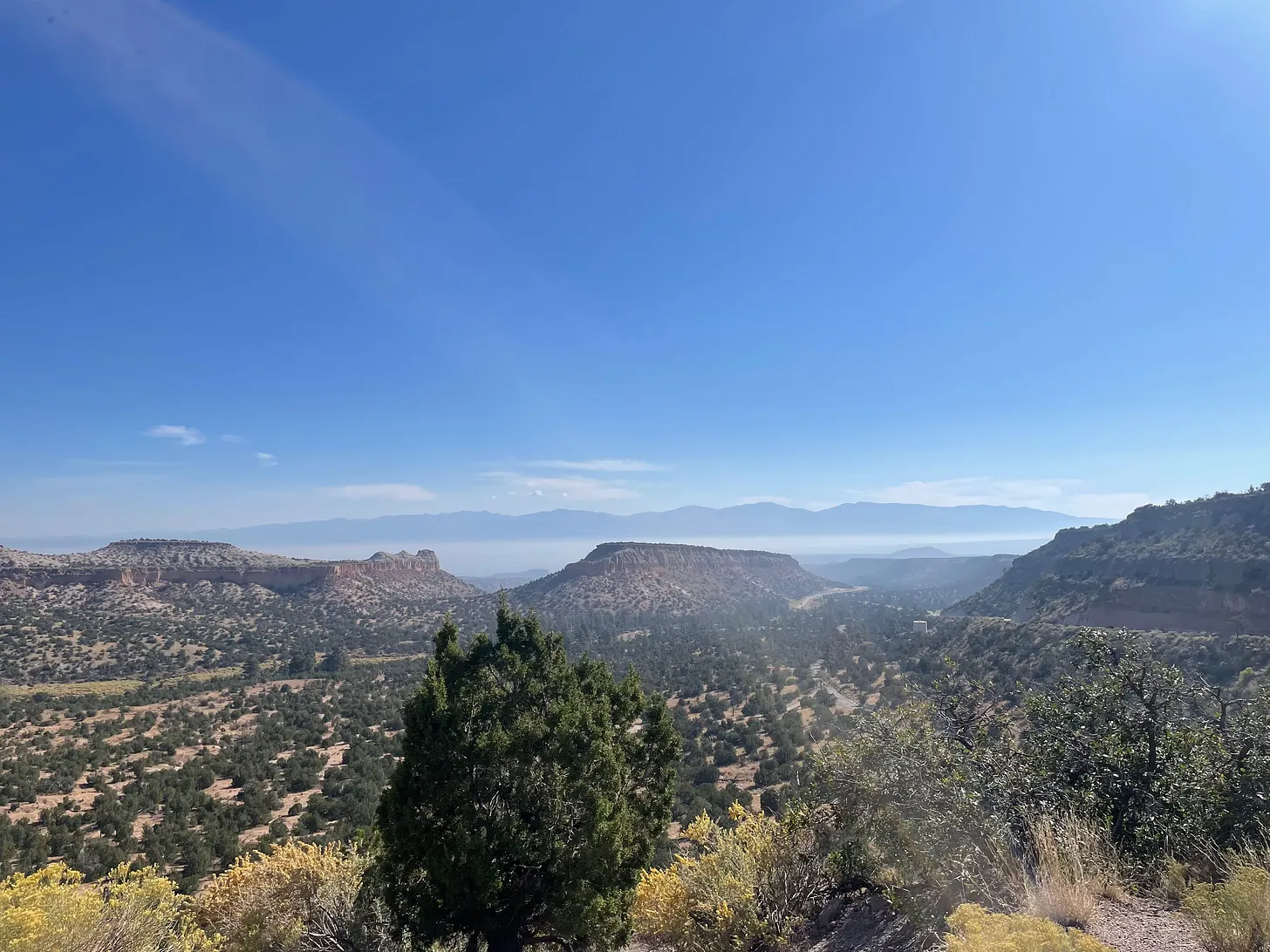
In October 2024, we undertook a tour of the American Southwest in order to learn more about the nuclear industry, from uranium mining and processing to weapons manufacturing and waste disposal. We met with people resisting the nuclear industry on three different reservations (San Ildefonso Pueblo, Navajo Nation, Ute Mountain Ute) and learned about the legacy of uranium extraction and contamination, the history of land dispossession, and the nuclear colonialism that defines the economy of the region — as well as possibilities for resistance in the heart of US imperial power. Our hope was to learn about the industry, to learn how people conceive of dealing with nuclear waste on a local, practical level, and to learn and help develop a revolutionary perspective on the nuclear issue. We also wanted to connect with local militants struggling against the nuclear industry, to amplify their voices and connect them with people engaged in similar struggles elsewhere. Our trip took place only a few months after Energy Fuels started operations at the Pinyon Plain uranium mine on sacred Havasu ’Baaja[1] territory on the south rim of the Grand Canyon, and began hauling radioactive uranium ore across Diné (Navajo) territory to be processed at the White Mesa Mill on traditional Weenuche (Ute Mountain Ute) territory.
In this interview, we spoke with Jen Marley from San Ildefonso Pueblo, a revolutionary and organizer with the [Total Sovereignty Working Group]. San Ildefonso Pueblo lies immediately adjacent to the Los Alamos National Laboratory (LANL), the home of the Manhattan Project and the site where the two nuclear bombs dropped on Nagasaki and Hiroshima were developed. LANL is now involved in a massive effort to revitalize the entire US nuclear arsenal and is actively building new plutonium pits for warheads.
JEN: While we’re discussing about nuclear colonialism and the resistance to it here, I’m also very interested to learn more about the Japanese context. I know about the imperialist history of Japan. But I recently started learning more about the revolutionaries, and how intense the resistance has been because of how repressive the Japanese state was. I have all the respect in the world for the people — the anarchists, the socialists, the people rising up and pushing back against the spread of Japanese imperialism. And the risks they took to do that — it’s very inspiring to know that was happening even under the harshest conditions.
SABU: Unfortunately in recent years, the intensity of oppositionality in Japan has become very weak. In the ’60s and ’70s, and continuing thereafter, the real intense opposition, which also included some kind of community building, occurred in the day laborers’ ghettos of major cities. Some of the people who live there are Japanese, the lowest class of Japanese people. But also there are people from the Indigenous populations, Okinawans, and also resident Koreans. These are all people who are outside so-called Japanese civil society. Opposition was very intense in the ’60s and ’70s. Some people started taking up arms, though that current didn’t last long. There’s a tragic history within the oppositional movements too. We call it uchigeba, which means intersectarian violence.
I don’t live in Japan anymore so I can’t say much about Japanese radicals today. One really good thing is happening, reconnecting comrades across East Asia, China, Korea, Hong Kong… Tokyo comrades are intending to provide a center for the people who cannot express their opinions in their countries. The oppression in mainland China is especially harsh, so they cannot express their political opinions there, and some of them have a difficult time living there. So Tokyo is trying to be an operation center for East Asian solidarity. Historically from the late 19th to the early 20th centuries, Tokyo was a space for the independence movements, East Asian countries fighting against colonialism organized their movements there. So that kind of current, Tokyo might be able to provide again.
JEN: That’s amazing. When I was in The Red Nation, we called ourselves internationalists explicitly. Our sense of nationalism is not the kind of nationalism or patriotism like in the US or the Japanese nation-state. We believe it’s the only way to bolster our autonomy, our sovereignty — to connect with other Indigenous people and other colonized people all over the world, and build power on that front. We cannot be free until we’re all free. Our nations can’t exist as autonomous nations until Palestine is free, until everyone is free. And so that’s why we call ourselves internationalists.
We are especially inspired by plurinationalism as it came out of South America, specifically Bolivia. We are so inspired by Bolivia because, much like New Mexico, it was subjected to Spanish colonization and violent resource extraction. And they have a majority Indigenous population encompassing many, many tribes. And when those Native people seized power, it was a huge threat to US interests and imperialism. The fact they did it in such a way — they are socialists, a movement toward socialism, but it is a specific political model that is based in Indigenous core values and traditional beliefs, making it so unique. We deeply appreciate their project and we see it as a model for what we want to build here. For example, traditional healers have the same status as doctors of Western medicine, and there’s a way to incorporate people with traditional knowledge into society, in a way that isn’t compromising or exploiting the knowledge that they have, but also valuing it. Which we don’t see in the Global North at all.
So, plurinationalism is more specifically what we’re looking to build. We envision that all of these Indigenous nations, and all colonized people in what we call Turtle Island, can have that kind of autonomy and self-determination, and not have their destiny shaped by the US. And another thing that I have to say for myself personally, when I’m talking especially about the anti-nuclear work, is that I don’t consider myself to be American. America is my occupier.
I’m always thinking about geography. I visited Oahu, Hawaii a couple years ago, and I went to the Pearl Harbor Memorial Museum. I was thinking about the Bradbury Science Museum at Los Alamos the whole time, because the propaganda is the same. The first thing you see when you walk in is a big map on the ground, it starts at Los Alamos and it ends in Japan. That’s the scope of the map, it’s the whole Pacific. They just admit it, like, this is the geography of the Manhattan Project and the birth of nuclear colonialism: New Mexico, Hawaii, the Pacific, Japan. And I was like, this is really a trip. Because the imperialists understand the scope of this, and I think we also need to understand the scope of it. That was really powerful, in a depressing way.
SABU: So you have a solidarity relationship with the people in Oahu?
JEN: Yeah. We were invited there by the Oahu Water Protectors to help them organize. I would never go there uninvited. They invited us to work with them on the Red Hill fuel leak. Are you familiar with it? In Oahu, there’s a site called Red Hill. It’s one of the oldest military bases there. They built it at the start of World War II. There’s a massive silo that contains jet fuel. It’s dubbed “America’s gas station on the way to Asia.” And the silo has been leaking since the 1930s, it’s just been leaking continuously. There’s been activism about it for years, but it got a lot of attention around 2018 when a worker leaked footage of the actual leak, and how bad it was. And so the Indigenous people, the Kanaka ʻŌiwi people, started organizing with the families at the military base to say, hey, this is hurting our families and our land, but it’s actually hurting you all first — so you ought to care about the quality of water that your children are drinking and bathing in. So from that, they formed the Oahu Water Protectors coalition. Of course, they came out of Standing Rock, water protectors is a direct reference to that.
And so they called The Red Nation over, because some people at the University of Hawaii had done first-of-their-kind studies on the impacts of the jet fuel leak in the ground water, the air quality, there were kids from the base getting rashes, people getting serious illnesses.… But the university stopped them from publishing the results. And so while we were there we did a big rapid campaign to get them to release the studies. So we were producing videos, content, talking to people. We were all there on the island, and within a matter of a few days we did successfully get them to publish the study. That was really such a victory.
They took us to missile ranges that still have active explosives in the ground. I just saw that there was a World War II explosive that went off in Japan, just the other day! A US land mine blew up at an airport, something detonated it.[2]
SABU: Oh, I didn’t know!
JEN: It happened a few days ago. They cancelled flights but there were no injuries. It was a huge explosion. I just thought it was ironic because, when I was in Hawaii, they were telling us that there are so many unexploded munitions there that it’s literally a reserve. A reservation that the US condemned. It was a sacred site, a place of prayer for Kanaka ʻŌiwi people, with holy sites and shrines. They need to go there to worship. But they can’t do it unless they’re escorted by people from the Army Corps of Engineers, because there’s so many unexploded munitions. There are multiple instances of children dying because they find a grenade when they’re just playing in the hills. And so, learning about how a place like Oahu has also been a laboratory, it’s also been a test site, it’s totally militarized.
After visiting Oahu, I now understand that Oahu is actually the first site of the Manhattan Project. Because that is the place where they developed tactics that they would bring here, when they started building the atomic bomb at Los Alamos. After Japan’s bombing of Pearl Harbor, they bribed spiritual leaders to regurgitate US propaganda to their people about why they needed military bases there. They created that fear about national security. And they started really co-constitutively building the militarization, alongside the tourism industry. And that’s something that is very apparent here. So I was like, wow, this is where they actually developed these things that they would come and bring here. Oahu is where they started weaving Indigenous spirituality with military projects, which is what is done here. And so the groundwork that they laid there is what they took and mapped onto us.
So that was really life-changing, and helped me understand not just the scope of the Manhattan Project, but the scope of the resistance too. Because Kanaka ʻŌiwi people, they really do resist it. They are very culturally intact, and they know their land very well. And they still know their sacred sites from before colonization. That’s so important.
But I’m also one who says that, San Ildefonso people, Tewa people, we are connected to the people who are victims of every single atrocity the US commits. Every instance of US imperialism, we’re at the center of it. Because Los Alamos is not only on our land, but quite literally on our sacred sites.
You might have seen the movie Oppenheimer? We made a [podcast] about it. Oppenheimer had family who were descended from the hacienda owners and ranch owners in Los Alamos, the rich Spanish who forcibly displaced us. It’s really ironic, because all of the Spanish families who once held a lot of power, as soon as the Americans came, they had nothing. They’re just as poor as the rest of us. So, Oppenheimer had some family who had land here, and he was the one who suggested that this be the site of the Manhattan Project. It was remote enough that it was secret, out in the desert, but it still had access to places like Santa Fe. And of course there was the convenient labor force comprised of all the Native people and Hispanos here, who were still living off the land. We still had subsistence economies. Our subsistence economies literally were not disrupted until US colonization happened, and most specifically the Manhattan Project. Up until then, we were still depending on our hunting grounds, we were still depending on our fields. That was how we sustained ourselves into the 1940s. We were still using horses and mules. So we were in a pretty unique situation compared to other tribes in the United States, who had already been forced to sell their resources or adopt a new economy. We still had the real old-time economy here. Even my grandma — not just my great-grandma, but my grandma — that’s how she lived. They lived off the land, off the fields. She would sell her pottery for like five cents. So it’s in very, very recent memory, it’s not even three generations back. A lot of the people are still living, who were the first workers at the Los Alamos labs.
They built the labs close to a place called White Rock. And at first it was just straight-up weapons manufacturing facilities. It wasn’t experimental — I mean it was experimental in the sense that they were developing the bomb — but that was all that they were doing there, manufacturing weapons. Today they’re doing other stuff like energy-related research, for example. So they built their first nuclear weapons development facilities here, one of them being called Tewa Reactor, which is profoundly offensive. And the very first nuclear waste that was ever created was dumped here. If you’re familiar with Chaco Canyon, Mesa Verde, what those places look like?[3] We had a bunch of structures like that, really vast rooms and structures. And the first nuclear waste that was produced by the labs, they started pouring directly into the kivas[4], because they were underground. They were like, oh look at these conveniently made pits, let’s put the waste here. At that time, there were no standards for testing the impacts of the waste, or for even understanding what it was, or how it worked, or what harm it could do. That was all completely deprioritized. The priority was to create the weapons. And so, these kivas are totally unlined, and the waste has been seeping into our aquifers since it was put there. At Bandelier National Monument, two-thirds of the area is closed off to the public because of the nuclear waste. The other third is open to tourism. So when you go there, be aware you’re getting irradiated. Radiation doesn’t know arbitrary boundaries.
Recently they started escorting tribal members out to the sites that have been closed off. I had some aunties go recently. And they were saying, there’s like 800 structures that we didn’t even know about, because we haven’t been allowed to access them. You really can’t stay long because you’re going to get exposed to radiation. But they are starting to let us in there, which is interesting. Where they poured this waste, it’s in our old homes, which we only left 800 years ago. We were only here in our current homes for about 300 years, before the Spanish came. So that history is very well remembered and documented in oral histories.
In addition to dumping this waste, they also built the main lab facilities in the place that we consider to be our emergence place. Multiple shrines there marked our emergence into this world. That’s as sacrilegious as it gets for us. It’s the site of our emergence into this world, where we believe we came from the ground. We have migration stories that tell where we lived before. We know that we came from Mesa Verde, at least San Ildefonso people did. Most Tewa people. Southern Pueblos came from Chaco Canyon.
So, some of our most sacred spots we cannot access. There’s stories of elders trying to access these places and having guns pulled out on them. There’s multiple stories of elders going hunting and having guns pulled out on them, and they’re like, what’s even happening here? There’s stories of elders who had no idea the extent of the facilities and how big they were, that they were just shocked to realize how far it went into our hunting grounds. One of our mountains there is completely hollowed out. There’s more underground infrastructure than there is above ground. They have reactors, they have a hadron collider, they have all kinds of things. So one of our mountains is totally hollowed out, to make room for all these underground facilities. I think they tried to store some of the waste on-site, once there was a little more knowledge about that, like in the ’60s and ’70s. At that time they decided it was best practice to try to store the waste that was produced on-site. You know, EPA (Environmental Protection Agency) stuff. Nonetheless, all of the infrastructure is in the heart of our holiest places, our homelands. It’s devastating. And all of that in addition to the economic and political repression that we still deal with today.
I’m always talking to people about the class aspect and how it totally transformed our society and our economy. There’s a good book by Joseph Masco called The Nuclear Borderlands. He has this term plutonium economy to describe the new economy that was installed in this region with the coming of Los Alamos National Laboratory (LANL). Almost all of our people, all of the people in the Pueblos here, once they took our hunting grounds, and then they started to divide our farmland and forced us to abide by private ownership — before that, all of this land was communally owned, all of the fields we worked together. They forced us to have the family-allotted plots. So they greatly reduced our farmlands, and our accessibility to our farmlands, which reduced our ability to attend to our fields as a community. I argue that this was intentional, as a way to force us into wage labor at the labs.
SABU: At the same time, imposing the idea of private ownership of land.
JEN: Yeah. Private property and the wage economy.
SABU: Because you didn’t have the idea that the Earth can be owned, right? This is ultimately the most bullshit thing.
JEN: Exactly. And of course we had dealt with the Spanish land grants, the attempt to steal our land before that. We were definitely familiar with that. But since that had been imposed, in the couple hundred years that had passed, we had found a way to rebuild that kind of communal connection. Once all of the descendants of the Hispanos got super poor — so like Myrriah’s[5] family for instance — we started working together. It was actually one of the instances of us working together to push out the Mexican state, the rich hacienda owners, and the Americans. There were a lot of rebellions that happened before and after the Pueblo Revolt of 1680. And they were always aligned on the basis of class. Because the land is our subsistence. Because the land was our collective livelihood, that’s what we fought for collectively.
So the wage economy and private property are introduced around the same time. And we started working exclusively as maintenance people and domestic laborers for LANL. The men are the construction workers, building the facilities, doing all the maintenance. To this day, they still are. And the women are all the domestic laborers, nannies, maids. My great-grandma, my grandpa’s mom, was a domestic worker at the lab. She and most of the other women and girls her age were doing that. For that reason, she was totally disconnected from her own family. Her sons, my grandfather and his brothers, grew up with a very strained relationship to their mother. That’s why I argue that LANL totally disrupted our kinship structure. It literally took away the mothers from the children. We had this whole generation being raised in a new kind of poverty, because they’re scraping by paycheck to paycheck now. And one in which we can’t even perform our day-to-day communal life because everybody’s now working at the lab. So it disrupts cultural life. It disrupts our society. It disrupts kinship structures. My auntie still talks very much about how her working that job affected our families. We have addiction, alcohol, there’s a lot of domestic violence — which I believe has its roots back in Catholicism. I mean, we see what it’s like, the way femicides develop in nations recovering from Spanish colonialism, and the way machismo culture catches on. So that’s a big part of it. But also, with the coming of LANL, breaking apart families.
And then, a lot of our people started getting sick. Rio Arriba County is the one place in the US that has the largest variety of cancers seen in such a small population. So many people are dying of different types of cancer. The men are bringing back tools from the lab that by today’s improved standards are radioactive waste. My sister has a very young friend who’s only twenty-one, who was working at the lab as a maintenance man for a good chunk of his life, and he was telling me that they told him to leave his tools at whatever site they worked on, because those sites are so irradiated that they have to just leave the tools there every time.
O: But it’s deemed ok for the workers to go work there.
JEN: They’re totally disposable in the eyes of LANL. There are Tewa men who have made their whole career there. And they have kind of fake unions now, I don’t know what to call them, it’s a LANL-represented union. This is a result of how there were successful strikes led by Tewa men to improve their working conditions. But they totally crushed those strikes, and now they’re erased from history. It’s so hard to find any documentation of it. You really have to dig into the archives.
SABU: When were the strikes?
JEN: I think it was in the ’40s, because World War II was in swing. And that’s why they crushed it and suppressed it so hard, because they couldn’t afford to have the weapons manufacturing halted at all. There was even a time when they were so dependent specifically on San Ildefonso labor that they had to close the labs on our feast day because there was nobody there to work. So they’re entirely dependent on our labor, especially during the Manhattan Project. Completely dependent on our labor for everything.
And to this day, my Pueblo and Santa Clara Pueblo have employment contracts with the lab. The labs guarantee maintenance positions and low-clearance-level positions. They say we’ll be prioritized for employment. And to me, that almost shows a sense of fear that they have, because they know that if we of all people resisted them, and openly built a movement to try to abolish and close the lab, it’d be a lot more potent than even we realize. They know our power — so we should know our power.
With nuclear issues, it’s never just an Indigenous issue. It affects everyone and everything. It knows no boundaries. Everything on the land. No one is safe. My friend Tina Cordova with the [Tularosa Downwinders], she always starts her talks by saying, “Everyone’s a downwinder in New Mexico.” It’s not just us who were exposed directly to the Trinity test. There’s been so much testing here, there’s so much nuclear infrastructure. It is impossible for anyone who lives here to not be affected by that. No matter how rich you are, no matter how isolated you think you are in Los Alamos County or in the hills of Santa Fe. It affects you no matter what.
Around here, the richest people aren’t even hyper-conservative. They’re well-meaning liberals, they’re the petit bourgeoisie — or just the bourgeoisie. There’s celebrities who live in the hills of Santa Fe, some of the most renowned nuclear physicists in the world live there. And they are always downplaying the effects until something threatens them directly. The Santa Fe Relief Route, the only reason that exists is because when the Waste Isolation Pilot Plant opened in southern New Mexico — they’re taking the nuclear waste down there, all the way down to the salt caves — the rich people in Santa Fe were like, oh naw, we are not going to tolerate having these trucks carrying radioactive waste pass through the city.[6] And all of these rich liberals, then they knew how to fight! They fought and fought until they had the relief route made so that the trucks could bypass the city.
SABU: They’re called NIMBYs, right? Not in my backyard, as long as it doesn’t affect me that’s ok.
O: What communities does the alternate trucking route go through, then?
JEN: It’s still affecting the people in Santa Fe, but it’s going through the poor, primarily Mexican parts of town. Where the relief route goes, south of Santa Fe, there are a lot of poor communities out there who are probably not even being informed.
SABU: Can I ask you a question? It’s about two aspects of radiation exposure. One aspect is related to the Japanese experience of Hiroshima, Nagasaki and Fukushima. It’s very hard to prove the internal exposure from eating and breathing radioactive material, as opposed to external exposure. So in many cases in Japan, if they start a court battle, it’s very hard to prove the responsibility of the government or the electric company. So that’s one aspect. But another aspect is, after Fukushima, there was a popular practice of protecting people from the effects of radiation, like civilian practices of radiation monitoring. Also there are practices of caring for the body already exposed to radiation, like enforcing the immunity system and so on. So I’m curious about these two aspects, the health issue and also the court battle, in your experience. Especially also if you have a traditional practice of protecting your body from radiation.
JEN: It is incredibly hard to track or to prove the effects on the body. I was actually going to ask if this is part of why the women’s movement got really strong after Fukushima. One of the ways that you can observe the impacts of radiation is on fertility and on the development of fetuses. This is because radioactivity destroys your RNA, so usually the visible effects don’t show up until generations later, when it gets passed on. In fact, it’s only been about seventy, eighty years since the first nuclear waste was made, since we were first exposed to it. A lot of scientists speculate that we’re not going to see impacts until five or seven generations down the line. And so I think there’s a big push to look specifically at women’s health, at fertility, and at the development of babies, because it’s more apparent and it has more validity in the eyes of doctors.
Another example is from the Black Hills in South Dakota, where “Mount Rushmore” is — that’s also a sacred site.[7] The Black Hills are sacred to Lakota people, and that’s where they started some of the first uranium mining. And so these Lakota women were having constant miscarriages, and their babies were being born with birth defects all the time, it was so undeniable. Much like the Marshall Islands, if you’re familiar with the birth defects there. And the government wasn’t taking it seriously. We have Indian Health Services, which is basically third-world health care. The Lakota women were trying to appeal to federal agencies, saying please do some testing, we need to figure out why this is going on. And the government refused. Finally, the women took it into their own hands and formed Women of All Red Nations, which was like the female branch of the American Indian Movement. Their first big campaign was to take it upon themselves to do medical testing, to provide the evidence and statistics of how the uranium mining was affecting their fertility and the health of the community.
And so it’s similar here, where there’s this push to emphasize women’s health and fertility and children’s health, because it is easier to see the more apparent affects. My friend Beata, she’s always saying that when one person is exposed to radiation, it is automatically affecting the next three. So for example, if a pregnant woman is exposed to radiation, and her baby is carrying the eggs that are going to become her children later, in the next generation — it’s affecting grandma-daughter-granddaughter in one exposure to one person. But what we know now about the nature of radioactivity, it’s apparent that it’s not going to show until several generations down the line, and it is going to cause disruptions in our genetic structure, which is very disturbing! We don’t even know the full impacts of nuclear colonialism. It hasn’t existed long enough for us to know what it’s really going to do.
So it’s definitely scary. There’s been minor efforts by the Pueblos to warn the people of the impacts. For example, Santa Clara Pueblo has this little infographic that they made and gave out to their people, that tells them how much deer or elk meat they can consume safely within a year before it’s too much and will harm their health. All of our wildlife is irradiated. Again, hunting is a part of ceremonial life. So there are instances where we have to hunt and we have to consume that meat. Although it’s obviously impossible for us to fully sustain ourselves off of hunting today, but anyway, you know, now there’s these infographics. And there’s these stories like, oh my aunt so-and-so loved deer meat, and she died of cancer. It’s such a common story around here.
Same with the stories of miscarriages. I know that they’re fairly common in general, but the rate at which they happen here is absolutely unnatural. And that’s something that I think almost any woman here could speak to directly from their personal life, from their own experiences from their own bodies, and also witnessing these things happening in their families. So that’s one that I really drive home when I’m talking to my people about it. This isn’t supposed to happen. This isn’t normal for us to all have had a miscarriage. It’s not natural.
That’s why the anti-nuclear work here is really heavily woman-fronted. It’s tied directly into reproductive justice in general. My friend Beata Tsosie-Peña is the founder of a place called [Breath of My Heart Birthplace]. It’s the first Indigenous-centered birthing center in the area, which is an alternative to the Indian Health Services system or the general health services that we have here. It incorporates our knowledge about birthing practices and about caregiving, so that is a really big deal. And it’s beautiful that something like this came out of the anti-nuclear activism here. Really getting back to something as simple as having healthy children.
SABU: That’s the essential thing.
JEN: And it’s so existential. Because it creates so much anxiety and fear in people. It’s truly hard to wrap your mind around something like nuclear waste and the radioactivity that is never going to go away. It’s going to outlast the existence of human beings. It’s hard for people to wrap their minds around it. And so I think what we see here, with Tewa people coming to terms with the fact that we were the first to be exposed to this kind of evil, to this kind of everlasting monster, they tend to lean back into spirituality, and to lean back into things like family making. Because the scope of it is so intense.
Nonetheless, I still hope that along with that, we can build a strong political and activist front. And what’s really quelled that in recent years is nonprofits. There’s anti-nuclear nonprofits that come up and say they’re the good guys, but they’re actually funneling more potent direct action through them, and they’re really quelling the political momentum that’s coming out of the tribes. The Red Nation has experienced this a lot with critiques like, “Why are you so violent? There’s a less violent alternative.” But the nonprofits make it so that we remain powerless.
And the tribes are very afraid to stand up to this monster, which is rational because it is the core of US imperialism. It’s the heart of US imperialism. It’s the last thing that the US is going to let go of. And I believe that the US empire is crumbling. And it’s a truly disturbing thought to think that this nuclear heart right here, that’s probably going to be the front line of the final battle — that’s the last thing they’re going to let go of. It represents the stronghold that the US has on the world. The only reason why any country has nukes is because the US has nukes.
SABU: Right. The logic is security. And of course, other states are fucked up. But the US is the one that tries to monopolize nuclear violence. They are the first terrorist state.
JEN: The US is the only one to never sign the no-use treaties. China signs them, Russia signs them, North Korea signs them. But not the US! They’re the only world power to never sign any of those. Because they want to make it clear that they have the monopoly on nuclear violence. And so I really think that my homelands and our sacred sites are going to be the final battle for resisting US occupation. And actually, those nukes are made of us. Our labor. Our blood, sweat and tears. When it comes down to it, I want a world where there’s no nukes at all. But I think there may be a moment in history where it’s going to be us having to seize that power, for the sake of making sure that we can rid the world of it. And that’s going to be a really wild moment. Because nobody wanted to have nukes, right? Even these countries that the US tries so hard to vilify. They’re not gonna be the ones to use them first. Nobody wants that!
SABU: And the US is the only country that has actually used it. On real people. They actually used it.
JEN: And on a whim! So unnecessary. That display of power — and cowardice, really — to the world. It just says it all. And so right now, to bring us up to the present, officials at the lab are saying that they’re going into “Manhattan Project 2.” That’s the language that they’re using. They’re like, we need to start cranking out nukes again. And it’s because of the global political climate. The US is losing power and status in the eyes of the world. It’s losing its place on the global stage. And what is the response? To make more bombs! If that’s not the ultimate show of cowardice, I don’t know what is. When you lose respect on the world stage because you’re funding genocides, and you’re perpetuating genocide all over the world, and your response is to make more death machines? That really marks the end of the empire. And so that’s what’s happening right now, they’re working on weapons production.
Maybe you saw the billboards on the way here? There are billboards as you come into Pojoaque, and all over this area, telling people to apply for jobs at the labs. The labs will pay for school for tribal members if they go into STEM, and if they work on the production of nuclear weapons. They’re always bribing the tribe. They’ll give laptops out to the kids. It’s this constant bombardment. And around here, there’s such extreme poverty that people do take the bribes. They go work at the labs because it’s the only option they have. Also there’s the drug trade, the sex trade — it’s really horrific out here in this whole region of northern New Mexico. They call Española the heroin capitol of the world. I lost four relatives to fentanyl overdoses in the past two years. The fentanyl epidemic is ravaging this whole area. And so the desperation is intensifying, in tandem with the production of nuclear weapons. Once again!
I’m also interested in looking at the correlation between LANL and the sex trade here. People talk about “Missing and Murdered Indigenous Women,” right? We hesitate to talk about the origins of the sex trade on our lands, and LANL is certainly one of the things that exacerbated it here. Throughout history, northern New Mexico was the site of the greatest slave trade, but more specifically it was sex trade. If you read The Other Slavery by Andrés Reséndez, that’s a really good book to get a feel for the history here. This ties in a lot with my personal research. There was straight-up slavery here. But after some time, as the Spanish empire was trying to protect its borders from the British and the French, they created “buffer communities” known as genízaros. That term comes from the word janissary.[8] What was happening was they were taking Native women from all different tribes — Pueblos, Navajos, Utes, Comanches, Apaches — and they were trafficking them. If somebody brought a man to the auction block he would be executed on-site. They only wanted the women because they were using the women as incubators to produce this buffer force. They were using the bodies of Native women to have these children that would comprise these buffer communities, that were basically meant to take the hit of any encroaching empire like the British or the French. So they were disposable communities meant to be human shields. And it is the mass trafficking and rape of Native women that created these communities. And so literally the economy of every small town in northern New Mexico is built on the sex trade. It’s pretty apparent today, the sex trade and all the drug trade. And when LANL came, all these women and girls were going up to do domestic labor. And just a couple years after LANL started, some Pueblos even began discussing having to reduce their blood quantum requirements for enrollment, because all of a sudden there’s all these women from the tribe having babies from these white men at the lab. Primarily through sexual violence, through rape. And it’s just happening en masse, all of these women and all of these children, to the point that they were forced to reduce the blood quantum to accommodate how much this was happening. And that is something that gets very covered up. It’s a really, really hard conversation for us to have.
Again, the Catholic colonization and machismo culture of sexual violence is really hard for us to talk about, even though it is so ever present in our lives. And not just with the women. You might have heard about the massive network of pedophile priests who were primarily located to places like here, like Jemez Springs. The men deal with a great deal of sexual violence trauma that is still very much impacting our people. So that’s a huge part of what’s disrupted our society, our culture. It’s profoundly disempowering. It makes it so that we don’t talk about these things. But it’s something I’m always reminding people about, because it’s so covered up. There’s so little documentation. It’s covered up by us. It’s been hard.
It’s starting to change very gradually, with younger people. People younger than me are so incredibly brave and I give them so much props. I was considered to be too wild or too much for talking about these things, just within the past ten years, but now I’m seeing younger people who feel more comfortable finally talking about these things, and making all these connections. That makes me really happy, because it’s been far too long.
Today a lot of people, a lot of my friends and comrades here in the surrounding Pueblos are shifting their ideas of what they want to do with their lives toward the realm of health care. To respond directly to these things. And I think that’s really powerful, and it’s interesting to me that that’s the turn that people are taking. They want to be able to provide their own health care. They want to be able to do these in-depth studies. They want to make the connection between our bodies and how colonization has impacted us.
I really think that having something like basic health care and access to rehabilitation is going to be where we start. Also because of how bad drug use and addiction is here. And again, capitalism profits off the drug trade. It’s not just Big Pharma, it’s literally the state itself. They refuse to put rehabilitation centers here, and the ones that they do are those ridiculous scam rehab centers where they funnel people from all over the country and then just leave them unsheltered. So now we have this massive issue of unsheltered people. People are getting displaced en masse because of these scam rehabilitation centers. They’re just left on the streets with no access to anything. And any material support involving needle exchanges or safety kits all comes from boots-on-the-ground mutual aid — none of that has any kind of state funding. And of course addiction is hyper-criminalized. If you even just want to access a rehab, if you want to access something like Suboxone, you have to go through the courts. You have to have a case opened up to access basic things like that. And so that’s the state of things in a place like Española, and it reverberates through this broader area.
We need our basic needs taken care of first and foremost, before we can storm the gates. It’s a hard pill to swallow to really understand. I’ve been asking myself since I was a kid, what is it really going to take? And it’s gonna take that — we need our basic needs met first. We talk about that in [The Red Deal]. Again, we’re very much inspired by Bolivia. In order for them to have defeated coups, in order for them to have the power that they do and the force they do, they had to provide the basic infrastructure for their people first. And that was a long haul.
So that’s my dream. That’s really what I see as the way forward now. That in itself is a pretty radical version of sovereignty. To have something like our own hospitals, our own treatment centers, our own suicide prevention programs that aren’t just based in the nonprofit nonsense. I had multiple relatives take their own lives recently. It’s a really big problem amongst our young men. There’s rampant suicide, all the time. And so it’s a matter of people feeling empowered. It’s a matter of fighting demoralization so that we can build that political power amongst ourselves. So we can believe that’s a possibility, and go forth and do it.
The scale of time is something I’m always thinking about too, because it feels like things are happening so fast. Some days it feels especially apocalyptic. Like the other day when Hurricane Helene was hitting, and the port workers were striking, and Iran sent rockets to Tel Aviv — I was like, this is an especially apocalyptic day. Ok, what do we do? What do we do right now? Sometimes it feels like we have generations to work towards something; other days it feels like the US isn’t going to be here in five years. And who and what is going to help us sustain day-to-day life? I’m always thinking about that, and I’m always wanting us to build the power to sustain ourselves.
Again, the Pueblos here are in a unique position compared with a lot of tribes in the US, where other tribes do have more robust economies. They have a little bit more of a say in how their resources are sold. I’m looking at places like Oklahoma, where they have advanced, developed economies, to the point that they’re repairing roads where the state can’t. They’re providing COVID relief when the state can’t, even to the non-Native communities. These are examples of Native nations that are built up enough to at least provide support like that on the local level.
The only tribe that might be capable of doing that here is Pojoaque Pueblo, because they are actually not federally recognized or state recognized, and so they’re able to have more LLCs and develop more enterprises and have a stronger economy. So they have Buffalo Thunder Resort, Cities of Gold, all these little companies here. So when we were dealing with COVID at first, Pojoaque Pueblo took up the work of supporting all the other Pueblos and also the non-Native communities too. They shut down the hotel and made that a quarantine center. They were sending out tests and vaccines and supplies to the surrounding area. They were doing food distribution. They literally sustained this area in a desperate time. This gave me a little glimpse into how we could handle things, and it actually gave me a lot of hope. I’m like, you guys, this could be us all the time! We don’t need to scrap and fight for federal money and the crumbs they throw at us.
I also hope it makes some of the Pueblos consider the limitations of federal recognition. Going back to the Kanaka ʻŌiwi people in Hawaii, they’ve been fighting against federal recognition forever. They don’t want to be recognized by the US. They don’t want to be an appendage of the US. That’s what our tribal governments are, they’re appendages of the US government, sadly. But tribes like us who are so small — my tribe is only 800 people — we depend on the federal money to sustain ourselves. Whereas the bigger tribes like some of the ones in Oklahoma, they actually aren’t dependent on that, they have their own enterprises. The Kanaka ʻŌiwi people, they struggle in protecting themselves and asserting their lands because of their kind of unique political status where they’re not classified as American Indians politically. But they have their unique kinship and societal structures that do fortify them to some extent. So I’m always looking at them for how they approach things like sovereignty, while also refusing federal recognition.
My dream, my real out-of-pocket dream, is that we collectively deny federal recognition and make it a point to assert ourselves, with the backing of nations like Bolivia. Places that are developing projects which, while imperfect, are still examples of experiments that are facilitating decolonization. And that’s really all we can do, that’s all we have, are opportunities to experiment with our sovereignty and our livelihoods and building projects. So that’s my long-term dream. I think that’s why I really appreciate the scope of your project, because it is also wanting to facilitate this international solidarity that can come in and replace or at least contest these great world powers that are in decline. And I really believe that that is a possibility. Some of my Red Nation comrades believe it is an inevitability.
So that’s where I’m at. I think we’re going to have to make alliances with countries who are more able to support our well-being. While again, although not perfect, it can certainly be some kind of alternative to the relationship that we have with the United States, which is actively facilitating our genocide.
SABU: A lot of my anti-capitalist and anarchist friends in the US are unaware of how much the US has expanded military bases across the planet. There are 750 official US bases worldwide, and probably more. In all these places, the people need to stand up together to fight at some point. And like your solidarity with Hawaiian Indigenous people — that’s really the most crucial power.
I can imagine Okinawa in a similar situation. Okinawa is not actually Japan, but it was territorialized by Japan. Japan invaded Okinawa, and then it became Japan. And after World War II it was occupied by the US. It became a US military base. One quarter of the whole territory became a US base. And then after 1972 it was “reverted” to Japan — but it’s not supposed to be Japan either. So the awakening of their own Okinawan autonomy, that model would come from your kind of practice, I think.
JEN: I deeply appreciate looking at Okinawans and also the Ainu. I appreciate looking at their struggles and their sovereignty movements, because it’s so similar to ours, and they have such repression. This is off topic, but they are actually culturally similar to us in ways I didn’t expect. Even in terms of their outfits. I had some uncles who went to Japan under World War II and they were stationed on some of the islands, and they said that they could almost understand the language. And also the Ainu people and the face masks that they have, they are similar to ours. These are very sacred figures to us, they have a sacred role in our society. And I always thought it was fascinating how much the face masks and the paint look like the Ainu sculptures. Even the weavings that they do. It’s very similar.
SABU: That’s fascinating.
JEN: There’s definitely cultural similarities, which I think is very powerful. I don’t talk about that as much for the general audience because, you know, we’re very secretive as Pueblo people. We’re known as some of the most secretive. We do have a lot intact culturally, because the US didn’t try to assimilate us quite to the extent that they did to other tribes. Because in their mind they were like, oh they’re Catholicized. They’re pre-conquered. That’s what they call us, pre-conquered. Because of the Spanish. They actually think we’re not even Indians, that we’re just Mexicans, they don’t need to do anything about us. And then only in the 1920s did they have people that they called moral reformers. I think they were Protestant. They were called moral reformers and they were women who would come out on behalf of the government and do surveys on the morality in the newly-acquired US territories. And when the moral reformers came, they saw that we were still doing ceremonies. And they said, nope, these guys are still Indians. And so only then did we get that status. That was very recent, in the 20th century.
And so we have a lot intact culturally. It’s the source of a lot of fetishizing, a lot of romanticizing, glorifying Pueblo culture in a way that benefits the tourist industry and art industry. It’s like, oh you guys are the docile artists, you’re not the savage Indians. You’re the docile artists who are Catholic.It’s incredibly paternalistic and it really affects our own identity formation. So you see then Pueblo people trying to adhere to these notions of what Americans and anthropologists made it mean to be Pueblo. I call it being stuck in the settler formaldehyde. They treat us like artifacts, and so in turn we start to see ourselves that way. If I’m not this perfectly pure, traditional person, then I’m failing. It’s because of this move on the part of anthropologists to romanticize us and our culture, that pushed us to develop these derogatory attitudes about ourselves, where we’re always afraid of this sense of loss.
That’s a common narrative throughout Indian country. Like “Oh my god we’re headed towards extinction.” But that’s not our narrative. That’s not our timeline. That is the empire’s narrative. The empire thinks we’re inevitably going to be killed off because that’s their goal. And so when people internalize that, it’s like, no we’re not! We’re not going to die off. We’re not going to go extinct. That frame of thinking is simply incorrect for how we understand ourselves and what it means to be of us. It’s not about blood quantum. It’s about the ways in which we claim citizens, and that looks different for everyone. It’s about your participation in your community. It’s not about who you’re related to or how much percentage you are of what. And so that is also something that causes a lot of social issues.
SABU: Treating people like the aesthetic object, not like people have both aesthetics and ethics, right? So ritual is important for community building and politics, ethical and aesthetic both. But colonizers only look at it like some kind of art or something. And then eventually this view is internalized. Japan is also like this. Japanese are good at garden making, or like a painting of Mount Fuji or something. As if they don’t have a political edge.
JEN: Yeah. And it’s so funny, I don’t know if you know this, but Native kids love anime. It’s funny because, they love it because of the cultural similarities. The things they depict with demons or spiritual life. It’s similar to us, but we can’t talk about it. And so when they watch anime they feel something.
SABU: You know more than I do, but I hear a lot of people love Princess Mononoke.
JEN: Of course! I really love Hayao Miyazaki. I like his work a lot. I don’t like all anime, but I like his stuff. Native people like him a lot too because what he depicts is very much like our core spiritual values, like protection of the Earth. Respecting spirits that maybe you don’t understand. So there’s a lot of cultural connection. But I’m always reminding people like, hey, that’s cool, but Japanese history is not cool. Be careful what you’re consuming. And be careful about what you’re buying into.
Because we very much deal with the romanticizing of our culture and the visual aesthetics. People forget that we’re real people with real lives and struggles. My Pueblo is open to tourism. It’s a little tiny Pueblo, and my family home is right on the plaza. And we just get tourists walking around. And the kids are playing outside, we’re trying to do yard work, and it’s to the extent that we often have people just enter our homes, because they think it’s a museum or they think it’s like a reenactment town. That’s what they think it is!
O: That’s so embarrassing.
JEN: Yeah it’s sadly really common. People will just walk in and be like, oh what is this, are you actors? It’s a real living community! But that’s just how they see us, stuck in the past. They don’t allow us to come into modernity. They don’t allow us to have a future.
And so I’m also really interested in reminding my people that we do have a future. The future that we built for ourselves is in our hands, and it’s actually our duty to continue to pave a way for ourselves that isn’t dependent on the settler gaze. That isn’t dependent on federal recognition. It isn’t dependent on the state existing. And that can be a scary prospect for people who depend on the land for their livelihood. But I’m always emphasizing over and over again that we were here before the US, and we’re going to be here after the US.
JEAN: It’s really inspiring to hear you talk about all of this. Thank you so much for sharing your knowledge. It’s interesting because we were just talking earlier about this problem that we’ve encountered, where anti-nuclear activism feels really separate from revolutionary struggle. There are nonprofits that are reform-oriented, or older anti-nuke people who don’t have any revolutionary horizon or sense of the actual force it will take. And then at the same time, the people who we are close to, who are revolutionaries, are trying to take seriously the possibility of the decline of the US empire and creating something else happening in its place, but they don’t talk about the nuclear question. And I understand the knee-jerk reaction to the older generations. For me personally I was politicized during the first Iraq war, and I have a very strong allergy that I developed then to white liberal anti-war peace activists and their politics. But I think the other reason is that it’s not easy to solve and it feels impossible to confront, and so we just don’t think about it. We say we want revolution, we want total transformation of society, we want the end of capitalism, the end of America, the end of the police, but no one is willing to talk about how we confront the nuclear question. So it’s inspiring to hear you really articulate that the core of US imperialism is where the fight will be.
Also, we live on the Olympic Peninsula, and the Bangor Base, which is where all the Trident nuclear submarines are located, is less than twenty miles from us. And that’s the origin point of the US empire’s force projection into the Pacific, coming from right where we live.
O: And it’s on a fault line.
JEAN: Yeah, and there’s going to be a giant category 9 earthquake and devastating tsunami any year now.
JEN: Well you know what’s interesting? The San Andreas fault line starts in Japan, goes through the Pacific, and it literally bisects the state of New Mexico. It comes down the Pacific coast, cuts through California, goes through southern Arizona, and comes right down the middle of New Mexico. And we have a lot of dormant volcanoes here. These mountains right here, there’s a lot of dormant volcanoes. To the point that they even tried to do geothermal fracking, but we shut it down. For now.
SABU: I resonate with what Jean said, the nuclear issue is really difficult. But exactly because somehow there is a blind spot for a lot of radical people as far as I know in Japan, despite Fukushima, despite Hiroshima and Nagasaki. Somehow the history of anti-nuke movement in Japan is a history of failure. First of all, the anti-nuclear movement involved people who are against nuclear power totally, both nuclear energy and nuclear weapons. But then gradually during the period of post-war economic reconstruction, somehow even some communists started saying that we have to affirm nuclear power. Only nuclear weapons are bad. And then even among the anti-nuclear weapons people, some people said, oh it’s just the US that shouldn’t have it, but Soviets it’s ok, or China it’s ok. As long as it’s against US nuclear weapons. I can kind of understand it, at that time, but all in all from today’s viewpoint, we can see the way that nuclear colonialism is universal, in a sense.
JEN: Yeah absolutely. And that’s a tough one that we’re reckoning with here too. Because LANL is trying to tell the public, oh we’re increasing activity so we can do nuclear energy, which is an alternative to fracking. Because there’s so much anti-fracking activism here, from mostly Native people. And they’re like, ok you don’t want to frack anymore, let’s do nuclear energy. And we’re like, Jesus Christ! And I’m somebody who has complicated feelings and positions about the future of energy, and the role nuclear may or may not play. I don’t believe in glorifying it at all. And I am a socialist, and I don’t appreciate the glorification of nuclear energy on the part of a lot of other socialists around the world. I don’t think it’s necessary. Because it’s different when you’re including that Indigenous perspective.
SABU: Right, because the history of anti-colonialism and anti-nuclear are really one and the same, like you’re saying.
JEN: And you know, what we build is going to be a distinct political project. Much like Bolivia. It’s going to be one that has our distinct core values at the center of it. I think that’s also what’s so intimidating to the settler states about Indigenous movements: we don’t care about getting — don’t get me wrong, we struggle with identity politics in our own way — but it’s not like how you can divide the Left. Because it’s not premised in that. We’re not following those same kinds of revolutionary traditions. We’re based in our own histories of resistance to colonialism. And we take the teachings and ideology of movements around the world as tools that can assist us, but it’s a distinct political project we’re working with. And distinct forms of nationhood built on plurinationalism that I’m interested in seeing develop. If we are to build something like that, it’s not something you can quell as easily, it’s not something you can divide and dissect.
During Standing Rock, we were victims of infiltration. And one thing that the feds themselves admitted, they said that Native movements are so hard to infiltrate, because of our kinship structures. Because our means of trust and relationality that we have with each other are not the same as movements where people don’t have that kind of very familial and very serious relationship with each other. That meant a lot to me too. I study COINTELPRO. What happened there was very clear. In the Bay Area, the status of Native organizing has all but been destroyed because of that. That’s also why I’m big on pushing back against divisive identity politics by looking at how people look at things in the Global South. I’m interested in challenging the very bizarre and niche ways that the US Left attempts to quantify how oppressed you are, as a means of deciding how deserving someone is of liberation. I really hate that. And that’s just so distinct to the US.
JEAN: And it comes out of US academia. Specifically from scholars funded by the CIA and the State Department and the Ford Foundation. The whole origin point for what’s now being described as “wokeism” — that was actually counterinsurgency from the start. And it’s people who everyone cites as radical, it’s where people get their politics from.
JEN: God yeah. I could talk about that.
O: I’m curious — obviously so much of this is your story, and your work is inextricable from your story — but in a crude sense, how did you get into the work that you’re doing?
JEN: When I was little, I was always full of questions. And my mom would answer me very honestly about everything that I would ask about. I asked about the Pueblo Revolt. I asked about the slave trade. I asked about the Holocaust. And she would tell me in very plain language, in a way a kid could understand about these things. And so really early on I had an interest in social justice. I was fascinated by the ills of the world. And by the time I was in high school, I was interested in studying genocide. I had this teacher who taught this amazing class called Contemporary World Issues, but we just basically studied imperialism and genocide. And so the first thing we learned about was the Armenian genocide. And I had background knowledge on it because my favorite band was System of a Down, and I would google all the meanings of all their song lyrics, and I was like, oh my god the Armenian genocide happened. So I knew about it and I was like, wow this class is talking about that. And my teacher really encouraged me to pursue that kind of work. It’s a morbid thing for a teen, but that’s what I was into, straight-up studying genocides. And so one day I’m looking at Africa, I’m looking at the rise of fascism in India, I’m looking at South America, all these places.
And I got involved in local activism. Mostly LGBTQ activism, because it was a rough place out here for queer kids when I was young. I can’t believe how much I’ve seen things change since I was young. So I got involved in that. I was working with the Santa Fe Mountain Center, which is one of the only centers that has youth programs and is a space for youth organizing. It’s still a nonprofit, it has its limitations. But to this day it’s one of the only places facilitating that kind of stuff around here.
And then I went to college and I found The Red Nation. It’s actually really crazy how I found Red Nation. I saw a flyer for a film screening called Nuclear Savage. Y’all heard of it? It’s available, I’m pretty sure you can watch it somewhere free online. It was supposed to be a CBS documentary, but they banned it, they prevented it from airing. So I saw this flyer for a film called Nuclear Savage and that immediately called my attention. I was like, who are they talking about? And that documentary is all about the testing in the Marshall Islands, Castle Bravo and the radioactive fallout on the Marshallese people. It was exposing how that was covered up, how that was a blatant experiment on human beings by the US government. And it’s looking at the status of Marshallese sovereignty, looking at the health impacts. And I was just blown away by it. That was what really made me realize, wow this is so much bigger than us. And that’s what made me interested in the Pacific and nuclear testing infrastructure there.
So that film screening is what led me to The Red Nation. I picked up their old manifesto and I was like, wow I can’t believe this community is doing this kind of stuff. It was so cool! And from there it was just a really active political moment, between 2015 and 2017 — that’s when we saw the rise of Black Lives Matter, Standing Rock happened — and so Red Nation was riding that momentum and growing and expanding our campaigns.
We also formed around bordertown justice — bordertown referring to towns that border reservations, where there’s a lot of anti-Indian violence, specifically police and vigilante violence. So within the first two years of Red Nation’s existence, we responded to at least three instances of what they call “Indian rolling,” which is just vigilante anti-Indian murder. Which sadly is so common that it has its own term. That’s mostly what we were working on, and that fomented into the broader anti-police-violence movement in Albuquerque and in New Mexico. And so that was really amazing, and that work is ongoing of course. But yeah that really just became my life. Organizing. And it inspired me — you know, I am still a scholar. Although I definitely will be the first to talk about the limitations of the academy and how much I hate other academics.
SABU: But in your case, it’s a good example of a way to do both.
JEN: I’m really trying to. And my mentor, Nick Estes, I told him I’m back in school — because I had been on a little hiatus — and he sent me a message the other day saying, it’s really important, we need our people in the academy. He was like, I’m not talking about Native people. I’m talking about anti-imperialists. And I was like, that’s right. There are reasons that so much momentum comes from college campuses.
The way another mentor responded to me was like, force all these white men to cite you if they want to write anything about what you’re talking about. There’s a way to assert some power over narratives about yourself and your people through the academy. And so that’s what I’m interested in doing. I’m interested in talking about all these things not just from the perspective of — I personally think it’s more important to look at the perspectives of everyday people — but when it comes to challenging US hegemony, I am interested in having a way to kind of access, not what they’re doing, but to be taken seriously on a level that transcends just the locality. And funnily, actually being a scholar demotes me around here, to be honest.
So I’m always trying to keep a foot in the door, in either side. Maintaining participating in organizing work that is really fundamental — and really it’s always going to be my priority — but also find a way to write about these things and to produce new knowledge that can change the scope of how we’re talked about. And I do believe in that power, because I’ve seen it happen, just in my time with The Red Nation. Before we wrote The Red Deal, I didn’t hear people talking about the settler state, or talking so swiftly about decolonization. Some of the terminology that we use, I feel got popularized. It first appeared in the scholarly work and then it got popularized in the organizing spheres. And I think that’s so important because I actually watched, like when I was working at the Santa Fe Mountain Center, I would watch how nonprofit jargon would become popularized.
SABU: Our project, 1000 Voices, is interested in exactly this aspect. How language embodies and empowers external discourses in general. But this is something we want to understand. That’s why we cherish this kind of conversation. The moment that language really has a power is something that we are very interested in.
JEN: It’s been one of the most impactful things, I think, for example to change the way people talk about something like climate change. Especially with Natives, how we talk about climate justice, it’s never just about climate and the Earth. It is an Indigenous sovereignty movement.
Another powerful thing about The Red Deal: it’s actually comprised of fifty different people, we wrote it in a series of community forums. And then it has twelve editors. That text really is a result of literally sitting down and talking to the people. And then when it launched we had a series of book launches in different bordertowns, and those were also really powerful ways to build political power in places where that doesn’t usually happen at all, places like Farmington, Gallup, or Española.
You know, the scholarship can be taken in ways that people don’t always realize. And I think maybe people don’t even realize that it is scholarship that has these impacts in the broader organizing scene, or in broader anti-imperialist language. Our goal was to bring the ways that anti-imperialism is talked about in the Global South to the US. And it was more successful than I think any of us expected. That’s what I’ve been working on. I’m continuing my scholarship. I’m very cautious about talking about individual actions being the end-all be-all, but it was certain things that we really didn’t think were a big deal at the time, that ended up having some of the biggest impacts in how our political work took on a life of its own.
I really remind myself that talking to your own people is the hardest, especially about something like nuclear colonialism. But the other day, I was in a study group with Pueblo Action Alliance, another organization that came out soon after Red Nation. And it’s very unique because Pueblo people have historically distanced themselves from Native activism and Red Power. They took pride in this kind of docile title that was put on them. And I don’t want to say all of us in general, but the older generations, the boarding school generations were really interested in assimilation and having a kind of “dignified” life. They really bought into that. But that is changing for people of all ages now. And younger folks in this study group were talking about exactly how our work informed and shaped their understanding of these things. And it was not until that moment that I really realized the place that me and my work and The Red Nation has had in transforming the conditions of Pueblo people. Like if there’s young women challenging their parents to talk about these things, challenging their leaders to talk about these things, that’s a win that I didn’t think I would see manifest for years! And so I am starting to celebrate the small victories in between, because they actually are fully working to build up this kind of power and this courage in the people. Of course I’m always inspired by the Zapatistas, thinking about the snail and how revolution can slowly come and be built.
We were thinking about how we revolted in the past. Like the Pueblo Revolt, it wasn’t spontaneous. I always correct people when they call it a rebellion. It wasn’t a rebellion, it was a revolution! It wasn’t spontaneous. It was very thoroughly planned for decades prior, under the cover of darkness and secret. It was such a sleeping giant. And so, thinking about our movement as a sleeping giant is something that keeps me motivated. Really looking to the youth, too, and how strong and courageous they are. And how people who are in their teens and twenties right now, they never knew a world without war. If you talk to teenagers now, they can hardly envision a future, because they never lived in a world where they weren’t hyper-aware of climate change, or looming war. That’s all they know. They don’t have that sparkly alternative that I think older people in the US do, like oh it’s gonna get better, it’s alright, we’re gonna go back to normal. But these kids, they’ve never known normal. They’ve never known a life of peace. They’ve never known a life of security. And so they can’t grasp onto that.
For a few years, I taught a class called US War on Terror. It’s based on the book Never-Ending War on Terror by Alex Lubin. When we saw the same old playbook plan that they whipped out as things were going down in Palestine a year ago, watching the ways that same post-9/11 propaganda was being rolled out — and it failed to work on the young ones! It utterly failed. I was like, ok they’re doing it again, what’s coming next? And then it just failed! That, in itself, is such a victory. It does not work on the kids.
The Never-Ending War on Terror is a really good one because it locates the origin of the war on terror within the Indian Wars. Indians being the first insurgents. The first terrorists. And that’s another point I’m always trying to bring home. You can’t buy into these narratives about LANL representing our security. Because we are the first terrorists, and they will push us right back into that category the second we stand up for anything. Standing Rock is the greatest example of that.
Terrorist is a word that’s just for shock value, to the point that it doesn’t even have any weight in the realm of international law. I did a podcast with somebody recently, who said that the term holds no weight legally. Especially in international law. Because it is literally for shock value. And it’s employed primarily by the United States.
So yeah, it’s scary times. Definitely scary times. But it’s also a moment, in the cracks there are opportunities to pave different ways forward. As there are cracks in the United States, as the monster starts to die, there’s these little avenues where we’re going to have opportunities to seize power in ways that we haven’t had ever before. And I just want people to be prepared for that, to take that really seriously. And to have a sense of self and pride that would allow Native people and colonized people to move forward and take advantage of those spaces that are being made.
SABU: Thank you so much for the powerful discussion. I learned a lot.
JEN: Thank you too. I’m learning a lot from you too. Thank you for allowing me to hold this space, and thank you for coming out here.
Footnotes
Havasupai ↩︎
On October 2, 2024, an unexploded 500-pound US bomb detonated at the Miyazaki Airport in Miyazaki, Japan, creating a seven-meter crater and grounding more than eighty flights. ↩︎
Sites of Ancestral Puebloan dwellings in present-day New Mexico and Colorado. ↩︎
Circular underground chambers with special political and spiritual importance. ↩︎
Myrriah Gomez, author of Nuclear Nuevo Mexico. ↩︎
New Mexico State Road 599 was built as a bypass around downtown Santa Fe, as part of the route for radioactive transuranic waste traveling from the Los Alamos National Laboratory to the Waste Isolation Pilot Plant (WIPP). Located near Carlsbad, New Mexico, WIPP is the only permanent repository for nuclear waste from US nuclear weapons development, where it is buried in a salt formation 2,150 feet underground. Licensed to store the waste for an ostensible 10,000 years, already WIPP has been the site of multiple accidents. ↩︎
Tȟuŋkášila Šákpe is the Lakota name of this site, a sacred place for many Indigenous groups in the area. ↩︎
Janissary (from the Turkish yeŋiçeri) were infantry units of the Ottoman Empire. Thought to be the modern world’s first example of a standing army, they were formed largely by enslaving Christian boys from the Balkans and training them as soldiers. ↩︎